

Establishing operational risk framework in organization powerpoint presentation slides




Try Before you Buy Download Free Sample Product
 Impress Your
 Audience
 100%
100% Editable
 Save Hours
 of Time


Our Establishing Operational Risk Framework In Organization Powerpoint Presentation Slides are topically designed to provide an attractive backdrop to any subject. Use them to look like a presentation pro.
People who downloaded this PowerPoint presentation also viewed the following :
Establishing operational risk framework in organization powerpoint presentation slides with all 48 slides:
Use our Establishing Operational Risk Framework In Organization Powerpoint Presentation Slides to effectively help you save your valuable time. They are readymade to fit into any presentation structure.





FAQs for Establishing operational risk framework in organization
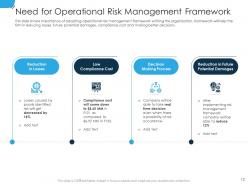
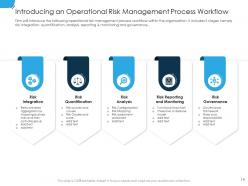
An effective Operational Risk Framework includes risk identification processes, assessment methodologies, control mechanisms, monitoring systems, and reporting structures. These components work together by establishing clear risk appetite boundaries, implementing automated control systems, and enabling real-time monitoring across business units, with many organizations finding that integrated frameworks significantly reduce operational losses while enhancing regulatory compliance.
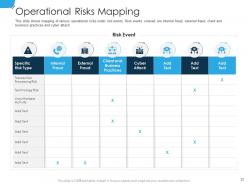
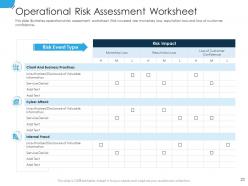
Organizations identify and assess operational risks through comprehensive risk mapping, process audits, data analysis, employee feedback systems, and scenario modeling. These methodologies streamline risk detection by evaluating internal controls, analyzing historical incident patterns, and conducting regular operational assessments, with many financial services and manufacturing companies finding that systematic risk identification ultimately enhances operational efficiency and regulatory compliance.
Data analytics enhances Operational Risk Frameworks by enabling predictive risk modeling, real-time monitoring, automated anomaly detection, comprehensive risk dashboards, and advanced pattern recognition across operational processes. Through machine learning algorithms and statistical analysis, organizations can identify emerging risks earlier, quantify potential impacts more accurately, and streamline risk mitigation strategies, ultimately delivering proactive risk management and competitive operational advantage.
Regulatory compliance fundamentally shapes Operational Risk Framework design by mandating specific risk assessment methodologies, reporting standards, and governance structures that align with industry regulations. Financial institutions, healthcare organizations, and manufacturing companies must integrate compliance requirements into their risk identification, monitoring, and mitigation processes, ultimately delivering enhanced transparency, reduced regulatory penalties, and stronger operational resilience across all business functions.
Operational risk quantification methodologies include Monte Carlo simulations, Value at Risk (VaR) models, scenario analysis, loss distribution approaches, and Bayesian networks. These frameworks enable organizations to measure potential losses through statistical modeling, historical data analysis, and stress testing, with many financial institutions and corporations finding that robust quantification ultimately delivers better capital allocation, regulatory compliance, and strategic risk management across their operations.
Organizations establish risk tolerance levels by defining quantitative thresholds for acceptable losses, setting qualitative criteria for risk categories, and aligning these parameters with strategic objectives and regulatory requirements. Through comprehensive risk assessments and stakeholder consultations, financial institutions, healthcare systems, and manufacturing companies create tailored tolerance bands that balance growth opportunities with operational stability, ultimately enabling informed decision-making across all business units.
Creating a culture of risk awareness involves regular training programs, clear communication of risk policies, leadership commitment, employee engagement initiatives, and integrated risk reporting systems. These practices enhance organizational resilience by embedding risk consciousness into daily operations, encouraging proactive identification of potential issues, and fostering accountability across all levels, ultimately delivering stronger operational performance and regulatory compliance.
Technology and automation enhance operational risk management by streamlining risk identification, accelerating data analysis, and enabling real-time monitoring across organizations. Through AI-powered analytics and automated reporting systems, financial institutions and healthcare organizations significantly reduce manual errors, accelerate incident response times, and enhance regulatory compliance, ultimately delivering stronger risk controls and operational efficiency.
Key metrics include risk incident frequency and severity, control effectiveness scores, risk appetite adherence levels, mean time to resolution, and cost of operational losses. These indicators enable organizations to track framework performance by measuring risk reduction, control efficiency, and response capabilities, with many financial institutions finding that comprehensive monitoring ultimately delivers enhanced regulatory compliance and competitive operational resilience.
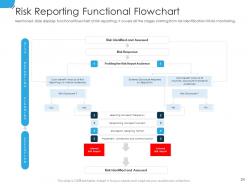
Organizations respond to operational risk incidents through immediate containment protocols, systematic root cause analysis, and coordinated recovery procedures that minimize business disruption. These frameworks enable rapid decision-making, clear communication channels, and resource reallocation, with many financial institutions and healthcare systems finding that pre-established incident response teams significantly reduce recovery times and operational losses.
Continuous improvement ensures operational risk frameworks remain effective against evolving threats, regulatory changes, and business growth by incorporating lessons learned, updating controls, and refining risk assessments. This iterative approach enables organizations to strengthen resilience, reduce operational losses, and maintain regulatory compliance, with many financial institutions and healthcare systems finding that regular framework updates deliver enhanced risk visibility and competitive advantage.
Past operational failures provide crucial insights that reshape risk strategies through enhanced controls, improved monitoring systems, and strengthened governance structures. Organizations analyze failure patterns to identify systemic vulnerabilities, implement preventive measures, and develop robust contingency plans, with many financial institutions and healthcare systems finding that documented lessons learned significantly reduce recurring risks while building organizational resilience.
Companies face challenges including data silos between departments, inconsistent risk measurement methodologies, conflicting governance structures, technology integration complexities, and cultural resistance to unified processes. These integration hurdles often result in duplicated efforts, incomplete risk visibility, and slower decision-making, with many organizations finding that strategic alignment and standardized frameworks ultimately streamline operations while enhancing enterprise-wide risk transparency.
Market volatility significantly amplifies operational risk exposure by straining internal systems, increasing transaction volumes, and creating pressure for rapid decision-making that can bypass normal controls. During volatile periods, financial institutions often experience heightened settlement failures, liquidity pressures, and technology system overloads, while staff face increased stress that can lead to errors, ultimately requiring robust contingency planning and enhanced monitoring capabilities.
Essential training includes risk assessment methodologies, incident response protocols, regulatory compliance requirements, internal control systems, and scenario-based simulations. These programs enhance staff capabilities through hands-on workshops, cross-departmental collaboration exercises, and continuous learning modules, with many financial institutions and healthcare organizations finding that comprehensive competency development ultimately delivers stronger risk mitigation and operational resilience.
-
Great product with highly impressive and engaging designs.
-
Graphics are very appealing to eyes.
-
Colors used are bright and distinctive.
-
Use of different colors is good. It's simple and attractive.
-
Amazing product with appealing content and design.
-
Illustrative design with editable content. Exceptional value for money. Highly pleased with the product.
-
Awesome presentation, really professional and easy to edit.
-
Awesome use of colors and designs in product templates.