


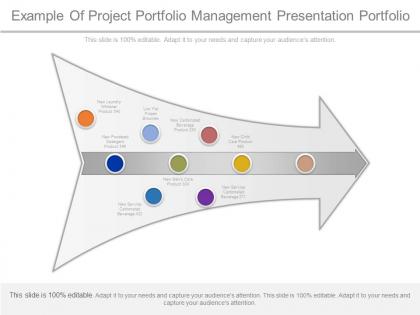
Example of project portfolio management presentation portfolio




Try Before you Buy Download Free Sample Product
 Impress Your
 Audience
 100%
100% Editable
 Save Hours
 of Time


Fulfill expectations with our Example Of Project Portfolio Management Presentation Portfolio. They will more than meet the demand.
People who downloaded this PowerPoint presentation also viewed the following :
Example of project portfolio management presentation portfolio with all 7 slides:
Begin your big attempt with our Example Of Project Portfolio Management Presentation Portfolio. They guarantee a happy ending.


FAQs for Example of project portfolio
Effective PPM strategies include strategic alignment frameworks, resource allocation models, performance measurement systems, risk assessment protocols, and stakeholder governance structures. These components work together by ensuring projects support business objectives, optimizing resource distribution across initiatives, and enabling data-driven decision making, with many organizations finding that integrated PPM approaches deliver improved ROI and enhanced competitive positioning.
Organizations prioritize projects by evaluating strategic alignment, resource requirements, market potential, risk levels, and expected financial returns through scoring matrices and ROI calculations. Many companies combine quantitative metrics with qualitative factors, regularly reassessing priorities based on changing market conditions, ultimately enabling better resource allocation and maximizing portfolio value across diverse business initiatives.
Stakeholder engagement ensures portfolio alignment with organizational objectives through regular communication, feedback collection, and expectation management across all project levels. Effective engagement enables portfolio managers to secure executive buy-in, resolve resource conflicts, and maintain strategic focus, with many organizations finding that consistent stakeholder involvement significantly reduces project failures and enhances overall portfolio success rates.
Technology and software tools enhance project portfolio management by providing real-time visibility into project status, automating resource allocation, and enabling data-driven decision making across multiple initiatives. Through integrated dashboards and analytics platforms, organizations streamline portfolio oversight, optimize budget distribution, and accelerate strategic alignment, with many enterprises finding that automated reporting significantly reduces administrative overhead while improving project success rates.
Portfolio performance metrics include resource utilization rates, portfolio ROI, strategic alignment scores, risk-adjusted returns, and time-to-market measurements. These metrics enable organizations to evaluate financial performance, strategic value delivery, and operational efficiency across multiple projects simultaneously, with many enterprises finding that balanced scorecards combining financial and strategic indicators deliver the most comprehensive portfolio insights.
Project portfolio management differs from traditional project management by focusing on strategic alignment, resource optimization across multiple initiatives, and organizational value maximization rather than individual project execution. While traditional project management concentrates on delivering specific projects on time and budget, portfolio management enables executives to prioritize investments, balance risk across ventures, and ensure projects collectively advance business objectives, ultimately delivering greater strategic advantage and operational efficiency.
Common PPM implementation challenges include resistance to change, inadequate training, poor data quality, lack of executive support, and integration difficulties with existing systems. Organizations often struggle with establishing standardized processes, ensuring user adoption across departments, and aligning portfolio strategies with business objectives, with many finding that successful implementation requires dedicated change management and phased rollout approaches.
Risk management integrates into project portfolio management through systematic risk assessment across all projects, standardized risk frameworks, regular portfolio-level risk reviews, and resource allocation based on risk-adjusted returns. This strategic combination enables organizations to balance high-risk, high-reward initiatives with stable projects, optimize resource distribution across the portfolio, and make informed investment decisions, ultimately delivering better portfolio performance and competitive advantage.
Project portfolio management supports strategic alignment by ensuring projects directly contribute to organizational objectives, optimizing resource allocation across initiatives, and providing visibility into portfolio performance against strategic goals. Through systematic prioritization and governance frameworks, organizations streamline decision-making processes, eliminate redundant efforts, and accelerate strategic outcomes, with many enterprises finding that disciplined portfolio management ultimately delivers enhanced competitive advantage and measurable business value.
Best practices for balancing short-term and long-term projects include establishing strategic allocation ratios, implementing staged funding approaches, maintaining diversified risk profiles, and creating cross-project resource sharing mechanisms. These methodologies streamline portfolio management by delivering immediate wins while building future capabilities, with many organizations finding that strategic combinations ultimately enhance competitive advantage and sustained growth.
Effective communication across multiple projects requires standardized reporting frameworks, regular cross-project meetings, centralized collaboration platforms, and clear escalation protocols. Through integrated project management tools, teams streamline information sharing, minimize duplicated efforts, and maintain consistent messaging, with many organizations finding that structured communication matrices ultimately deliver enhanced transparency and faster decision-making across their entire portfolio.
Regular portfolio reviews and audits deliver enhanced strategic alignment, improved resource allocation, risk mitigation, performance optimization, and increased stakeholder transparency. These systematic evaluations enable organizations to identify underperforming projects, reallocate resources to high-value initiatives, and maintain competitive advantage, with many companies finding that quarterly reviews significantly improve project success rates and overall portfolio ROI.
Organizations leverage data analytics in project portfolio decision-making by analyzing historical performance metrics, resource utilization patterns, risk assessments, and ROI projections to prioritize initiatives strategically. Through predictive modeling and real-time dashboards, companies streamline resource allocation, identify underperforming projects earlier, and optimize portfolio balance, with many finding that data-driven approaches deliver significantly improved project success rates and competitive advantage.
Organizational culture significantly impacts project portfolio management success by influencing decision-making processes, resource allocation priorities, risk tolerance levels, and cross-functional collaboration effectiveness. Companies with collaborative, data-driven cultures typically achieve better portfolio alignment and project outcomes, while organizations emphasizing transparency and accountability find that teams communicate more effectively, ultimately delivering stronger strategic results and competitive advantage.
Lessons learned from past projects can be incorporated into future portfolio decisions through systematic knowledge capture, performance analysis, risk assessment documentation, and strategic review processes. Organizations increasingly leverage project databases, post-implementation reviews, and cross-functional debriefings to identify patterns, with many finding that structured knowledge management ultimately delivers better resource allocation and improved project success rates.
-
Great quality slides in rapid time.
-
Great quality slides in rapid time.