


Executive Summary Plan Business Solution Overview Technical Marketing Growth




Try Before you Buy Download Free Sample Product
 Impress Your
 Audience
 100%
100% Editable
 Save Hours
 of Time


Our Executive Summary Plan Business Solution Overview Technical Marketing Growth are topically designed to provide an attractive backdrop to any subject. Use them to look like a presentation pro.
People who downloaded this PowerPoint presentation also viewed the following :
Executive Summary Plan Business Solution Overview Technical Marketing Growth with all 12 slides:
Use our Executive Summary Plan Business Solution Overview Technical Marketing Growth to effectively help you save your valuable time. They are readymade to fit into any presentation structure.
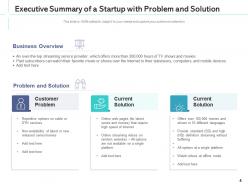
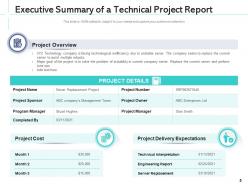
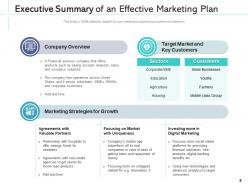
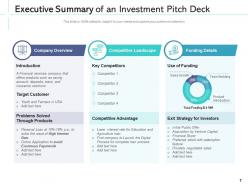

FAQs for Executive Summary Plan Business Solution Overview
Key components of an effective business strategy include clear vision and mission statements, comprehensive market analysis, competitive positioning, resource allocation plans, and measurable performance indicators. These elements work together by aligning organizational goals with market opportunities, optimizing operational efficiency, and establishing sustainable competitive advantages, with many successful companies finding that strategic integration across these components ultimately delivers consistent growth and enhanced market positioning.
Businesses leverage SWOT analysis by systematically evaluating internal strengths and weaknesses alongside external opportunities and threats to inform strategic decisions. This framework enables organizations to identify competitive advantages, address operational gaps, and capitalize on market opportunities while mitigating risks, ultimately delivering more focused resource allocation and strategic positioning in increasingly complex markets.
Competitive analysis influences business strategy development by identifying market gaps, revealing competitor strengths and weaknesses, informing pricing strategies, and highlighting differentiation opportunities. Through systematic competitor evaluation, organizations can anticipate market trends, adjust their positioning, and develop strategic advantages, with many companies finding that regular competitive insights enable more agile decision-making and sustainable growth.
Market research provides critical insights into customer needs, competitor positioning, market trends, industry dynamics, and emerging opportunities that inform strategic decision-making. Through comprehensive data analysis, businesses can identify untapped segments, optimize product development, refine pricing strategies, and anticipate market shifts, with many organizations finding that robust research significantly reduces strategic risks while enhancing competitive positioning.
Organizations align business strategy with corporate social responsibility by integrating sustainability metrics into performance indicators, embedding social impact considerations into decision-making processes, and establishing cross-functional teams that connect CSR initiatives with core business objectives. Through strategic partnerships with nonprofits and community organizations, companies enhance brand reputation, attract socially conscious talent, and access new markets, while delivering measurable social impact and long-term competitive advantage.
Common business strategy pitfalls include inadequate market research, ignoring competitive positioning, overestimating internal capabilities, setting unrealistic timelines, and failing to secure stakeholder buy-in. These strategic missteps often derail implementation across industries, with many organizations finding that thorough analysis, realistic resource assessment, and comprehensive planning ultimately deliver sustainable competitive advantage and measurable growth outcomes.
Innovation drives long-term business strategy by enabling market differentiation, operational efficiency, and adaptive capability in evolving industries. Through strategic R&D investments, digital transformation initiatives, and product development cycles, organizations enhance competitive positioning, streamline processes, and anticipate customer needs, with many companies finding that consistent innovation ultimately delivers sustainable growth and market leadership.
Successful adaptation strategies include continuous market research, agile business models, diversified revenue streams, strategic partnerships, and robust data analytics capabilities. These approaches enable organizations to pivot quickly when consumer preferences shift, with companies in retail, technology, and financial services finding that flexible operations and proactive trend monitoring deliver sustained competitive advantage and market resilience.
Companies can measure business strategy implementation success through key performance indicators (KPIs), financial metrics like revenue growth and profit margins, operational efficiency measures, and customer satisfaction scores. These measurement frameworks enable organizations to track progress against strategic objectives, identify areas requiring adjustment, and demonstrate tangible returns on strategic investments, with many finding that regular assessment cycles ultimately deliver competitive advantage and sustained growth.
Leadership significantly impacts business strategy effectiveness by setting clear vision, allocating resources strategically, driving organizational alignment, and fostering adaptive decision-making capabilities. Strong leaders enhance strategy execution through effective communication, stakeholder engagement, and cultural transformation, with many organizations finding that leadership quality directly correlates with successful strategic outcomes and competitive advantage.
Businesses should approach diversification by conducting thorough market research, assessing core competencies, evaluating financial capacity, analyzing competitive landscapes, and identifying synergistic opportunities that align with existing strengths. Strategic diversification enables companies to reduce risk exposure, capture new revenue streams, and enhance market resilience, with many organizations finding that measured expansion into complementary sectors delivers sustainable competitive advantage.
Clear communication ensures strategy alignment across all organizational levels, eliminates confusion about roles and objectives, and enables coordinated execution toward common goals. It facilitates real-time feedback, accelerates decision-making processes, and builds employee buy-in, with many companies finding that transparent communication reduces implementation delays by up to 40%, ultimately delivering faster strategic outcomes and competitive advantage.
Technology can be integrated into business strategy through automation, data analytics, AI-powered decision-making, digital customer experiences, and cloud-based scalability. These strategic combinations enable organizations to streamline operations, reduce costs, and enhance service delivery, with many companies in retail, finance, and manufacturing finding that technology-driven approaches ultimately deliver faster innovation cycles and sustainable competitive advantage.
Growth strategies focus on expanding market share, revenue, and operations through acquisitions, new markets, and product development, while sustainability strategies emphasize long-term viability, environmental responsibility, and resource efficiency. Many organizations find that combining both approaches delivers competitive advantage, with companies like Unilever and Patagonia demonstrating how sustainable practices can drive growth while building brand loyalty and operational resilience.
Strategic partnerships enhance business strategy by expanding market reach, sharing resources and expertise, reducing operational costs, accessing new technologies, and mitigating competitive risks. Through collaborative ventures, companies leverage complementary strengths, accelerate innovation cycles, and enter new geographic markets more efficiently, with many organizations finding that strategic alliances deliver faster growth and sustained competitive advantage.
-
Great designs, really helpful.
-
Amazing product with appealing content and design.
-
Top Quality presentations that are easily editable.