


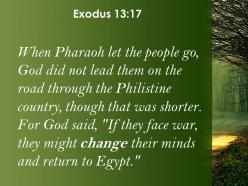
Exodus 13 17 their minds and return to egypt powerpoint church sermon





Try Before you Buy Download Free Sample Product
 Impress Your
 Audience
 100%
100% Editable
 Save Hours
 of Time


Create a culture with our Exodus 13 17 Their Minds And Return To Egypt Powerpoint Church Sermon. Fashion your thoughts for the day.
People who downloaded this PowerPoint presentation also viewed the following :
Exodus 13 17 their minds and return to egypt powerpoint church sermon with all 8 slides:
Figure out the best course with our Exodus 13 17 Their Minds And Return To Egypt Powerpoint Church Sermon. They cover all alternatives.





FAQs for Exodus 13 17 their minds and return to egypt
The Exodus story emerged from Israel's enslavement in Egypt, likely during the New Kingdom period, escalating oppression under pharaohs who feared Hebrew population growth, and divine intervention through Moses' leadership. These foundational events include the initial migration during famine, generations of forced labor in construction projects, and ultimately the dramatic departure that established Israel's covenant identity, with many scholars finding that these narratives shaped Jewish historical consciousness and religious tradition.
Exodus represents liberation from oppression across diverse cultural contexts, serving as a foundational narrative for civil rights movements, anti-colonial struggles, and social justice causes worldwide. From African American spirituals during slavery to liberation theology in Latin America, this archetypal journey from bondage to freedom resonates universally, ultimately delivering hope and inspiring transformative social change across generations.
Beyond Judeo-Christian contexts, "Exodus" represents themes of liberation, spiritual journey, and divine intervention across various religious traditions, including Islamic narratives of Prophet Musa, Hindu concepts of moksha as soul liberation, and Buddhist interpretations of escaping samsara. These diverse religious frameworks embrace exodus as transformative movement from bondage to freedom, spiritual awakening, and collective deliverance, ultimately delivering universal messages of hope, redemption, and transcendence that resonate across cultures and faith communities seeking liberation narratives.
The Exodus narrative has profoundly shaped modern civil rights movements by providing a powerful framework of liberation from oppression, divine justice, and collective struggle toward freedom. From the African American civil rights movement's "Let My People Go" rallying cry to liberation theology in Latin America, activists have drawn upon Moses's leadership model and the journey from bondage to promised land, ultimately delivering hope, moral authority, and strategic inspiration for sustained resistance movements.
Symbols and metaphors in Exodus convey profound themes of liberation, transformation, and divine guidance through elements like the burning bush, parting seas, and wilderness journey. These powerful visual narratives translate effectively into business presentations, with organizations using journey metaphors for change management, breakthrough symbolism for innovation initiatives, and transformation imagery for strategic pivots, ultimately delivering compelling storytelling that resonates with audiences and enhances message retention.
Multimedia elements enhance Exodus presentations through interactive maps tracing the Israelites' journey, dramatic audio narration, historical imagery, timeline animations, and documentary video clips. These technologies streamline complex biblical narratives by improving audience engagement, facilitating better comprehension of geographical context, and delivering immersive storytelling experiences, with many religious educators finding that visual elements significantly enhance retention and spiritual connection.
The Exodus narrative offers powerful frameworks for navigating modern challenges through faith-based resilience, community support, incremental progress despite setbacks, and maintaining vision during difficult transitions. These themes resonate strongly with individuals facing career changes, health struggles, or personal transformations, with many finding that the journey's emphasis on collective strength and divine guidance provides practical strategies for perseverance, ultimately delivering hope and renewed purpose during life's most challenging passages.
Common misconceptions about Exodus include viewing it as purely historical narrative, assuming uniform scholarly consensus, oversimplifying complex theological themes, and ignoring archaeological debates surrounding dating and evidence. Presenters should address these by acknowledging diverse scholarly perspectives, distinguishing between literal and literary interpretations, contextualizing ancient Near Eastern practices, and presenting balanced viewpoints that respect both faith-based and academic approaches, ultimately delivering comprehensive understanding rather than oversimplified conclusions.
Artistic representations of Exodus have evolved from ancient frescoes and illuminated manuscripts to modern Hollywood epics like "The Ten Commandments" and "The Prince of Egypt," spanning religious art, Renaissance masterpieces, and contemporary literature. These interpretations have consistently emphasized themes of liberation, divine intervention, and moral triumph, with many finding that the story's universal appeal transcends religious boundaries, ultimately delivering powerful narratives about freedom and human resilience.
Comparing different versions of the Exodus across biblical texts, cinematic adaptations, and cultural interpretations enhances audience understanding by revealing diverse perspectives, historical contexts, and thematic emphases that illuminate universal human experiences. These comparative approaches enable deeper analysis through contrasting narrative structures, visual storytelling techniques, and cultural significance, ultimately delivering richer comprehension and broader appreciation of this foundational story's enduring relevance.
The Exodus narrative offers principles of hospitality, collective responsibility, and systemic change that apply to modern migration challenges. Through community mobilization, advocacy for just policies, and direct humanitarian support, societies can address root causes of displacement while providing immediate relief, with many faith-based and secular organizations finding that these ancient teachings enhance both refugee integration and broader social cohesion.
Effective pedagogical strategies for teaching Exodus include interactive storytelling, comparative analysis with other liberation narratives, multimedia presentations, role-playing activities, and cross-curricular connections linking history, literature, and ethics. These approaches enhance student engagement by connecting ancient themes to contemporary social justice movements, ultimately delivering deeper comprehension and critical thinking skills while fostering meaningful discussions about freedom, leadership, and moral responsibility.
Academic disciplines approach Exodus through distinct methodological lenses, with historians examining archaeological evidence and ancient Near Eastern contexts, theologians analyzing spiritual themes and covenant theology, and sociologists studying identity formation and collective memory. These interdisciplinary perspectives enhance understanding by combining empirical research, textual analysis, and social theory, with many scholars finding that integrating historical, theological, and sociological frameworks delivers comprehensive insights into the narrative's enduring significance.
The Exodus narrative has profoundly shaped Jewish, Christian, and Islamic identities through themes of liberation, covenant, and divine intervention. Jewish identity centers on the covenant at Sinai, Christian theology emphasizes redemption parallels, and Islamic tradition honors Moses as a prophet, with each religion finding foundational principles of faith, freedom, and divine relationship that ultimately deliver distinct theological frameworks and spiritual practices.
Storytelling techniques enhance Exodus presentations by incorporating narrative arcs, character development, emotional connections, vivid imagery, and relatable themes that resonate with audiences. These approaches transform historical content into compelling experiences, with religious institutions, educational organizations, and cultural centers finding that personal testimonies, visual metaphors, and contemporary parallels significantly increase audience retention and emotional engagement.
-
Editable templates with innovative design and color combination.
-
It saves your time and decrease your efforts in half.