


Extension Strategies To Increase Product Lifecycle Nike Brand Extension




Try Before you Buy Download Free Sample Product
 Impress Your
 Audience
 100%
100% Editable
 Save Hours
 of Time


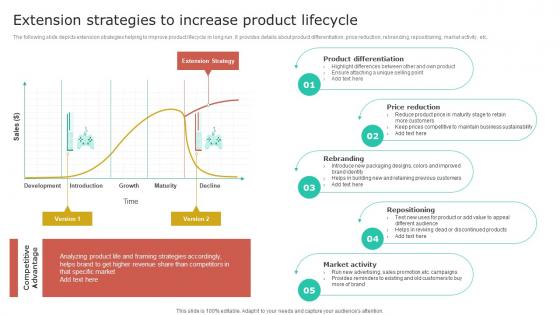
The following slide depicts extension strategies helping to improve product lifecycle in long run. It provides details about product differentiation, price reduction, rebranding, repositioning, market activity, etc.
People who downloaded this PowerPoint presentation also viewed the following :
Extension Strategies To Increase Product Lifecycle Nike Brand Extension with all 6 slides:
Use our Extension Strategies To Increase Product Lifecycle Nike Brand Extension to effectively help you save your valuable time. They are readymade to fit into any presentation structure.





FAQs for Extension Strategies To Increase Product Lifecycle
So there are four stages: Introduction, Growth, Maturity, and Decline. Each one's totally different. Introduction is when you're burning through cash trying to get people to even know your product exists - honestly the worst part financially. Then Growth hits and suddenly sales take off, you're scaling like crazy. Maturity sucks because everyone's fighting over the same customers and you're just trying to cut costs. Decline is decision time - do you try to save it or just kill it? Your focus shifts from creating cool stuff to expanding fast to being efficient to making tough calls. Watch your sales patterns to figure out where you are.
So PLM cuts development costs and gets your stuff to market way faster. You're basically eliminating all the waste in your product processes - cuts down time-to-revenue too. Catching design problems early saves you from expensive manufacturing headaches later. Better team collaboration means less back-and-forth revisions, which honestly saves more money than people realize. The data visibility is huge for deciding which products are worth pushing vs. killing off. Oh, and definitely start by mapping out your current process first - find where things get stuck the most.
Honestly, tech is a game-changer for PLM - turns all that paperwork chaos into something you can actually handle. Digital twins let you test stuff before you build it, which is pretty cool. Cloud platforms mean your whole team can work together without the usual headaches. AI spots problems early (when you can still fix them easily), and automation handles the boring repetitive tasks. IoT sensors on existing products feed data back for your next designs too. My advice? Figure out what's slowing you down most - that's where you'll see the biggest wins when you add new tech.
Dude, compliance and sustainability stuff pretty much runs the whole product roadmap now. Map out regulations for your target markets first - trust me on this one. Baking those requirements into design upfront saves you from expensive redesigns later. Materials, energy use, disposal - all that has to be planned from the start since rules keep getting tighter. Honestly felt overwhelming when I first dealt with it, but it actually helps you focus and stops feature creep. Oh, and don't forget your requirements doc needs all these constraints built in early. Makes everything smoother down the line.
Honestly, timing is your biggest nightmare. Getting engineering, marketing, and sales on the same page feels impossible sometimes - they're all in their own worlds. Features keep getting added last minute, which screws up your deadlines. Then you're fighting other product teams for the same developers or budget. Oh, and markets shift out of nowhere. That roadmap you spent weeks perfecting? Suddenly worthless because some competitor just dropped something crazy. Build in way more buffer time than you think you need. Seriously, like double it. And just keep talking to everyone constantly - I know it's annoying but miscommunication kills launches faster than anything else.
Honestly, feedback should be baked into everything you do. Start with surveys and focus groups before building features - trust me, it'll save you so much headache later. Beta testing is clutch for spotting problems early. After launch, keep an eye on reviews, support tickets, and user data to find patterns. One thing people mess up though - they collect feedback but never close the loop. Actually respond to customers and show them how their suggestions changed things. Don't just be reactive either. Set up regular check-ins and actually do something with what you learn. Otherwise you're just collecting data for no reason.
Honestly, refreshing your product beats letting it die a slow death. Add new features or find different customer groups who haven't tried it yet. Sometimes rebranding works wonders too - I've watched companies squeeze years out of this approach. Bundle pricing can help, or create premium versions. Listen to why current customers are bailing and fix those issues first. That's usually the low-hanging fruit. Then hunt for fresh audiences who don't know your product exists. Oh, and don't underestimate how much a simple repositioning can breathe new life into something that feels stale.
So basically PLM gets rid of those annoying silos by putting all your product data in one place. Engineering tweaks something? Manufacturing sees it right away instead of finding out three weeks later (been there!). Everyone - marketing, procurement, whoever - works off the same specs instead of juggling fifteen different spreadsheets. Real-time updates save you from those version control disasters we've all suffered through. Your teams can actually collaborate on workflows and share feedback directly. Honestly, the biggest wins come from setting up user permissions right and training people properly on the workflows.
Oh man, you definitely need analytics for PLM - it's like trying to drive with a blindfold on otherwise. Track how your products actually perform vs what you assume they're doing. Spot problems before they blow up, see which features users actually care about. I've watched teams burn weeks chasing hunches that basic data would've shut down immediately. Even simple dashboards and user tracking will save you so much headache. The difference between guessing and knowing is honestly night and day when you're making product decisions.
Honestly, you gotta nail the stage-gate thing first - validate everything at each checkpoint before moving on. Get your marketing, sales, and ops people involved way earlier than you think. I can't tell you how many launches I've watched crash because someone thought they were too cool for the boring checklist stuff. Set up clear go/no-go criteria around market readiness and production capability. Build detailed timelines with backup plans too. Oh, and definitely do a pilot program first! Catching issues during a soft launch beats having them blow up during your big rollout. Trust me on this one.
So PLM is like having one place where all your design stuff lives - data, feedback, collaboration, everything. No more digging through ancient email threads or wondering which file is actually the latest version. Your team can move way faster since everyone's looking at the same info. Honestly, the version control feature alone will save your sanity - goodbye "final_final_ACTUALLY_final_v4" madness! You'll be able to see what worked before and why certain decisions got made, so you're not starting from scratch every time. Oh, and it makes dealing with regulatory requirements less painful too. I'd start by looking at where your current process gets bottlenecked.
Ugh, globalization makes product management such a headache. You're juggling teams in different time zones, dealing with random regulations in every country, and your supply chain is scattered everywhere. But honestly? The upside is huge - way more talent to pick from, cheaper production costs, and massive markets to sell into. Your PLM system basically becomes the lifeline keeping everyone on the same page about specs and deadlines. I'd definitely go with cloud-based tools that sync everything in real-time. Trust me, you don't want to be that person chasing down version control issues across three continents.
First, figure out which products are actually dying vs just having a rough patch - don't kill something that might recover. After you've spotted the real duds, map out a timeline considering customers, inventory, contracts, all that fun stuff. This gets messy though, fair warning. Angry customers and suppliers are inevitable. Give people heads up early about discontinuation dates, suggest alternatives if you have them, and maybe do clearance sales to dump leftover stock. Way better to have an actual exit strategy than just yanking products and scrambling to fix the fallout afterward.
B2B PLM is all about those heavy technical specs and compliance stuff - plus you're looking at development cycles that drag on for years. Industrial equipment that'll run for decades, you know? Consumer products are a completely different beast though. You've got way faster iterations, and honestly, aesthetics matter more than anyone wants to admit. Consumer feedback loops are huge too. B2C companies dig way deeper into social listening and trend analysis since people's tastes change like every five minutes. First thing I'd do? Map out how long your products typically last - that alone will tell you which direction to go.
Honestly, PLM is a game-changer for getting ahead of competitors. It speeds up your time-to-market and cuts development costs because teams collaborate better - way fewer painful redesigns eating your budget. You'll respond to market shifts faster and launch before everyone else does. The visibility piece is huge too - finally see which products actually make money and what features customers are obsessed with. That data helps you figure out where to throw money next instead of just guessing. I'd start by looking at your biggest development bottlenecks first, then see where PLM could fix the worst time-wasters.
-
The design is very attractive, informative, and eye-catching, with bold colors that stand out against all the basic presentation templates.
-
The templates are easy to get, and the chat customer support is excellent.