


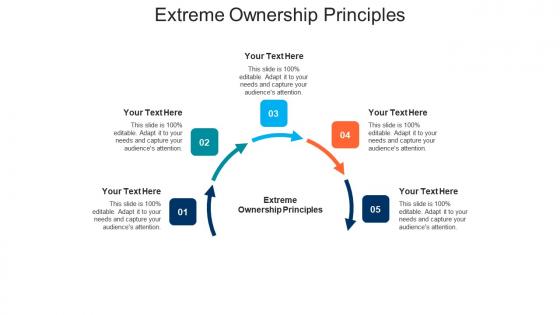
Extreme ownership principles ppt powerpoint presentation portfolio backgrounds cpb




Try Before you Buy Download Free Sample Product
 Impress Your
 Audience
 100%
100% Editable
 Save Hours
 of Time


Our Extreme Ownership Principles Ppt Powerpoint Presentation Portfolio Backgrounds Cpb are topically designed to provide an attractive backdrop to any subject. Use them to look like a presentation pro.
People who downloaded this PowerPoint presentation also viewed the following :
Extreme ownership principles ppt powerpoint presentation portfolio backgrounds cpb with all 9 slides:
Use our Extreme Ownership Principles Ppt Powerpoint Presentation Portfolio Backgrounds Cpb to effectively help you save your valuable time. They are readymade to fit into any presentation structure.








FAQs for Extreme ownership principles ppt powerpoint presentation
Extreme Ownership's foundational concepts include taking complete responsibility for outcomes, leading up and down the chain of command, prioritizing and executing tasks systematically, and maintaining decentralized command structures. These leadership principles streamline decision-making by eliminating blame, enhancing team accountability, and fostering proactive problem-solving, with many organizations finding that this approach ultimately delivers improved operational efficiency and stronger competitive positioning.
Leaders implement Extreme Ownership by modeling accountability for all outcomes, eliminating blame from team discussions, and consistently taking responsibility for failures while crediting teams for successes. Through regular ownership reviews, clear communication of expectations, and transparent decision-making processes, organizations streamline accountability cultures, enhance team trust, and ultimately deliver improved performance with reduced finger-pointing dynamics.
Accountability serves as the foundational pillar of Extreme Ownership, requiring leaders to take complete responsibility for their team's performance, failures, and outcomes without deflecting blame. This approach transforms organizational culture by fostering trust, improving decision-making, and accelerating problem-solving, with many companies finding that leaders who embrace total accountability create more resilient teams and deliver superior results.
Extreme Ownership shifts mindset by eliminating blame culture, encouraging personal accountability, and fostering proactive problem-solving across all organizational levels. This leadership philosophy transforms team members from reactive participants into strategic contributors who take initiative, collaborate more effectively, and drive solutions rather than excuses, ultimately delivering enhanced performance and competitive advantage.
Examples include military units taking full accountability for mission outcomes, CEOs accepting responsibility for company-wide failures, project managers owning team delays, and department heads addressing customer complaints without deflecting blame. These leaders enhance organizational trust, streamline decision-making, and accelerate problem resolution by eliminating excuses, with many organizations finding that ownership-focused cultures ultimately deliver improved performance and stronger team cohesion.
Common challenges when adopting Extreme Ownership principles include resistance to accountability culture, difficulty letting go of blame habits, leadership vulnerability fears, and overcoming ingrained excuse-making behaviors. These obstacles require consistent reinforcement and modeling, with many organizations finding that gradual implementation through team workshops, leadership coaching, and transparent communication ultimately delivers stronger accountability, improved problem-solving capabilities, and enhanced operational performance.
Extreme Ownership improves team performance by eliminating blame culture, fostering accountability at every level, and encouraging proactive problem-solving rather than defensive behaviors. This leadership philosophy enhances communication, builds trust between team members, and creates psychological safety where mistakes become learning opportunities, ultimately delivering stronger collaboration, faster decision-making, and measurable improvements in project outcomes across organizations.
Communication enhances Extreme Ownership by enabling transparent accountability, fostering collaborative problem-solving, and ensuring clear direction across organizational levels. Through open dialogue and structured feedback mechanisms, leaders streamline decision-making processes, minimize misunderstandings, and accelerate issue resolution, with many organizations finding that enhanced communication ultimately delivers stronger team cohesion and operational efficiency.
Leaders model Extreme Ownership by publicly accepting responsibility for team failures, openly admitting their mistakes, and demonstrating accountability in decision-making processes. Through transparent communication and consistent self-reflection, leaders create psychological safety where team members feel empowered to take ownership of their roles, ultimately fostering a culture of accountability, innovation, and collective responsibility across the organization.
Extreme Ownership transforms organizational culture by fostering accountability, eliminating blame-shifting, and encouraging proactive problem-solving at every level. This leadership philosophy creates environments where teams take responsibility for outcomes, communicate more transparently, and collaborate effectively, with many organizations finding that it significantly enhances trust, reduces conflicts, and accelerates decision-making processes.
Extreme Ownership principles transform crisis management by requiring leaders to accept full accountability, communicate transparently with stakeholders, and focus on solutions rather than blame attribution. Through decisive leadership and clear communication protocols, organizations streamline response times, enhance team coordination, and maintain stakeholder confidence, ultimately delivering faster crisis resolution and stronger organizational resilience.
Effective strategies include leading by example, demonstrating vulnerability through personal accountability stories, providing clear frameworks for decision-making, offering consistent support during transition periods, and celebrating team members who embrace ownership behaviors. Through gradual implementation and transparent communication, organizations can address initial skepticism while building psychological safety, with many finding that resistance diminishes when teams experience improved collaboration and operational efficiency.
Extreme Ownership differs by requiring leaders to accept complete responsibility for all team outcomes, rather than delegating blame or accountability downward like traditional approaches. This philosophy transforms organizational culture by eliminating excuses, enhancing trust between teams and management, and accelerating problem-solving, with many military and corporate leaders finding that total accountability ultimately delivers faster adaptation and stronger competitive performance.
**INPUT**: What resources or training materials can support the learning of Extreme Ownership? **OUTPUT**: Extreme Ownership learning resources include Jocko Willink's foundational books, leadership podcasts, military case studies, corporate training workshops, and online certification programs. These materials enhance understanding by combining battlefield lessons with business applications, real-world scenarios, and practical exercises, with many organizations finding that structured programs ultimately deliver stronger leadership accountability and improved team performance. **Word count: 54 words**
Extreme Ownership accelerates personal development by fostering accountability, emotional intelligence, and leadership skills through complete responsibility for outcomes. By embracing this mindset, individuals enhance their decision-making capabilities, build stronger relationships, and develop resilience in challenging situations, ultimately delivering improved performance and career advancement opportunities across professional environments.
-
Informative design.
-
Best Representation of topics, really appreciable.
-
Unique research projects to present in meeting.
-
Amazing product with appealing content and design.