


Factors affecting labor market ppt powerpoint presentation outline ideas cpb




Try Before you Buy Download Free Sample Product
 Impress Your
 Audience
 100%
100% Editable
 Save Hours
 of Time


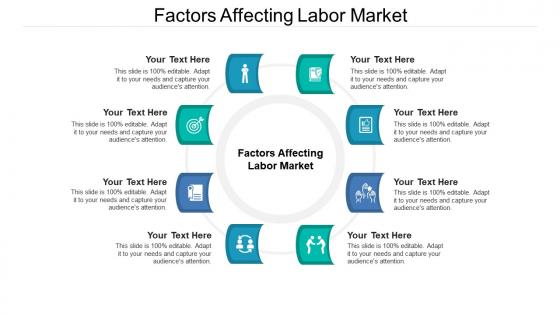
Our Factors Affecting Labor Market Ppt Powerpoint Presentation Outline Ideas Cpb are topically designed to provide an attractive backdrop to any subject. Use them to look like a presentation pro.
People who downloaded this PowerPoint presentation also viewed the following :
Factors affecting labor market ppt powerpoint presentation outline ideas cpb with all 6 slides:
Use our Factors Affecting Labor Market Ppt Powerpoint Presentation Outline Ideas Cpb to effectively help you save your valuable time. They are readymade to fit into any presentation structure.





FAQs for Factors affecting labor market ppt powerpoint presentation
Economic trends significantly impact labor market dynamics through inflation rates, GDP growth, interest rates, consumer spending patterns, and technological advancement cycles. During economic expansion, industries like manufacturing, retail, and financial services typically experience increased hiring and wage growth, while recessions often lead to workforce reductions and skills mismatches, ultimately reshaping employment patterns and competitive positioning across sectors.
Technological advancements significantly increase demand for skilled labor by creating new roles in AI development, data analytics, cybersecurity, and automation management, while reducing need for routine tasks. Industries like healthcare, finance, and manufacturing increasingly seek workers with technical expertise, programming skills, and analytical capabilities, ultimately delivering competitive advantage through enhanced innovation and operational efficiency.
Education fundamentally shapes the labor market by developing skilled workforces, reducing unemployment rates, and driving wage growth across industries. Through vocational training, higher education, and continuous learning programs, educational institutions enable workers to meet evolving job demands, with sectors like technology, healthcare, and finance increasingly requiring specialized skills, ultimately delivering greater economic mobility and competitive advantage for both individuals and organizations.
Demographic shifts significantly impact labor supply and demand through aging populations, changing birth rates, migration patterns, and evolving skill requirements across different age cohorts. These changes reshape workforce composition, with industries like healthcare and senior services experiencing increased demand, while sectors requiring physical labor face supply constraints, ultimately driving businesses to adapt recruitment strategies and invest in automation for competitive advantage.
Remote work creates both opportunities and challenges for local labor markets, enabling talent retention, reducing geographic constraints, and expanding employment options, while potentially decreasing local economic activity and competition for workers. Through digital platforms and flexible arrangements, communities experience workforce diversification and reduced commuting demands, with many regions finding that strategic remote work policies ultimately deliver enhanced talent attraction and economic resilience.
Government policies influence unemployment rates through fiscal stimulus, monetary policy adjustments, job training programs, infrastructure investments, and labor market regulations. These interventions enable governments to create employment opportunities, enhance workforce skills, and stimulate economic growth, with many countries finding that strategic policy combinations ultimately deliver lower unemployment and improved economic stability.
Globalization intensifies labor market competition by expanding talent pools beyond geographic boundaries, enabling remote work arrangements, and creating wage pressures across different regions. This presents both challenges and opportunities, with companies accessing specialized skills globally while workers face increased competition, ultimately driving skill development demands and creating more dynamic, efficient labor markets worldwide.
Labor unions shape working conditions and wages through collective bargaining, advocacy for safety standards, negotiating benefit packages, establishing grievance procedures, and lobbying for worker-friendly legislation. These organizations enable employees to secure higher compensation, improved workplace safety, and better work-life balance, with many industries finding that unionized environments deliver enhanced job security and standardized wage structures.
The gig economy transforms traditional employment by replacing fixed contracts with project-based arrangements, shifting benefits responsibility to workers, and enabling flexible scheduling across multiple platforms. Through digital marketplaces, businesses access on-demand talent while workers gain autonomy and income diversification, ultimately creating more fluid labor relationships, though with considerations around job security and benefits coverage.
Skills mismatches arise from rapid technological advancement, inadequate educational curricula, geographic disparities between job locations and workforce, and insufficient professional development opportunities. These disconnects particularly affect manufacturing, healthcare, and technology sectors, where evolving requirements outpace training programs, ultimately creating competitive disadvantages and reduced operational efficiency for organizations struggling to find qualified talent.
Seasonal trends create cyclical employment patterns across sectors, with retail, hospitality, agriculture, and tourism experiencing significant workforce fluctuations during peak periods like holidays and harvest seasons. These patterns enable strategic workforce planning, temporary employment opportunities, and specialized staffing solutions, with many organizations finding that seasonal hiring strategies ultimately deliver operational flexibility and cost efficiency while meeting fluctuating consumer demands.
Automation's long-term effects on job security include job displacement in routine-based roles, creation of new technology-focused positions, increased demand for reskilling, wage polarization between high and low-skill jobs, and enhanced productivity in human-machine collaboration. While manufacturing and retail workers face displacement challenges, many organizations find that strategic workforce development and automation integration ultimately deliver competitive advantage and create higher-value employment opportunities.
Labor market flexibility enhances economic growth by enabling faster job creation, streamlining workforce reallocation across sectors, and reducing structural unemployment barriers. This adaptability allows economies to respond more efficiently to market changes, with countries like Denmark and Singapore finding that flexible labor policies ultimately deliver higher productivity, increased innovation, and stronger competitive positioning in global markets.
Employee well-being plays a crucial role in attracting top talent by demonstrating organizational commitment to work-life balance, mental health support, comprehensive benefits, and positive workplace culture. Companies prioritizing well-being initiatives, especially in competitive sectors like technology and healthcare, find they can attract higher-quality candidates while reducing recruitment costs and ultimately gaining significant competitive advantage in talent acquisition.
Cultural factors significantly influence job-seeking behaviors through varying communication styles, networking preferences, family involvement levels, and career prioritization approaches. In collectivist cultures, candidates often rely heavily on family guidance and relationship-based networking, while individualist cultures emphasize personal achievement and direct applications, ultimately shaping recruitment strategies and workplace integration across diverse organizations.
-
Informative presentations that are easily editable.
-
Innovative and attractive designs.