


Fashion Business Plan Cash Flow Statement A Detailed Business Cash Inflow And Outflow Analysis BP SS




Try Before you Buy Download Free Sample Product
 Impress Your
 Audience
 100%
100% Editable
 Save Hours
 of Time


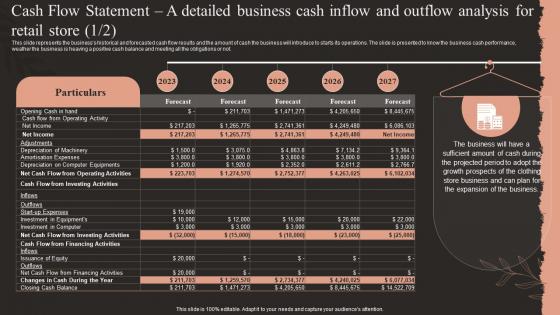
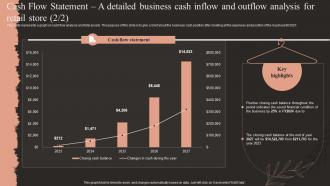
This slide represents the business historical and forecasted cash flow results and the amount of cash the business will introduce to starts its operations. The slide is presented to know the business cash performance, weather the business is heaving a positive cash balance and meeting all the obligations or not.
People who downloaded this PowerPoint presentation also viewed the following :
Fashion Business Plan Cash Flow Statement A Detailed Business Cash Inflow And Outflow Analysis BP SS with all 10 slides:
Use our Fashion Business Plan Cash Flow Statement A Detailed Business Cash Inflow And Outflow Analysis BP SS to effectively help you save your valuable time. They are readymade to fit into any presentation structure.








FAQs for Fashion Business Plan Cash Flow Statement A Detailed Business Cash Inflow And Outflow
An effective fashion business plan includes market analysis, target audience definition, brand positioning, product line strategy, manufacturing and sourcing plans, marketing strategy, financial projections, and competitive analysis. These components work together by establishing clear brand identity, streamlining production processes, and identifying market opportunities, with many fashion startups finding that comprehensive planning significantly reduces operational risks while accelerating market entry and sustainable growth.
Market research influences fashion business plan direction by identifying target demographics, analyzing competitor strategies, forecasting trend cycles, and revealing pricing opportunities within specific market segments. Through consumer behavior analysis and competitive intelligence, fashion brands can strategically position their collections, optimize distribution channels, and align production timelines with market demand, ultimately delivering more targeted products and sustainable growth in an increasingly competitive fashion landscape.
Essential financial projections include revenue forecasts, cost of goods sold, operating expenses, cash flow statements, break-even analysis, and profit and loss projections for three to five years. These projections enable fashion entrepreneurs to demonstrate market viability, secure investor funding, and guide strategic decision-making, with many fashion startups finding that detailed financial modeling significantly enhances their credibility with stakeholders.
Branding strategies fundamentally define a fashion business's identity, target audience, pricing positioning, design aesthetic, and market differentiation approach. These strategic elements create cohesive direction across product development, marketing campaigns, and customer experiences, with luxury brands like Chanel and accessible retailers like Zara demonstrating how distinct branding visions drive operational decisions and ultimately deliver competitive market advantage.
Best practices for outlining target customer profiles include demographic analysis, psychographic segmentation, shopping behavior patterns, brand preferences, and lifestyle characteristics. These comprehensive profiles enable fashion businesses to tailor product lines, marketing strategies, and retail experiences more effectively, with many successful brands finding that detailed customer personas ultimately drive higher engagement and sales conversion rates.
A fashion business plan effectively incorporates sustainability by integrating eco-friendly materials sourcing, circular design principles, ethical manufacturing partnerships, waste reduction strategies, and transparent supply chain management throughout operations. These practices enable fashion companies to reduce environmental impact, appeal to conscious consumers, and build competitive advantage, with many brands finding that sustainable approaches ultimately drive customer loyalty while minimizing long-term operational costs.
Digital marketing serves as the cornerstone of modern fashion business plans, encompassing social media engagement, influencer partnerships, e-commerce optimization, content creation, and targeted advertising campaigns. These strategies enable fashion brands to reach global audiences, build authentic customer relationships, and drive direct-to-consumer sales, with many retailers finding that integrated digital approaches deliver significantly higher engagement rates and competitive market positioning.
Fashion startups should conduct competitor analysis by examining direct and indirect competitors' pricing strategies, target demographics, marketing channels, product positioning, and distribution methods. This comprehensive assessment enables identification of market gaps, differentiation opportunities, and competitive advantages, while helping startups understand industry benchmarks, avoid oversaturated segments, and position themselves strategically within the fashion landscape for sustainable growth.
A detailed supply chain management section enables transparent vendor relationships, efficient inventory control, streamlined production timelines, cost optimization strategies, and quality assurance protocols. Through strategic supplier partnerships, fashion businesses minimize lead times, reduce operational costs, and enhance product consistency, with many retailers finding that robust supply chain planning delivers competitive pricing and faster market responsiveness.
Trends and forecasts can be integrated through market research analysis, seasonal planning cycles, product development timelines, inventory management strategies, and financial projections. Fashion retailers and manufacturers leverage consumer behavior data, runway insights, and demographic shifts to align production schedules with anticipated demand, ultimately reducing excess inventory while maximizing sales opportunities in an increasingly competitive market.
Critical metrics for measuring success in a fashion business include gross margin percentage, inventory turnover rates, sell-through percentages, customer acquisition costs, and return on investment per collection. These metrics enable fashion brands to optimize pricing strategies, minimize overstock risks, and enhance profitability, with many retailers finding that tracking these indicators ultimately delivers improved cash flow and competitive positioning in increasingly dynamic markets.
A fashion business plan effectively addresses challenges by conducting thorough market analysis, identifying seasonal demand fluctuations, supply chain vulnerabilities, competitive pressures, and financial risks through comprehensive risk assessment frameworks. These strategic approaches enable fashion companies to develop contingency plans, diversify supplier networks, and build financial reserves, while many successful brands find that proactive risk management ultimately delivers greater market resilience and sustainable growth.
Essential marketing channels for a fashion brand include social media platforms, influencer partnerships, email marketing, content marketing, and retail collaborations. These channels work synergistically by building brand awareness through visual storytelling, driving engagement via targeted campaigns, and converting audiences through strategic partnerships, with many fashion brands finding that omnichannel approaches deliver higher customer acquisition rates and stronger brand loyalty.
Storytelling enhances a fashion business plan's presentation by creating emotional connections with investors, weaving brand narratives throughout financial projections, and transforming dry market analysis into compelling vision statements. Through strategic storytelling, fashion entrepreneurs can illustrate their brand's journey, showcase customer personas in realistic scenarios, and demonstrate market opportunities through relatable narratives, ultimately delivering memorable presentations that resonate with stakeholders.
Fashion business plan templates include financial projection spreadsheets, market analysis frameworks, product line planning tools, competitive analysis matrices, and brand positioning canvases. These resources streamline planning by organizing cash flow forecasts, target market research, and seasonal collection strategies, with many fashion entrepreneurs finding that comprehensive templates accelerate investor presentations while ensuring critical business elements aren't overlooked.
-
The PPT layout is great and it has an effective design that helps in presenting corporate presentations. It's easy to edit and the stunning visuals make it an absolute steal!
-
“I always have a wonderful experience with SlideTeam. It's my ""go to"" when I need a template.”