


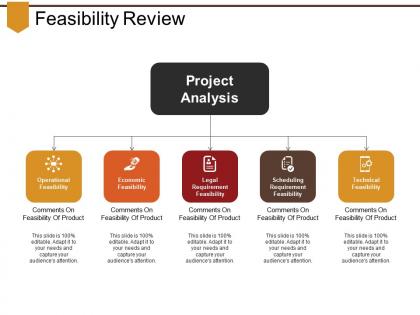
Feasibility review ppt design




Try Before you Buy Download Free Sample Product
 Impress Your
 Audience
 100%
100% Editable
 Save Hours
 of Time


Your presentations need to look their best. Our Feasibility Review Ppt Design have been designed to help you stay afloat in this image conscious presentation world.
People who downloaded this PowerPoint presentation also viewed the following :
Feasibility review ppt design with all 5 slides:
Indulge in cost cutting with our Feasibility Review Ppt Design. Bring down expenses incurred.
FAQs for Feasibility
Key components include executive summary, project scope and objectives, market analysis, technical requirements, financial projections, risk assessment, implementation timeline, and resource allocation plans. These elements enable stakeholders to evaluate project viability through comprehensive data analysis, cost-benefit comparisons, and strategic alignment assessments, ultimately delivering informed decision-making and competitive positioning advantages.
Assessing market demand involves analyzing target demographics, competitor landscape, customer surveys, industry trends, and potential market size through comprehensive research methodologies. These assessments streamline decision-making by identifying revenue opportunities, pricing strategies, and market entry points, with many organizations finding that thorough demand analysis ultimately delivers competitive positioning and reduces investment risks.
Financial viability analysis methods include net present value (NPV), internal rate of return (IRR), payback period, break-even analysis, and sensitivity analysis. These approaches enable organizations to evaluate cash flows, profitability timelines, and risk scenarios across manufacturing, healthcare, and technology sectors, ultimately delivering data-driven investment decisions and competitive advantage.
Potential risks are identified through comprehensive market analysis, financial modeling, technical assessments, regulatory reviews, and stakeholder impact evaluations during feasibility reviews. These systematic approaches enable organizations to develop targeted mitigation strategies, create contingency plans, and implement risk monitoring frameworks, ultimately delivering more resilient project outcomes and enhanced decision-making confidence for strategic investments.
Stakeholder analysis identifies key parties affected by the project, assesses their influence, interests, and potential impact on feasibility outcomes. This strategic evaluation enables project teams to anticipate concerns, secure buy-in, and address resistance early, with many organizations finding that thorough stakeholder mapping significantly improves project approval rates and implementation success.
Timeline determination involves analyzing project scope, resource availability, regulatory requirements, stakeholder dependencies, and potential risk factors within your feasibility presentation. Through comprehensive assessment of these variables, organizations can establish realistic milestones, allocate resources strategically, and communicate achievable deadlines to stakeholders, while building in contingency buffers that ultimately enhance project credibility and execution success.
Graphical tools that enhance feasibility review clarity include Gantt charts, financial dashboards, risk heat maps, SWOT analysis matrices, and ROI comparison charts. These visualization methods streamline complex data interpretation by highlighting critical timelines, budget variances, and potential obstacles, with many project teams finding that strategic visual presentations accelerate stakeholder decision-making and approval processes.
**INPUT**: How can you tailor your feasibility presentation to different audiences (investors, stakeholders, management)? **OUTPUT**: Tailoring feasibility presentations involves emphasizing financial returns and ROI projections for investors, operational impacts and risk mitigation for stakeholders, and strategic alignment with resource requirements for management teams. This targeted approach streamlines decision-making by addressing each audience's primary concerns, ultimately delivering more compelling presentations that accelerate project approvals and secure necessary support across organizational levels.
Qualitative data should be presented through structured narratives, case studies, stakeholder testimonials, and visual frameworks that highlight strategic implications, while quantitative data requires clear charts, financial models, statistical comparisons, and trend analyses with specific metrics. This strategic combination enables decision-makers to assess both measurable outcomes and contextual factors, with many organizations finding that balanced presentations deliver comprehensive insights, enhanced stakeholder buy-in, and ultimately stronger feasibility conclusions.
Effectively summarizing feasibility study findings requires clear executive summaries, visual data representations, risk-benefit analyses, financial projections, and actionable recommendations structured for decision-makers. Through compelling charts and concise narratives, organizations streamline complex data into digestible insights, enabling stakeholders to quickly assess viability, understand resource requirements, and make informed strategic decisions that drive competitive advantage.
The conclusion should focus on delivering a clear recommendation based on comprehensive analysis, summarizing key findings across financial viability, technical requirements, and market conditions. It should present actionable next steps with specific timelines, resource requirements, and risk mitigation strategies, ultimately enabling stakeholders to make informed decisions while highlighting competitive advantages and strategic alignment with organizational objectives.
Real-world case studies strengthen feasibility presentations by providing concrete evidence of successful implementations, demonstrating measurable outcomes, and addressing potential stakeholder concerns through proven examples. These case studies enable presenters to showcase similar projects across industries like healthcare, manufacturing, or financial services, ultimately building credibility and confidence while illustrating practical applications that resonate with decision-makers.
Feasibility evaluation criteria include technical viability, financial requirements, resource availability, implementation timeline, and risk assessment factors. These comprehensive metrics enable organizations to systematically compare alternatives by analyzing cost-benefit ratios, operational complexity, and strategic alignment, with many companies finding that structured evaluation frameworks ultimately deliver more informed decision-making and successful project outcomes.
Effective feedback gathering involves structured evaluation forms, stakeholder interviews, follow-up meetings, and anonymous suggestion channels to capture diverse perspectives on feasibility findings. Organizations can incorporate this input by documenting concerns, reassessing key assumptions, updating financial models, and revising recommendations, with many finding that iterative refinement strengthens project viability and stakeholder buy-in.
Professional presentation software like PowerPoint, Keynote, and Canva provide templates and design capabilities, while data visualization tools such as Tableau, Excel, and Google Charts enhance financial modeling and analytics presentation. These platforms streamline content creation, enable dynamic data representation, and deliver polished visual storytelling, with many organizations finding that strategic combination of design and analytical tools ultimately enhances stakeholder engagement and decision-making outcomes.
-
Easily Editable.
-
Excellent design and quick turnaround.