


Finance and sales management presentation graphics




Try Before you Buy Download Free Sample Product
 Impress Your
 Audience
 100%
100% Editable
 Save Hours
 of Time


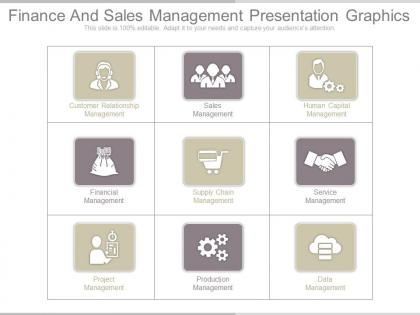
Enrich your presentation with specific business marketing fundamentals which top the priority list for a successful establishment. Expand your knowledge and set your goals straight only with our multifaceted Finance And Sales Presentation Graphics. The Management PowerPoint Templates can be used in an open ended manner to talk about sales management, customer relationship management and service management which are instrumental in building illustrious business standing in the market. Wherever you want to intimate your colleagues and team about complex financial and human capital fundamentals as well as their management; our pre designed set of versatile templates will assist in easy accomplishment of your task. The finance and sales PPT presentation model is a fine product of intense hard work and toil of our experts. So, the prolific and experimental icons on business money matters fail no chance to find uses in financial, commercial, economical, accounting, revenue or any other PPT slide show. Don’t miss out on a chance to add shine and sheen to your presentation with our utterly remarkable graphics. Devote energy to core aspects with our Finance And Sales Management Presentation Graphics. They help focus on crucial elements.
People who downloaded this PowerPoint presentation also viewed the following :
Finance and sales management presentation graphics with all 7 slides:
Draw bigger applause with our Finance And Sales Management Presentation Graphics. They will definitely add to your glory.





FAQs for Finance and sales
Focus on revenue growth, gross margin, and your CAC vs CLV - that ratio's honestly the best indicator of whether you're screwed or not. Track how long your sales cycle is and conversion rates too since those mess with your cash flow timing. Revenue per rep shows if your team's actually productive. Don't get bogged down in fancy ratios unless finance bugs you about them (they probably will). Just throw these into a simple dashboard you check monthly. Oh and sales cycle length is weirdly overlooked but super important. You'll catch issues way earlier this way.
Honestly, most people barely scratch the surface with their sales data and it shows. Dig into your historical revenue trends and seasonal patterns - that's where the real insights are hiding. Payment cycles matter too. Your conversion rates by deal size? Cross-reference those with your pipeline sources. Customer lifetime value versus acquisition costs will show you which segments actually make sense to chase (spoiler: probably not all of them). The whole point is basing forecasts on actual financial metrics instead of just hoping things work out. Trust me, gut feelings don't pay the bills.
Honestly, budgeting is a game changer for sales teams. Your reps get clear targets to hit, and you can actually see which channels are worth the money. No more throwing cash at random trade shows that bring in zero leads - learned that one the hard way! It forces everyone to be smarter about their approach too. When people know the budget constraints upfront, they don't just wing it anymore. I'd suggest doing quarterly check-ins with your managers. Keeps everyone honest and you can course-correct when something's clearly not working. Way better than flying blind all year.
Honestly, economic stuff controls everything about how you price and sell. High inflation? Push value instead of "cheap deals." Recession hitting? Focus on what people actually need and maybe offer payment plans or whatever. Currency changes will screw you over internationally - trust me on that one. Big purchases slow down when interest rates spike, so timing matters way more than people think. You've gotta watch local economic trends constantly. Having backup strategies ready to go is clutch because things shift fast and you don't want to get caught scrambling.
Honestly? Just focus on revenue growth, customer acquisition cost, and lifetime value first. Those are what your boss actually gives a shit about. Conversion rates matter too since they help predict your pipeline - finance will bug you about forecasting anyway. Track average deal size and sales cycle length while you're at it. The LTV to CAC ratio is like your north star metric though - shoot for 3:1 minimum. Here's the thing: don't try tracking everything at once. Pick two metrics this quarter and become obsessed with moving them. Way better than drowning in data you'll never use.
Think of financial data as your sales roadmap - it shows you exactly where to put your energy. I'd start pulling your top 3 metrics weekly and look for stuff that goes against what you think you know (honestly, that's where the gold is). Customer profitability tells you which prospects to chase harder. Conversion rates by channel? That's how you stop wasting marketing dollars. You can spot seasonal trends to plan your pipeline better, and win/loss ratios help you figure out the sweet spot for deal sizes. Revenue per segment shows which markets need more attention.
Honestly, just get your sales and finance people in the same room more often. Monthly pipeline reviews work great - both teams can actually see what's coming and spot problems before they blow up. Weekly 15-minute check-ins between the department heads help too. Set up shared dashboards so nobody's arguing over whose numbers are right (you know how that goes). Your CRM should feed directly into financial systems - saves so much manual work. Oh, and teach your sales team basic stuff like margins and cash flow impact. They'll make way better decisions once they get how their deals actually affect the business.
Look, cash flow basically controls everything you can actually do on the sales side. Tight cash means you're putting off new hires, slashing marketing budgets, or desperately offering longer payment terms just to close deals. You'll also get way more conservative with inventory and commission plans. I swear, half the sales teams I know get completely caught off guard when cash gets tight mid-quarter - it's brutal to watch. The trick is factoring cash flow into your sales planning right from the start. Otherwise you're just crossing your fingers and hoping the math works out.
Honestly, I'd start with whatever you're already using - don't overthink it. Salesforce and HubSpot both have budget tracking that connects to your pipeline data, which is pretty handy. But real talk? Sometimes a good old Excel sheet or Google Sheets setup works just as well, maybe even better for smaller teams. If you want to get fancy with the visuals later, Tableau and Power BI are solid for seeing patterns. QuickBooks handles the expense side if you need that accounting piece. My buddy's team tried switching everything at once and it was a mess - way better to build on what's working first.
Honestly, knowing your cost of sales is a game changer for pricing stuff right instead of just winging it. You'll figure out which products are actually making money and which ones are quietly draining your bank account - I've seen this mess up so many businesses. Once you know what things truly cost to deliver, setting margins becomes way easier. You can negotiate with confidence because you know exactly where your break-even point sits. Oh, and you might find ways to cut costs without touching your prices at all. Seriously, calculate this for each product line ASAP.
Honestly, start with cleaning your CRM data - that's gonna give you the biggest bang for your buck right away. Your forecasts are only as good as the info going in. Switch to weekly forecasting instead of monthly so you can actually catch changes before they bite you. And please, for the love of all that's holy, stop letting your reps throw every deal into "negotiating" - set up proper pipeline stages with real exit criteria. Oh, and make them assign probability percentages based on what buyers are actually doing, not what they're hoping will happen. Trust me on this one.
Your credit policies basically control who you can sell to and how. Tight requirements? You'll lose deals when customers can't qualify, but at least you won't be chasing down bad debt later. Go too loose and your sales team will love you - until finance starts freaking out about collections. Honestly, the trick is finding that middle ground where your terms actually help close business without screwing up cash flow. I'd work with your credit people to build in some wiggle room. That way you can stay competitive but not totally expose the company, you know?
Look, financial risk management is basically your backup plan for when shit hits the fan with sales. Check your customers' credit first - some will definitely flake on payments. Market changes can mess with demand too, plus currency stuff if you're going international. I learned this the hard way when a big client bailed and wrecked our whole quarter. Build some padding into your forecasts. Don't be overly optimistic with targets. Dig through your old data for patterns - like which customers always pay late or when sales typically drop. That's your starting point right there.
Don't just reward the final sale - that's where most companies screw up. Tie your commissions to the actual behaviors that matter: qualifying leads, closing within deadlines, upselling current clients. Build tiers so reps earn more as they hit specific milestones. Track the stuff that predicts success, not just the end results. I've watched too many sales teams fall apart because nobody knew what actions actually paid off. Make it super clear what gets rewarded, then pay fast when they deliver. Oh, and don't overcomplicate it - simple beats clever every time.
Yeah, so market volatility basically screws with your forecasting big time. Customers start acting weird - delaying purchases, changing budgets, you know how it is. Your revenue projections go out the window and suddenly you can't plan anything properly. Hiring? Investment decisions? Good luck with that. I learned this the hard way last quarter, honestly. What works is padding your forecasts more and running different scenarios - like best case, worst case, and what'll probably actually happen. That way you're not completely blindsided when reality hits different than your spreadsheet predicted.
-
Wonderful templates design to use in business meetings.
-
Excellent products for quick understanding.