


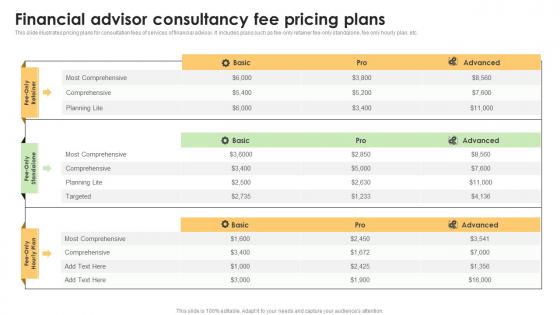
Financial Advisor Consultancy Fee Pricing Plans




Try Before you Buy Download Free Sample Product
 Impress Your
 Audience
 100%
100% Editable
 Save Hours
 of Time


This slide illustrates pricing plans for consultation fees of services of financial advisor. It includes plans such as fee only retainer fee only standalone, fee only hourly plan, etc.
People who downloaded this PowerPoint presentation also viewed the following :
Financial Advisor Consultancy Fee Pricing Plans with all 6 slides:
Use our Financial Advisor Consultancy Fee Pricing Plans to effectively help you save your valuable time. They are readymade to fit into any presentation structure.





FAQs for Financial Advisor Consultancy
Financial advisors typically employ asset-based fees (0.5-2% annually), hourly rates ($150-400), flat fees for specific services, commission-based compensation from product sales, and retainer arrangements for ongoing advisory relationships. These structures enable advisors to serve diverse client needs while providing scalable service models, with many firms increasingly combining multiple approaches to deliver comprehensive financial guidance and optimize client outcomes across different wealth levels.
Fee-only financial advisors charge transparent fees directly to clients through hourly rates, flat fees, or asset percentages, while commission-based advisors earn money from selling financial products like insurance or investment funds. This structure enables fee-only advisors to provide unbiased recommendations without product sales incentives, ultimately delivering more objective financial guidance and clearer cost transparency for clients.
Several factors influence financial advisory service costs, including assets under management, service complexity, advisor credentials, geographic location, and fee structure type. Investment portfolios requiring active management, comprehensive financial planning, or specialized expertise typically command higher fees, with many clients finding that experienced advisors in major metropolitan areas deliver greater long-term value despite premium pricing.
Yes, potential hidden expenses include transaction fees, fund expense ratios, account maintenance charges, advisory platform costs, and third-party custodial fees that aren't always clearly disclosed upfront. While transparent advisors provide comprehensive fee schedules, clients should specifically inquire about all costs beyond the stated advisory fee, with many finding that understanding total expense structures ultimately delivers better value assessment and informed decision-making.
Clients can effectively evaluate advisor value by comparing fee structures against delivered services, portfolio performance, financial planning comprehensiveness, and accessibility for guidance. Through detailed fee breakdowns, performance benchmarking against market indices, and assessing personalized strategies like tax optimization and retirement planning, clients ensure they receive strategic value, with many finding that transparent, outcome-focused advisors ultimately deliver measurable financial growth and peace of mind.
Financial advisory fees for assets under management typically range from 0.5% to 2% annually, with most advisors charging between 1% to 1.5% depending on portfolio size, service complexity, and client requirements. These fee structures often decrease as assets increase, with high-net-worth clients and institutional investors frequently negotiating lower percentages, ultimately enabling advisors to maintain competitive pricing while delivering comprehensive wealth management services.
Flat fee structures charge a predetermined amount for specific services regardless of portfolio size or transaction volume, typically ranging from annual retainer fees to project-based pricing for financial planning or investment management. These arrangements particularly benefit high-net-worth clients with substantial assets, those seeking comprehensive financial planning without ongoing percentage fees, and investors who prefer cost predictability, ultimately delivering transparent pricing and potentially significant savings compared to traditional asset-based fee models.
Clients should ask about the advisor's compensation model, whether fees are asset-based or flat-rate, what services are included, potential conflicts of interest, and any additional charges for specific transactions or consultations. These inquiries help establish transparency in the advisor-client relationship, enabling individuals to compare different advisory services effectively and make informed decisions, while ensuring they understand the total cost structure before committing to long-term financial planning partnerships.
Clients can negotiate financial advisor fees by researching market rates, demonstrating their account value, requesting fee breakdowns, and exploring alternative fee structures like flat fees or hourly arrangements. Many investors find success by bundling services, committing to longer-term relationships, or leveraging competitive quotes, while ensuring advisors maintain their fiduciary responsibilities and comprehensive planning expertise.
Performance-based fees serve as incentive-driven compensation tied directly to portfolio returns, investment gains, and client wealth growth, complementing traditional asset-based fees and commissions. These arrangements align advisor interests with client outcomes, with many wealth management firms and independent advisors finding that performance-linked compensation enhances client trust, retention, and ultimately delivers stronger long-term financial results.
Financial complexity significantly impacts advisory fees through increased time requirements, specialized expertise needs, and comprehensive service delivery across multiple financial areas. Clients with diverse investment portfolios, business ownership, estate planning needs, and tax considerations typically require more intensive analysis and ongoing management, with many advisors finding that complex situations justify premium pricing while delivering enhanced strategic value and coordinated financial outcomes.
Hourly fees offer cost control and payment flexibility for specific services, while retainer models provide ongoing comprehensive planning, predictable costs, and deeper advisor relationships. Hourly arrangements work well for project-based needs like retirement planning or investment reviews, whereas retainer fees enable continuous portfolio management and strategic financial guidance, with many clients finding that retainer models deliver greater long-term value and personalized service.
Regulatory considerations include fee disclosure requirements, fiduciary standards, registration obligations, conflict of interest rules, and compliance oversight by bodies like SEC and FINRA. These regulations enhance transparency and protect investors by ensuring advisors clearly communicate fee structures, potential conflicts, and investment approaches, with many clients finding that understanding these standards helps them evaluate advisor credibility and make more informed financial decisions.
Financial advisory fees for specialized services typically command premium rates, with estate planning ranging from $1,500-$5,000 per plan and tax advisory services charging $200-$500 hourly, compared to standard 1% asset management fees. These specialized areas require advanced certifications and expertise, with many advisors finding that clients willingly pay higher rates for complex planning services that deliver significant tax savings and wealth preservation strategies.
Robo-advisors, AI-powered portfolio management, automated rebalancing tools, digital financial planning platforms, and algorithm-driven investment strategies are revolutionizing advisory fee structures. These technologies streamline operations by reducing manual oversight, minimizing administrative costs, and enabling scalable service delivery, with many firms finding that automated solutions ultimately deliver lower client fees while maintaining competitive returns and enhanced accessibility.
-
Stunning collection! With a wide variety of options available, I was able to find a perfect slide for my presentation. Thank you, SlideTeam!
-
“I always have a wonderful experience with SlideTeam. It's my ""go to"" when I need a template.”