


Financial control process flow diagram




Try Before you Buy Download Free Sample Product
 Impress Your
 Audience
 100%
100% Editable
 Save Hours
 of Time


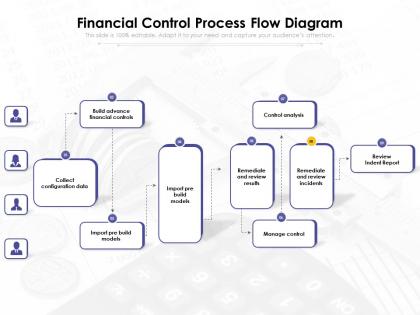
Our Financial Control Process Flow Diagram are topically designed to provide an attractive backdrop to any subject. Use them to look like a presentation pro.
People who downloaded this PowerPoint presentation also viewed the following :
Financial control process flow diagram with all 2 slides:
Use our Financial Control Process Flow Diagram to effectively help you save your valuable time. They are readymade to fit into any presentation structure.

FAQs for Financial control
Fundamental principles of financial control include budgeting and forecasting, internal auditing, segregation of duties, regular financial reporting, and variance analysis. These principles enable organizations to minimize financial risks, ensure regulatory compliance, and optimize resource allocation, with many companies finding that robust financial controls ultimately deliver enhanced operational efficiency, investor confidence, and sustainable competitive advantage.
Effective financial control prevents fraud and mismanagement through segregation of duties, regular audits, authorization protocols, real-time monitoring systems, and comprehensive documentation requirements. These mechanisms enable organizations to detect anomalies quickly, restrict unauthorized access to funds, and maintain transparent financial oversight, with many businesses finding that robust controls significantly reduce losses while enhancing stakeholder confidence and operational integrity.
Budgeting serves as the foundation for financial control by establishing spending limits, forecasting cash flows, tracking performance against targets, and enabling proactive resource allocation decisions. Through systematic budget monitoring, organizations streamline expense management, enhance operational transparency, and identify cost-saving opportunities early, with many companies finding that disciplined budgeting ultimately delivers improved profitability and strategic competitive advantage.
Technology and financial software enhance financial control processes by automating transaction monitoring, streamlining budget tracking, and providing real-time visibility into cash flows and expenditures. These solutions enable organizations to minimize manual errors, accelerate reconciliation procedures, and deliver comprehensive reporting dashboards, with many financial institutions and corporations finding that automated controls ultimately reduce operational costs while improving compliance accuracy.
Key performance indicators for robust financial control include cash flow ratios, budget variance analysis, accounts receivable turnover, debt-to-equity ratios, and gross profit margins. These KPIs enable organizations to streamline operations, enhance decision-making, and minimize financial risks, with many businesses finding that consistent monitoring ultimately delivers improved profitability and sustainable growth.
Small businesses can implement financial control measures through automated accounting software, monthly budget reviews, cash flow forecasting, expense categorization, and regular financial statement analysis. These cost-effective approaches streamline financial oversight by reducing manual errors, improving spending visibility, and enabling faster decision-making, with many small enterprises finding that consistent financial monitoring ultimately delivers better resource allocation and sustainable growth.
Common pitfalls include over-complicating processes, inadequate staff training, poor system integration, inconsistent policy enforcement, and insufficient real-time monitoring capabilities. Many organizations find that these challenges ultimately compromise accuracy and efficiency, with financial services and manufacturing companies increasingly streamlining controls through automated workflows, standardized procedures, and comprehensive training programs to enhance operational transparency.
Financial control in non-profits emphasizes compliance, donor stewardship, and mission alignment, while for-profit businesses focus on profitability, shareholder returns, and market performance. Non-profit organizations prioritize transparent fund allocation and regulatory compliance, whereas businesses streamline cost management and revenue optimization, with both ultimately delivering accountability and sustainable operations in their respective sectors.
Financial reporting enhances financial control effectiveness by providing real-time visibility into cash flows, budget variances, and performance metrics, enabling proactive decision-making and risk mitigation. Through automated dashboards and comprehensive analytics, organizations streamline compliance monitoring, accelerate variance identification, and strengthen accountability across departments, ultimately delivering improved resource allocation and stronger financial governance in increasingly complex business environments.
Financial control provides the data foundation and risk parameters that inform strategic decision-making, enabling leaders to evaluate opportunities, allocate resources effectively, and measure performance against objectives. Through robust financial monitoring and analysis, organizations can pivot strategies based on real-time insights, optimize capital deployment, and maintain competitive advantage, ultimately delivering sustainable growth and shareholder value.
Employee training and awareness enhance financial control by establishing consistent procedures, reducing human error, and fostering accountability across all organizational levels. Through comprehensive education on compliance requirements and best practices, teams develop stronger oversight capabilities, enabling faster detection of discrepancies, improved budget adherence, and ultimately more robust financial governance systems.
Poor financial control creates cash flow problems, limits investment capacity, reduces stakeholder confidence, and exposes businesses to regulatory risks and operational inefficiencies. These challenges ultimately restrict growth opportunities, compromise competitive positioning, and threaten long-term sustainability, with many organizations finding that inadequate financial oversight leads to missed market opportunities and diminished investor trust.
Organizations can assess their financial control effectiveness through regular internal audits, variance analysis comparing actual versus budgeted performance, compliance testing, and key performance indicator monitoring. Many companies implement quarterly control assessments and independent reviews, enabling them to identify weaknesses, streamline processes, and enhance accuracy, ultimately delivering improved financial transparency and reduced operational risk.
Internal auditing strengthens financial control by conducting independent assessments of financial processes, identifying compliance gaps, evaluating risk management systems, and ensuring adherence to regulatory standards. These systematic reviews enable organizations to detect fraud, streamline operations, and enhance accountability, with many financial institutions and corporations finding that regular internal audits ultimately deliver improved transparency and operational efficiency.
Economic downturns significantly impact financial control practices by requiring stricter cash flow monitoring, enhanced risk assessment protocols, and more frequent budget revisions. Organizations typically respond by implementing tighter expense controls, accelerating accounts receivable processes, and strengthening scenario planning capabilities, with many finding that these enhanced practices ultimately deliver greater operational resilience and competitive advantage.
-
Great designs, really helpful.
-
Qualitative and comprehensive slides.
-
Much better than the original! Thanks for the quick turnaround.