


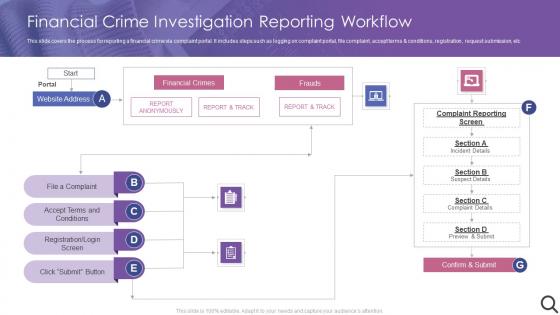
Financial Crime Investigation Reporting Workflow




Try Before you Buy Download Free Sample Product
 Impress Your
 Audience
 100%
100% Editable
 Save Hours
 of Time


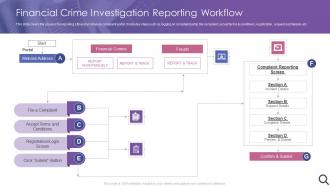
This slide covers the process for reporting a financial crime via complaint portal. It includes steps such as logging on complaint portal, file complaint, accept terms and conditions, registration, request submission, etc.
People who downloaded this PowerPoint presentation also viewed the following :
Financial Crime Investigation Reporting Workflow with all 6 slides:
Use our Financial Crime Investigation Reporting Workflow to effectively help you save your valuable time. They are readymade to fit into any presentation structure.





FAQs for Financial Crime
Financial crime workflows typically include detection and monitoring, investigation and analysis, case management and documentation, regulatory reporting, and resolution and remediation. These stages work together by automating suspicious activity identification, streamlining investigation processes, and ensuring compliance documentation, with many financial institutions finding that integrated workflows reduce investigation times while enhancing regulatory compliance and risk management capabilities.
Organizations identify potential financial crime risks through comprehensive risk assessments, transaction monitoring systems, customer due diligence protocols, employee background checks, and regulatory compliance audits. These approaches work together by analyzing transaction patterns, screening against watchlists, and monitoring unusual activities, with many financial institutions finding that combining automated detection tools with human expertise ultimately delivers enhanced fraud prevention and regulatory compliance.
Data analytics enhances financial crime detection workflows by identifying suspicious patterns, automating risk scoring, correlating transactions across multiple channels, and reducing false positives through machine learning algorithms. These capabilities enable financial institutions to process vast transaction volumes more efficiently, detect sophisticated fraud schemes in real-time, and ultimately deliver faster threat responses while minimizing operational costs.
AI and machine learning enhance financial crime investigations by automating pattern recognition, analyzing vast transaction datasets in real-time, and identifying suspicious behaviors that traditional methods might miss. These technologies streamline case prioritization, reduce false positives, and accelerate evidence gathering, with banks and financial institutions finding significantly faster investigation timelines and improved detection accuracy.
Critical indicators include unusual transaction patterns, rapid fund movements, transactions involving high-risk jurisdictions, inconsistent customer behavior, and structuring activities just below reporting thresholds. These red flags enable financial institutions to streamline fraud detection, enhance compliance monitoring, and accelerate investigation processes, with many banks finding that automated monitoring systems ultimately deliver faster threat identification and stronger regulatory protection.
Regulatory requirements fundamentally determine financial crime workflows through mandated compliance frameworks, reporting timelines, investigation procedures, and documentation standards that vary significantly across jurisdictions. While European GDPR emphasizes data protection alongside AML compliance, US regulations prioritize suspicious activity reporting, with Asian markets increasingly adopting hybrid approaches, ultimately requiring financial institutions to maintain flexible, multi-jurisdictional compliance systems.
Financial institutions can establish information-sharing consortiums, participate in regulatory reporting networks, utilize secure threat intelligence platforms, engage in cross-border partnerships, and collaborate with law enforcement agencies. These collaborative measures enhance fraud detection capabilities, accelerate suspicious activity identification, and strengthen regulatory compliance, with many banks finding that shared intelligence significantly reduces false positives while improving overall financial crime prevention.
Financial crime investigation documentation should include detailed case timelines, evidence preservation protocols, witness interview records, analytical findings, and regulatory compliance checklists. These practices streamline investigations by ensuring audit trails, maintaining legal admissibility standards, and facilitating cross-team collaboration, with many financial institutions finding that comprehensive documentation ultimately reduces case resolution times and enhances regulatory reporting accuracy.
Employee training significantly enhances financial crime workflow effectiveness by improving detection accuracy, reducing false positives, and ensuring regulatory compliance across all operational levels. Well-trained staff can identify suspicious patterns more efficiently, respond to alerts faster, and make informed decisions during investigations, with many financial institutions finding that comprehensive training programs reduce compliance costs while strengthening their overall risk management capabilities.
Integrating multiple systems in financial crime workflows presents challenges including data silos, inconsistent formats, regulatory compliance complexities, real-time synchronization requirements, and legacy system limitations. These integration hurdles can delay investigations, create compliance gaps, and increase operational costs, with many financial institutions finding that strategic middleware solutions and APIs help streamline connectivity while maintaining security standards.
Case management systems streamline financial crime investigations by centralizing case data, automating workflow routing, and providing real-time collaboration tools for investigators. These platforms enable banks and financial institutions to track suspicious activities more efficiently, reduce investigation timelines by up to 40%, and ensure regulatory compliance, ultimately delivering faster case resolution and enhanced fraud detection capabilities.
Customer due diligence serves as the foundational defense against financial crime by verifying customer identities, assessing risk profiles, monitoring transaction patterns, and ensuring ongoing compliance with regulatory requirements. Through enhanced screening processes, banks and financial institutions can detect suspicious activities, prevent money laundering, and minimize fraud exposure, ultimately delivering stronger security and regulatory compliance in an increasingly complex financial landscape.
Organizations can evaluate financial crime workflow effectiveness through key performance indicators like detection rates, false positive ratios, investigation resolution times, regulatory compliance scores, and cost per case processed. By benchmarking these metrics against industry standards and conducting regular audits, financial institutions can identify bottlenecks, streamline processes, and enhance their overall risk management capabilities while reducing operational costs.
Emerging trends include AI-powered fraud schemes, cryptocurrency money laundering, synthetic identity theft, real-time payment fraud, and deepfake-enabled social engineering attacks. These evolving threats are driving financial institutions to adopt advanced machine learning detection systems, blockchain analytics, and biometric verification technologies, ultimately delivering faster threat response and enhanced customer protection in an increasingly complex digital landscape.
Organizations can adapt their financial crime workflows by implementing real-time monitoring systems, advanced analytics platforms, machine learning algorithms, automated alert prioritization, and cross-channel transaction tracking. These technologies enhance detection capabilities by identifying suspicious patterns, reducing false positives, and accelerating investigation timelines, with many financial institutions finding that adaptive workflows deliver faster threat response and improved regulatory compliance in an increasingly sophisticated criminal landscape.
-
Their products can save your time, effort and money. What else you need. All in one package for presentation needs!
-
“I've always gotten excellent slides from them and the customer service is up to the mark.”