

Financial Health Checklist For Small Business




Try Before you Buy Download Free Sample Product
 Impress Your
 Audience
 100%
100% Editable
 Save Hours
 of Time


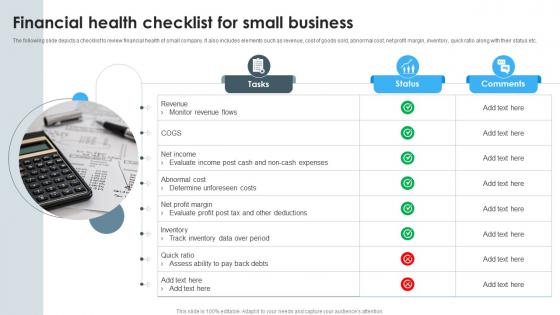
The following slide depicts a checklist to review financial health of small company.It also includes elements such as revenue, cost of goods sold, abnormal cost, net profit margin, inventory, quick ratio along with their status etc.
People who downloaded this PowerPoint presentation also viewed the following :
Financial Health Checklist For Small Business with all 6 slides:
Use our Financial Health Checklist For Small Business to effectively help you save your valuable time. They are readymade to fit into any presentation structure.





FAQs for Financial Health Checklist
Okay so first things first - get that emergency fund sorted (3-6 months of expenses). Then look at your debt-to-income ratio - you want it under 36% if possible. Are you saving at least 10-20% consistently? That's huge. Don't sleep on checking your credit score and tracking how your net worth grows over time. Maxing out retirement contributions is clutch too. Oh and insurance - I always forget about that one but it'll save your butt when life happens. Honestly, I'd just pick whatever feels most broken right now and tackle that first. Review everything monthly so nothing sneaks up on you.
Okay so you just add up all your monthly debt payments - credit cards, car loans, mortgage, whatever - then divide that by your gross monthly income. Multiply by 100 and boom, there's your percentage. Like if you're paying $2,000 in debts and making $6,000, that's 33%. Most people get a reality check when they finally crunch these numbers! You want to stay under 36% total, with housing being max 28%. I actually throw mine in a spreadsheet now since things change more than you'd think. Worth checking every few months or so.
You definitely need an emergency fund - it's like having a buffer between you and total financial chaos. Car breaks down? Medical bill? Boom, you're covered instead of maxing out credit cards. I found this out the hard way when my transmission died (ugh, worst timing ever). Most people say 3-6 months of expenses, but honestly? Start with whatever you can. Even $500 helps with smaller stuff and gets you into the saving groove. The mental relief is huge once you've got that cushion sitting there. Trust me, future you will thank present you for starting now.
Every three months works best for me. Monthly is way too much unless you're going through something major, but yearly? Too much stuff changes and you lose track. I tried the annual thing before and it was useless - by the time I checked, half my goals were already off track. Quarterly gives your income, debt payments, and expenses time to actually shift without letting everything slide. The real trick is picking the same date each quarter and sticking to it. Maybe when you're already doing other money stuff anyway. Honestly just set that calendar reminder right now or you'll definitely forget like I always do.
Watch out for crazy high debt compared to what you're making - that'll kill you. Also if you've got zero emergency money saved up, that's scary territory. Don't let your spending creep up just because you're earning more (guilty of this myself). Making only minimum credit card payments? Red flag. Same with randomly buying stocks without any real plan - I've done that too and it never ends well. Get decent insurance or one hospital visit could destroy everything you've built. Honestly, just be real about where your money actually goes versus where you think it should go. Check this stuff monthly so small problems don't become huge ones.
Honestly, budgeting apps are total lifesavers for tracking where your money actually goes. They automatically sort your expenses and show you real-time updates. I can't tell you how many times mine has saved me from going overboard on random stuff - like that month I almost spent $200 on DoorDash without realizing it. You'll get alerts before hitting your limits too. The coolest thing is connecting all your accounts so you can see everything at once. YNAB and Mint are solid free options to start with. Just link your main checking account first and go from there.
Start with the obvious stuff - checking and savings accounts, money markets. Those show what you can actually spend right now. After that, track your 401k, IRAs, brokerage accounts. Home equity matters too if you own. Oh, and don't be like me forgetting about random accounts - that HSA you never check, the 401k from your old job that's probably worth more than you think. Cars count as assets even though they're depreciating. I'd update everything quarterly so you can see if you're actually getting anywhere financially instead of just hoping.
Dude, your credit score is basically like a report card for your finances. Banks look at it to decide if they'll lend you money and what interest rate to charge. Good score (700+) = cheaper loans. Bad score = everything costs more and you might get rejected for apartments or even some jobs, which is kinda ridiculous if you ask me. The crazy part is how much money it can save you over time - we're talking thousands in interest. Just pay your bills on time and check it once in a while. That payment history thing alone makes up like 35% of the whole score.
Honestly? Emergency fund comes first - like 3-6 months of expenses. I know it's not sexy but trust me on this one. Once you've got that cushion (or even just $1k to start), tackle any high-interest debt since you're basically hemorrhaging money there. Then grab that employer 401k match if you have one - it's free money. After those boxes are checked, you can think about fun stuff like house down payments or that Europe trip. My sister learned this the hard way when her car died and she had zero savings. Don't be my sister.
Honestly, retirement stuff is way more straightforward than people make it seem. First thing - grab that employer match if you've got one, because who doesn't want free money? Then figure out if you're saving around 10-15% of what you make. Look at your investment mix too - should match your age and how much risk freaks you out. Quick reality check: calculate where you'll actually be when you retire with your current setup. Might be scary, might be fine. Either way, you'll know what needs tweaking from there.
Honestly, don't just randomly read finance stuff online - you'll get overwhelmed. Pick one solid book first, like "The Total Money Makeover" or "Your Money or Your Life." Download a budgeting app too (trust me, seeing where your cash actually goes is wild). Your bank probably has free workshops that are way better than you'd expect. Grab a financial podcast for your commute or whatever. But here's the thing - actually try this stuff out, even with like $20. Reading about investing without doing it is pretty useless. Oh, and maybe skip the finance influencers on social media for now.
Dude, apps can basically handle most of this stuff for you now. I've got mine set to track spending across all my accounts and it'll actually yell at me when I'm about to blow my budget lol. Some of them get pretty smart too - they'll look at where your money goes and be like "hey maybe stop buying so much coffee." Your bank app can move money to savings automatically, investment stuff rebalances itself. The trick is connecting everything so you're not logging into five different places. Honestly just start with one budgeting app, link your main accounts, and you'll be shocked how much easier it gets.
Honestly, a financial advisor is pretty clutch because they'll catch stuff you're totally blind to. Like, I thought I was doing fine until mine pointed out some gaps I hadn't even considered. They customize everything based on your actual situation - not some generic internet checklist that doesn't fit anyone's real life. Plus having someone who'll call you out when you're slacking? Game changer. They benchmark your progress against realistic goals too, which beats comparing yourself to some influencer's highlight reel. Even just one session can set you up right before you start tracking solo.
So lifestyle inflation is sneaky - it basically steals your raises before you even realize it. You get more money, then suddenly you're upgrading everything. Better apartment, nicer car, eating out more. I mean, who doesn't want good stuff when they can finally afford it? But here's the thing - your expenses just keep pace with your income. You're still broke, just with fancier broke stuff. What works is setting up automatic savings first when you get that raise. Then blow some of the rest on whatever makes you happy.
Think of insurance as your backup plan when life gets messy. One hospital visit or car wreck can totally drain your savings - I've watched it happen to people who thought they were fine without coverage. Health, auto, and disability are the must-haves that'll save your butt financially. Life insurance protects your family if the worst happens. You want enough coverage to actually matter, but don't go crazy with premiums that'll stress your budget every month. It's honestly one of those boring adult things that's worth figuring out early.
-
SlideTeam’s pool of 2Million+ PPTs has really benefited my team, everyone from the IT department to HR. We are lucky to have crossed ways with them.
-
SlideTeam just saved my project! Thank you so much. The variety of templates helped me showcase multiple perspectives easily.