


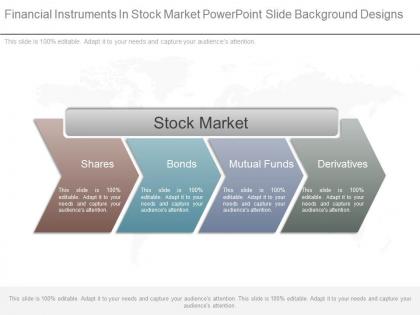
Financial instruments in stock market powerpoint slide background designs




Try Before you Buy Download Free Sample Product
 Impress Your
 Audience
 100%
100% Editable
 Save Hours
 of Time


Give your creative genes a go with our Financial Instruments In Stock Market Powerpoint Slide Background Designs. Generate ideas that are astoundingly exquisite.
People who downloaded this PowerPoint presentation also viewed the following :
Financial instruments in stock market powerpoint slide background designs with all 7 slides:
Head in the desired direction with our Financial Instruments In Stock Market Powerpoint Slide Background Designs. Focus your eyes on the goal.






FAQs for Financial instruments in stock market powerpoint
Primary financial instruments traded in stock markets include equities, bonds, derivatives like options and futures, exchange-traded funds, and mutual funds. These instruments enable investors to diversify portfolios, hedge risks, and access various market sectors, with many institutional and retail investors finding that strategic combinations deliver enhanced returns while managing exposure across different asset classes and market conditions.
Equities offer higher potential returns but greater volatility, with returns tied to company performance and market conditions, while fixed-income instruments provide more predictable, steady income through interest payments but typically deliver lower returns. Many institutional investors balance portfolios with both instruments, finding that equities drive growth during favorable market cycles, while bonds enhance stability and preserve capital, ultimately delivering diversified risk management and optimized long-term performance.
Derivatives serve as financial contracts that derive value from underlying stocks, enabling investors to hedge against price volatility, speculate on market movements, and enhance portfolio diversification through options, futures, and swaps. These instruments allow institutional investors and corporations to minimize risk exposure by locking in prices or creating protective positions, with many financial institutions finding that strategic derivative usage ultimately delivers improved risk management and competitive advantage in volatile markets.
Mutual funds offer diversification, professional management, and lower entry barriers, while individual stocks provide direct ownership, higher growth potential, and greater control over investment decisions. While mutual funds reduce risk through portfolio spreading and expert oversight, they also involve management fees and limited customization, whereas individual stocks enable targeted investing and cost efficiency but require more research and carry concentrated risk, with many investors finding that strategic combinations of both approaches optimize returns while managing exposure.
ETFs diversify portfolios by pooling investor funds to purchase hundreds or thousands of securities across different sectors, geographic regions, and asset classes within a single investment vehicle. Through this strategic combination, investors gain exposure to broad market segments, international markets, and various industries like technology, healthcare, and energy, while minimizing individual stock risk and enhancing long-term growth potential.
Market capitalization represents a company's total market value, serving as a fundamental metric for evaluating stock investments, risk profiles, and growth potential across different company sizes. It enables investors to assess investment strategies, portfolio diversification opportunities, and expected returns, with many financial institutions finding that market cap analysis streamlines asset allocation decisions and enhances risk management across large-cap stability and small-cap growth opportunities.
Interest rates significantly impact financial instrument valuations by affecting discount rates for future cash flows, borrowing costs, and investment attractiveness across sectors. When rates rise, bond prices decline while dividend-paying stocks face pressure, though financial institutions like banks often benefit from wider lending margins, while lower rates typically boost growth stocks and real estate investment trusts, ultimately reshaping portfolio allocations.
Primary markets involve new financial instrument issuances directly from companies to investors through IPOs, bond offerings, and rights issues, while secondary markets facilitate trading of existing securities between investors through stock exchanges and OTC platforms. These markets work together to enhance capital formation, provide liquidity, and enable price discovery, with many institutions finding that this dual structure ultimately delivers efficient resource allocation and broader investment opportunities.
Liquidity significantly impacts trading by enabling faster transactions, reducing bid-ask spreads, and minimizing price volatility during large trades. High liquidity instruments like blue-chip stocks and major ETFs allow institutional investors to execute substantial orders without dramatically affecting market prices, while low liquidity securities may experience sharp price swings, ultimately delivering more efficient price discovery and lower transaction costs for all market participants.
Market volatility significantly impacts stock options and futures contracts by increasing premiums, amplifying potential gains and losses, and creating higher margin requirements. During volatile periods, options traders experience enhanced time decay and pricing fluctuations, while futures traders face margin calls and liquidation risks, ultimately requiring more sophisticated risk management strategies and capital reserves for successful trading.
Regulatory changes significantly impact financial instruments through altered compliance requirements, modified risk assessments, and updated reporting standards, directly affecting market liquidity and pricing mechanisms. These modifications can reshape trading volumes, influence investor confidence, and require institutions to adjust their valuation models, with many financial services firms finding that proactive regulatory adaptation ultimately delivers competitive advantages and enhanced market positioning.
**INPUT**: What metrics are commonly used to analyze the performance of financial instruments? **OUTPUT**: Performance analysis metrics include return on investment, volatility measures, price-to-earnings ratios, dividend yields, and risk-adjusted returns like Sharpe ratios. These indicators enable investors to evaluate profitability, assess market risk, and compare opportunities across sectors, with many financial institutions finding that combining multiple metrics delivers more comprehensive investment insights.
Technical analysis helps investors make informed trading decisions by examining price patterns, chart formations, volume trends, and key indicators like moving averages and RSI. Through these analytical tools, traders can identify optimal entry and exit points, assess market momentum, and manage risk more effectively, with many finding that combining multiple technical indicators ultimately enhances their trading accuracy and profitability.
**INPUT**: What are the risks associated with investing in international financial instruments? **OUTPUT**: International investing risks include currency fluctuations, political instability, regulatory differences, liquidity constraints, and varying accounting standards across markets. While these challenges present complexity, diversified portfolios increasingly benefit from global exposure, with many institutional investors finding that strategic international allocation enhances long-term returns and competitive positioning. **Word count: 50 words**
Behavioral finance concepts significantly influence investor decisions through cognitive biases, emotional responses, and herd mentality patterns that often override rational analysis. These psychological factors lead to phenomena like overconfidence in stock selection, loss aversion in bond trading, and momentum investing in derivatives, with many institutional investors now incorporating behavioral insights into their risk management strategies, ultimately delivering more balanced portfolio performance and enhanced decision-making frameworks.
-
It saves your time and decrease your efforts in half.
-
Design layout is very impressive.