


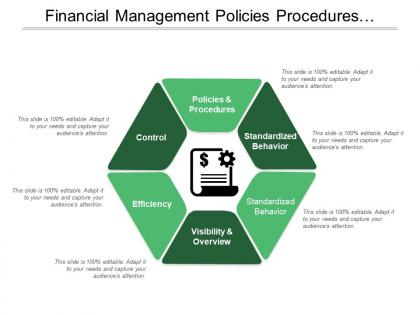
Financial management policies procedures standardized efficiency control




Try Before you Buy Download Free Sample Product
 Impress Your
 Audience
 100%
100% Editable
 Save Hours
 of Time


Create a jolly epidemic with our Financial Management Policies Procedures Standardized Efficiency Control. It ensures good humor is infectious.
People who downloaded this PowerPoint presentation also viewed the following :
Financial management policies procedures standardized efficiency control with all 5 slides:
Our Financial Management Policies Procedures Standardized Efficiency Control are an invaluable asset. You will get an incalculable boost.





FAQs for Financial management policies procedures
Key components include cash flow management, budgeting and forecasting, expense tracking, financial reporting, and strategic planning for growth. These elements work together by enabling small businesses to monitor liquidity, control costs, and make data-driven decisions, with many finding that integrated financial systems ultimately deliver improved profitability and sustainable competitive advantage.
Financial forecasting improves organizational decision-making by providing data-driven insights into future cash flows, revenue projections, and potential financial risks. Through predictive analytics and scenario planning, companies can optimize resource allocation, identify growth opportunities, and mitigate financial challenges, with many organizations finding that accurate forecasting ultimately delivers enhanced strategic planning and competitive advantage.
Budgeting serves as the foundation for strategic financial management by translating long-term goals into actionable plans, allocating resources effectively, and establishing performance benchmarks. Through systematic budget planning, organizations streamline decision-making processes, enhance operational efficiency, and maintain financial discipline, with many companies finding that strategic budgeting delivers improved cash flow management and competitive advantage.
Companies can assess their financial health using KPIs like liquidity ratios, profitability margins, debt-to-equity ratios, cash flow metrics, and return on investment measurements. These indicators enable organizations to identify operational inefficiencies, optimize resource allocation, and make strategic decisions, with many financial institutions and manufacturing companies finding that regular KPI monitoring ultimately delivers improved forecasting accuracy and competitive advantage.
Interest rates significantly impact financial management strategies by influencing borrowing costs, investment returns, capital allocation decisions, and cash flow timing. When rates rise, organizations typically prioritize debt reduction and short-term investments, while lower rates encourage expansion financing and long-term projects, with many financial managers finding that adaptive strategies ultimately deliver competitive advantage in changing economic environments.
Businesses can leverage technology for better financial management through automated bookkeeping, real-time analytics, cloud-based accounting systems, AI-driven forecasting, and integrated payment platforms. These solutions streamline operations by reducing manual errors, accelerating reporting cycles, and enhancing cash flow visibility, with many organizations finding that automated financial processes deliver significant cost savings and improved decision-making capabilities.
Common financial management pitfalls include inadequate cash flow forecasting, over-leveraging, poor budgeting practices, lack of financial controls, and insufficient emergency reserves. These challenges often stem from reactive rather than strategic planning, with many organizations finding that implementing robust financial oversight, regular performance reviews, and diversified funding strategies ultimately delivers greater operational stability and competitive advantage.
Cash flow management directly influences business sustainability by ensuring adequate liquidity for operations, enabling timely payments to suppliers and employees, and providing resources for growth opportunities. Effective cash flow monitoring helps businesses weather economic downturns, maintain creditworthiness, and make strategic investments, with many companies finding that proactive cash management ultimately delivers operational stability and long-term competitive advantage.
Financial analysis informs investment decisions by evaluating profitability ratios, cash flow patterns, debt-to-equity levels, market trends, and competitive positioning across potential opportunities. Through comprehensive financial modeling, investors can assess risk-return profiles, identify undervalued assets, and optimize portfolio allocation, with many institutional investors finding that systematic analysis ultimately delivers superior returns and minimizes downside exposure.
Financial management decisions create significant tax implications including depreciation methods, debt versus equity financing, timing of revenue recognition, inventory valuation methods, and capital expenditure strategies. These choices directly impact taxable income through interest deductions, asset write-offs, and cash flow timing, with many organizations finding that strategic financial structuring delivers substantial tax savings while enhancing operational efficiency.
Organizations effectively manage debt by maintaining optimal debt-to-equity ratios, diversifying funding sources, and aligning borrowing with revenue-generating investments. Strategic debt management enables companies to leverage growth opportunities while minimizing interest costs, with many businesses finding that refinancing during favorable market conditions and prioritizing high-return projects ultimately delivers sustainable expansion and improved cash flow.
Risk management is crucial in financial planning because it identifies, assesses, and mitigates potential threats to financial objectives, ensuring long-term stability and growth. Through diversification strategies, insurance coverage, and contingency planning, organizations streamline decision-making, minimize unexpected losses, and enhance investor confidence, with many financial institutions finding that proactive risk management ultimately delivers sustainable returns and competitive advantage in volatile markets.
Businesses can develop financial accountability culture through transparent budgeting processes, regular financial training programs, performance metrics tied to financial outcomes, and clear expense approval workflows. By implementing departmental budget ownership, cost-center reporting, and employee recognition programs for cost-saving initiatives, organizations ultimately enhance operational efficiency while empowering teams to make informed financial decisions.
**INPUT**: What strategies can help improve financial literacy within an organization? **OUTPUT**: Effective financial literacy strategies include comprehensive training programs, mentorship initiatives, interactive workshops, digital learning platforms, and regular financial performance reviews. These approaches enhance organizational decision-making by empowering employees with budgeting skills, cost awareness, and strategic financial thinking, with many companies finding that improved financial literacy ultimately delivers better resource allocation, increased profitability, and stronger competitive positioning. **Word count: 60 words**
External economic factors significantly reshape financial management priorities by altering risk assessments, capital allocation strategies, and operational planning approaches. During economic uncertainty, organizations typically prioritize cash flow management, debt restructuring, and conservative investment strategies, while growth periods enable expansion funding and strategic acquisitions, ultimately requiring adaptive financial frameworks that balance opportunity with stability.
-
Excellent work done on template design and graphics.
-
Qualitative and comprehensive slides.