


Financial Portfolio Expansion Exploring New Avenues For Growth Powerpoint Presentation Slides





Try Before you Buy Download Free Sample Product
 Impress Your
 Audience
 100%
100% Editable
 Save Hours
 of Time


Check out our professionally designed Financial Portfolio Expansion Exploring New Avenues for Growth PowerPoint. This Portfolio management PowerPoint guides you to understanding client goals and risk tolerance, which are essential for crafting a professionally tailored portfolio. Moreover, this Portfolio diversification presentation explores effective risk management strategies, providing insights to mitigate potential pitfalls and enhance overall portfolio resilience. Further, our presentation is a comprehensive toolkit for financial advisors, offering a step-by-step guide to portfolio expansion. Also, this Template navigates through insightful content on assessing investment opportunities and fine-tuning asset allocation for optimal returns. Lastly, this Diversified Investment module concludes with a clear and compelling final portfolio outlook, ensuring alignment with client expectations and market dynamics. Download our 100 percent editable and customizable Template, which is also compatible with Google Slides.
People who downloaded this PowerPoint presentation also viewed the following :
Content of this Powerpoint Presentation
Slide 1: The slide introduces Financial Portfolio Expansion: Exploring New Avenues for Growth. State your company name and begin.
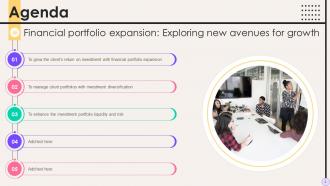
Slide 2: This is our Agenda slide. State your agenda here.
Slide 3: The slide displays Table of contents for the presentation.
Slide 4: The slide shows Table of contents further.
Slide 5: The slide presents information about various investment management company overviews.
Slide 6: The slide includes information about various investment services offered to customer for managing finances.
Slide 7: The slide provides information about company customer base.
Slide 8: The slide includes provides information about company client testimonials related to offered services.
Slide 9: The slide displays another Title of contents.
Slide 10: The slide provides information about business procedure for managing client for portfolio management.
Slide 11: The slide highlights Title of contents further.
Slide 12: The slide presents information about business client current investment portfolio split.
Slide 13: The slide includes information about key performance indicators to evaluation portfolio potential.
Slide 14: The slide highlights various challenges faced by businesses in investment portfolios.
Slide 15: The slide depicts Title of contents further.
Slide 16: The slide includes various solutions which can be adopted to manage challenges faced in a current portfolio.
Slide 17: The slide covers various reasons for selection of portfolio diversification as an option for managing client portfolios.
Slide 18: The slide contains Title of contents which is to be discussed further.
Slide 19: The slide outline steps taken by company to build customer diversified portfolio to increase customer portfolio performance and return on investment.
Slide 20: The slide also depicts Title of contents.
Slide 21: The slide demonstrates questionnaire that can be used to understand customer investment preference.
Slide 22: The slide includes various survey questionnaires that can be asked of customers to determine investment preferences.
Slide 23: The slide renders various investment options which can be combined and leverage for developing client diversified portfolio.
Slide 24: The slide provides information about various type of portfolio investment approaches that can be adopted by company to enhance portfolio.
Slide 25: The slide illustrates survey assessment results related to the client portfolio expansion questionnaire and options.
Slide 26: The slide also highlights survey assessment results related to client portfolio expansion questionnaire and options.
Slide 27: The slide contains Title of contents which is to be discussed further.
Slide 28: The slide provides information about various parameter for assessment and comparing different investment avenues.
Slide 29: The slide demonstrates comparative assessment of various investment options available for portfolio expansion.
Slide 30: The slide outlines various investment options such as stock, bonds, options, real estate, etc.
Slide 31: The slide describes a comparative assessment of investment options such as stock, bonds, options, real estate, etc.
Slide 32: The slide demonstrates another a comparative assessment of investment options such as stock, bonds, options, real estate, etc.
Slide 33: The slide also contains a comparative assessment of investment options such as stock, bonds, options, real estate, etc.
Slide 34: The slide demonstrates investment options selected for development of diversified portfolio.
Slide 35: The slide continues Title of contents.
Slide 36: The slide presents information about selected asset allocation approaches for client.
Slide 37: The slide briefs information about conservative options for funding allocations.
Slide 38: The slide represents information about balance options for funding allocation.
Slide 39: The slide renders information about evaluation of returns from various portfolio investment combination options.
Slide 40: The slide covers Title of contents further.
Slide 41: The slide demonstrates a new diversified investment portfolio designed for clients.
Slide 42: The slide shows Title contents further.
Slide 43: The slide includes various types of investment risks faced by investors in managing investment portfolio.
Slide 44: The slide describes potential solutions for mitigating risks related to investment portfolio.
Slide 45: The slide also depicts Title of contents.
Slide 46: The slide demonstrates impact of funding expansion on the investment portfolio performance.
Slide 47: The slide includes information about key performance indicators to evaluate portfolio potential.
Slide 48: The slide highlights Title of contents further.
Slide 49: The slide demonstrates the key performance indicator dashboard of the business financial portfolio.
Slide 50: This slide shows all the icons included in the presentation.
Slide 51: This slide is titled as Additional Slides for moving forward.
Slide 52: The slide demonstrates forecasted growth for global investment market size and CAGR (Compound Annual Growth Rate) with respective reasons.
Slide 53: The slide highlights forecasted market size growth of the US stock trading and investing application market.
Slide 54: The slide outlines stock trading and investing application market growth by region.
Slide 55: The slide provides information about key trends associated with global financial market.
Slide 56: The slide includes cases study related to liquidity management in financial portfolio.
Slide 57: The slide renders a case study related to individual investors requiring fund management services.
Slide 58: This is Our Team slide with names and designation.
Slide 59: This slide shows Post It Notes. Post your important notes here.
Slide 60: This slide depicts Venn diagram with text boxes.
Slide 61: This slide presents Roadmap with additional textboxes.
Slide 62: This is an Idea Generation slide to state a new idea or highlight information, specifications etc.
Slide 63: This is a Thank You slide with address, contact numbers and email address.
Financial Portfolio Expansion Exploring New Avenues For Growth Powerpoint Presentation Slides with all 71 slides:
Use our Financial Portfolio Expansion Exploring New Avenues For Growth Powerpoint Presentation Slides to effectively help you save your valuable time. They are readymade to fit into any presentation structure.












FAQs for Financial Portfolio Expansion Exploring New Avenues For Growth
Honestly, diversification is your best friend here - don't dump everything into one thing. Mix it up with stocks, bonds, maybe some REITs if you're feeling fancy. Your age matters too since it affects how much risk makes sense. Like, if you're 25 you can afford to be way more aggressive than someone who's 55. Fees are sneaky little wealth killers, so watch out for those. I'd start by figuring out what's missing from what you already have, then hunt for cheap options that actually match your timeline. Oh and ignore anyone who says they've found the "perfect" portfolio - that's BS.
You don't want everything crashing at once, so spread your money around different stuff - stocks, bonds, maybe some REITs or international markets. The whole point is that when one thing tanks, hopefully something else stays steady or even goes up. I learned this the hard way in 2020, honestly. Look at what you're already heavy in and slowly shift toward more variety. Once you've got more money to work with, you can take smaller positions without fees destroying you. Just avoid buying things that all move together when the market freaks out.
So alternative investments are basically anything that's not regular stocks and bonds - REITs, commodities, private equity, that kind of stuff. They're great because they don't move with the market the same way. When everything else is crashing, you won't get totally wiped out. Plus they can actually boost your returns over time and smooth out some of that crazy volatility. The downside? They're way less liquid and more complicated than normal investments. Honestly, I'd start with something simple like a REIT ETF first. You can always get into the weird exotic stuff later once you see how it feels.
Honestly, market trends are like your GPS for portfolio expansion. You'll want to watch for strong upward movement in sectors before throwing more money their way. If things look shaky or volatile? Maybe hold back and stick with safer bets. Nobody's trying to expand right before everything crashes, you know? I always tell people to look at both quick momentum and the bigger picture - sometimes it's real growth, sometimes it's just bubble nonsense. Track your target sectors for like 3-6 months first. Way better than guessing and getting burned.
Morningstar or Personal Capital are solid choices for portfolio tracking - though honestly, a good spreadsheet works fine too if you're into that. Real-time data feeds are clutch, plus you want something that breaks down your returns by asset class and geography. Benchmarking tools help you see how you're doing against the indices. Risk analytics become way more useful when you're diversified across different stuff - measuring volatility and correlations and all that. I'd start with just one comprehensive platform instead of trying to manage like five different apps.
Honestly, first figure out how much volatility you can actually stomach - like, would watching your money drop 30% (think 2008 or COVID) make you lose sleep? If yes, stay safer for now. Your timeline matters too - when do you need this cash? Plus consider your age and income stability. Younger folks can afford more risk obviously. Here's what I'd do: throw a small amount at something volatile first and see how you handle the swings. Way better to test your risk tolerance with play money than find out you're a nervous wreck when real stakes are involved.
Yeah so basically you want some international stuff to balance out your US stocks. Different markets don't always move together - like when we're having a rough time, Europe or Asia might be crushing it. Plus you get exposure to companies that just don't exist here much, different currencies too. It's way easier now than it used to be honestly. Just grab a broad international index fund - I'd probably do like 20-30% of whatever you're putting in stocks. Nothing too crazy but enough to actually matter, you know?
Look, it really comes down to when you need the cash. Got a goal under 3 years? Play it safe with bonds, CDs, maybe some conservative funds - you can't risk losing money right before you need it. But long-term stuff? That's where it gets interesting. Stocks, REITs, international markets, even some weird alternative investments if you're feeling adventurous. Time basically fixes all the crazy ups and downs for you. I'd honestly just map out your timeline first, then figure out how aggressive you wanna get with each bucket of money.
During bull markets, I'd stick to three moves. Use fresh money to buy whatever's lagging instead of selling winners - saves you on taxes. Set drift limits around 5% before you rebalance, not some random calendar date. Maybe tilt slightly toward defensive stuff since expansions always end eventually, but don't get too cute with timing. Honestly, the hardest part is staying disciplined when everything's going up and you feel invincible. Bull markets make terrible financial advisors.
I'd throw maybe 10-20% at ESG funds to start - they're pretty straightforward. Most let you avoid stuff like tobacco or weapons while backing companies with decent environmental practices. Your broker probably has a whole sustainable investing section now (mine does and it's actually helpful). Green bonds work too if you want something more stable. Performance-wise? The gap between ESG and regular funds has gotten way smaller lately. I was honestly surprised when I looked at the numbers. Don't overthink it - just pick a few screened index funds and see how it feels.
Honestly, don't sleep on taxes when you're expanding your portfolio. REITs hit you with ordinary income rates while index funds get the sweet capital gains treatment - totally different beasts. Your tax bracket right now actually matters a ton for figuring out if tax-deferred accounts are worth it. When you need the cash also plays into this since holding periods affect what you'll owe. I learned this the hard way last year, but anyway - always calculate your after-tax returns first, not just those shiny headline numbers everyone talks about.
Dude, portfolio tracking apps are a game changer. I use Personal Capital to see everything in one place - all my accounts, how different investments are doing, plus it tells me when things need rebalancing. Before this stuff existed, people must've had spreadsheets from hell or something. Betterment's pretty solid too if you want it to actually do the rebalancing for you automatically based on your risk level. Just make sure whatever app you pick syncs with your brokerages. Mint works too, though I think Personal Capital's better for investing. Try one this week and see how it goes.
Don't blow up your whole strategy by going crazy with expansion - honestly, I've watched people turn solid portfolios into complete disasters that way. Hot trends are tempting but they're usually traps. Same with dumping everything into whatever sector is killing it this month. Start tiny when you're testing new stuff. Like, embarrassingly small positions at first. Give it a few months to see how it actually behaves, then maybe scale up if you're feeling good about it. Your risk tolerance hasn't changed just because you found something shiny and new.
Market analysis is your best friend for smart expansion decisions. Don't just chase whatever's hot right now. I'm constantly reading reports (probably too much lol) but it actually works. You'll catch emerging sectors early and spot when markets are getting overpriced. Like right now tech might be peaked while healthcare looks undervalued. International markets could beat domestic ones too. Timing matters huge for entry points. Set up a weekly routine - check sector performance, economic data, analyst reports. Sounds boring but beats losing money on bad timing. Strategic diversification is where the real gains happen.
Track your total return and Sharpe ratio first - those show if expanding actually helps. Compare against your benchmark too. Correlation matters more than people think though. If your new picks move exactly like what you already own, you're not really diversifying. Watch volatility and max drawdown as well. Honestly, most people get obsessed with gains and totally ignore risk-adjusted performance, which is dumb. I'd do monthly check-ins to see how your metrics look before vs after adding new positions. Oh and don't forget - sometimes doing nothing is the right move if everything's already working well.
-
Superb! The innovative and inspiring template designs provide an edge to the presentation.
-
Out of the box and creative design.