

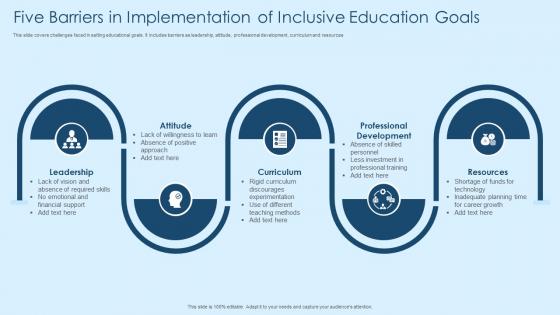
Five Barriers In Implementation Of Inclusive Education Goals




Try Before you Buy Download Free Sample Product
 Impress Your
 Audience
 100%
100% Editable
 Save Hours
 of Time


This slide covers challenges faced in setting educational goals. It includes barriers as leadership, attitude, professional development, curriculum and resources
People who downloaded this PowerPoint presentation also viewed the following :
Five Barriers In Implementation Of Inclusive Education Goals with all 6 slides:
Use our Five Barriers In Implementation Of Inclusive Education Goals to effectively help you save your valuable time. They are readymade to fit into any presentation structure.





FAQs for Five Barriers In Implementation Of
Main barriers include inadequate teacher training, insufficient funding for specialized resources, lack of administrative support, physical accessibility limitations, and resistance from parents or community members. These challenges often compound in resource-constrained schools, though many educational institutions find that strategic professional development, community engagement initiatives, and phased implementation approaches help overcome resistance while ultimately delivering improved learning outcomes for all students.
Socio-economic factors significantly influence inclusive education access through resource availability, parental support capacity, and institutional quality disparities. Lower-income families often face challenges with transportation, specialized materials, and supplementary services, while schools in economically disadvantaged areas may lack adequate facilities, trained staff, and adaptive technologies, ultimately creating barriers that limit educational opportunities for students with diverse needs.
Teacher training and professional development play crucial roles in overcoming inclusivity challenges by equipping educators with specialized skills, adaptive teaching strategies, evidence-based intervention techniques, and cultural competency awareness. Through comprehensive professional development programs, schools enhance classroom management for diverse learners, improve individualized instruction delivery, and build stronger family partnerships, ultimately creating more inclusive environments where all students thrive academically and socially.
Schools can assess diverse learning needs through comprehensive evaluations, individualized assessments, multi-sensory learning style inventories, collaborative teacher observations, and regular student feedback sessions. These approaches enable educators to implement differentiated instruction, assistive technologies, and flexible curriculum modifications, while fostering inclusive classroom environments that ultimately enhance academic outcomes and ensure equitable educational experiences for all students.
Cultural attitudes and beliefs significantly shape inclusive education perception by influencing community acceptance, parental support, teacher expectations, and policy implementation across different societies. These cultural factors can either facilitate or hinder progress, with many educational institutions finding that addressing cultural misconceptions through targeted awareness campaigns and community engagement ultimately enhances acceptance and delivers more effective inclusive programs.
Technology facilitates inclusive education through assistive software, adaptive hardware, personalized learning platforms, communication tools, and accessibility features that accommodate diverse learning needs. These solutions streamline curriculum delivery by providing text-to-speech capabilities, visual aids, and customized interfaces, enabling students with disabilities to access educational content seamlessly while enhancing classroom participation and academic outcomes.
Inclusive education policies include the Individuals with Disabilities Education Act (IDEA), Americans with Disabilities Act (ADA), Section 504 of the Rehabilitation Act, Every Student Succeeds Act (ESSA), and UN Convention on Rights of Persons with Disabilities. While these frameworks establish legal foundations and funding mechanisms, their effectiveness varies significantly across districts and regions, with many schools finding that implementation challenges often outweigh regulatory mandates, ultimately requiring stronger enforcement and resource allocation.
Parental involvement significantly enhances inclusive education by providing consistent support, advocating for appropriate accommodations, and reinforcing learning strategies at home. When families actively collaborate with educators, students with diverse needs experience improved academic outcomes, better social integration, and increased confidence, with many schools finding that engaged parents help create more accepting classroom environments for all children.
Educators can foster inclusive environments through differentiated instruction methods, collaborative learning structures, culturally responsive teaching practices, universal design principles, and consistent peer interaction opportunities. These strategies enhance classroom dynamics by accommodating diverse learning styles, celebrating cultural backgrounds, and promoting mutual respect, with many schools finding that such approaches ultimately deliver improved academic outcomes and stronger community connections.
Physical accessibility barriers significantly limit inclusive education by restricting student mobility, creating safety hazards, and preventing equal participation in learning activities. These infrastructure challenges affect students with disabilities across educational institutions, with many schools finding that inaccessible classrooms, restrooms, and learning spaces ultimately compromise educational outcomes and violate inclusive principles.
Teachers face psychological barriers including fear of inadequacy when supporting diverse learners, anxiety about classroom management with mixed abilities, resistance to changing established methods, and concern about meeting all students' needs effectively. These challenges often stem from insufficient training and support, though many educators find that gradual implementation with professional development ultimately enhances their teaching skills and student engagement across all learning styles.
Peer support enhances inclusion by fostering empathy, breaking down social barriers, and creating natural learning partnerships where students with diverse abilities collaborate on shared goals. Through structured peer mentoring, cooperative learning activities, and buddy systems, schools cultivate classroom communities where differences become strengths, ultimately delivering improved social skills and academic outcomes for all students.
Differentiated instruction is a teaching approach that tailors content, process, and assessment methods to accommodate diverse learning styles, abilities, and needs within the same classroom. It enables educators to create multiple pathways for student success, especially in inclusive environments where students with disabilities, different cultural backgrounds, and varying skill levels learn together, ultimately delivering equitable educational opportunities and enhanced academic outcomes for all learners.
Assessment methods must shift from standardized testing to personalized approaches, including portfolio-based evaluations, peer assessments, project-based learning, and multiple demonstration formats. These diverse strategies enable educators to accommodate different learning styles, physical abilities, and cognitive approaches, with many schools finding that flexible assessment ultimately delivers more accurate student progress measurement and enhanced educational outcomes.
Non-governmental organizations advocate for inclusive education through policy research, community awareness campaigns, teacher training programs, resource development, and direct support to marginalized students. These organizations bridge gaps between government initiatives and grassroots needs, with many educational NGOs finding that their strategic combination of advocacy and implementation ultimately delivers systemic change and enhanced accessibility across diverse learning environments.
-
The service is fast, and I could access any presentation after buying the subscription. I don’t think I’ll ever have to worry about a presentation in my life.
-
The Designed Graphic are very professional and classic.