


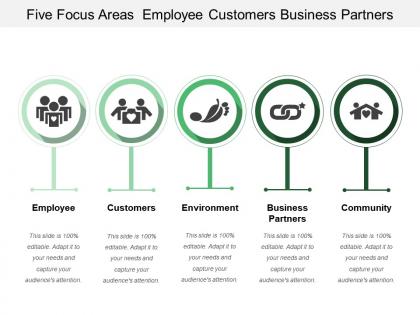
Five focus areas employee customers business partners




Try Before you Buy Download Free Sample Product
 Impress Your
 Audience
 100%
100% Editable
 Save Hours
 of Time


Use our attractive Five Focus Areas PPT slideshow to build a successful business strategy and become successful as a business. This marvelous PPT design shows multiple attractive focus areas like employees, customers, environment, business partners, and community. You can even edit the PowerPoint layout to add more attractive icons highlighting other factors like innovation, profitability, and time management. The strategic focus is a gateway to all the thinking, you can incorporate various pie charts, line and bar graphs into this PPT slide for the same. Use this PowerPoint template in your presentation to create a to-do list to show how to be productive in all the key areas. Sell product and services to a niche market, a particular type of consumer, a specific product line, or a particular geographical area by building a strategic focus with our PPT presentation. This PPT graphic is also beneficial for aspiring entrepreneurs. Go ahead and download our PowerPoint theme to give your business a direction.
People who downloaded this PowerPoint presentation also viewed the following :
Five focus areas employee customers business partners with all 5 slides:



FAQs for Five focus areas employee
Organizations can implement virtual team-building activities, flexible scheduling, regular one-on-one check-ins, digital recognition programs, and comprehensive communication platforms to boost remote employee engagement. These strategies enhance connection and productivity by fostering collaboration, maintaining work-life balance, and ensuring clear expectations, with many companies finding that structured virtual interactions and personalized feedback significantly improve remote workforce satisfaction and retention.
Employee engagement significantly impacts organizational productivity by increasing output quality, reducing turnover costs, enhancing customer satisfaction, and accelerating innovation cycles. Engaged employees demonstrate 21% higher profitability and 10% better customer metrics, with companies like Google and Microsoft finding that highly engaged teams deliver faster project completion, improved collaboration, and ultimately stronger competitive advantage in increasingly talent-driven markets.
Management plays a pivotal role in fostering engagement through clear communication, recognition programs, professional development opportunities, and transparent decision-making processes. Effective leaders create psychological safety, provide regular feedback, and align individual goals with organizational objectives, with many companies finding that engaged management teams directly correlate with higher employee satisfaction and productivity levels.
Companies measure employee engagement through regular pulse surveys, one-on-one meetings, exit interviews, performance metrics, and feedback platforms that track satisfaction and retention rates. These measurement tools enable organizations to identify engagement gaps, monitor team morale, and implement targeted improvements, with many businesses finding that consistent measurement ultimately delivers higher productivity, reduced turnover, and stronger workplace culture.
Leaders can improve emotional connection through regular one-on-one meetings, active listening during team discussions, recognizing individual achievements publicly, sharing personal experiences appropriately, and demonstrating vulnerability when facing challenges. These approaches enhance trust and psychological safety by fostering open communication, creating meaningful recognition moments, and building authentic relationships, with many organizations finding that emotionally connected teams deliver significantly higher performance and retention rates.
Recognition and reward significantly enhance employee engagement by fostering emotional connection, increasing motivation, and reinforcing desired behaviors within organizations. Through strategic recognition programs, companies streamline talent retention, accelerate performance improvements, and deliver enhanced workplace satisfaction, with many organizations finding that consistent acknowledgment ultimately creates competitive advantage through higher productivity and reduced turnover costs.
Employee engagement measures emotional commitment, motivation, and discretionary effort employees invest in their work, while employee satisfaction reflects contentment with job conditions, compensation, and workplace environment. Engaged employees actively contribute beyond basic requirements and drive innovation, whereas satisfied employees may perform adequately but lack the passion to exceed expectations, with many organizations finding that engagement delivers stronger business outcomes and competitive advantage.
Companies can leverage technology to enhance employee engagement through digital feedback platforms, mobile recognition apps, virtual collaboration tools, learning management systems, and real-time pulse surveys. These technologies streamline communication and personalize experiences by enabling instant feedback, facilitating remote teamwork, and delivering targeted professional development, with many organizations finding that automated recognition programs and data-driven insights ultimately boost retention and productivity.
Employee engagement survey best practices include clear, specific questions, anonymous responses, regular timing, mixed question formats, and leadership commitment to action. These approaches enhance data quality by encouraging honest feedback, measuring trends over time, and demonstrating organizational accountability, with many companies finding that transparent follow-up communication and visible improvements ultimately drive higher participation rates and stronger engagement outcomes.
Effective onboarding processes can be improved through structured orientation programs, mentorship assignments, clear role expectations, interactive training modules, and regular feedback sessions. These strategic approaches streamline new employee integration by fostering meaningful connections, accelerating productivity timelines, and establishing cultural alignment, with many organizations finding that comprehensive onboarding delivers significantly higher retention rates and faster performance outcomes.
Workplace diversity and inclusion significantly enhance employee engagement by fostering psychological safety, increasing innovation through varied perspectives, and creating stronger sense of belonging among team members. Organizations with inclusive cultures see higher retention rates, improved collaboration, and increased productivity, with many companies finding that diverse teams deliver better problem-solving capabilities and ultimately stronger business performance.
Ongoing professional development opportunities enhance employee involvement by demonstrating organizational investment in individual growth, creating clear advancement pathways, and building relevant skills that increase job satisfaction. These programs enable employees to expand their capabilities, pursue meaningful career progression, and contribute more strategically to organizational goals, ultimately delivering higher retention rates and improved performance across all business functions.
Organizational values and mission statements contribute to employee engagement by providing clear purpose, aligning individual goals with company objectives, and creating emotional connections to work. When employees understand how their roles support meaningful organizational missions, they demonstrate higher commitment, productivity, and retention rates, with many companies finding that well-communicated values ultimately deliver stronger workplace cultures and competitive advantage.
Work-life balance significantly enhances employee engagement by reducing burnout, increasing job satisfaction, and fostering loyalty through flexible schedules and supportive policies. Organizations prioritizing balance, from tech companies offering remote work to healthcare systems providing wellness programs, experience higher retention rates, improved productivity, and stronger workplace culture, ultimately delivering competitive advantage in talent acquisition.
Effective feedback loops include regular pulse surveys, one-on-one meetings, anonymous suggestion systems, exit interviews, and real-time feedback platforms. These mechanisms enable organizations to identify engagement drivers, address concerns proactively, and adapt strategies based on employee input, with many companies finding that continuous listening approaches deliver higher retention rates and improved workplace satisfaction.
-
Best Representation of topics, really appreciable.
-
Excellent Designs.