


Five Stages Of Production Improvement In Manufacturing Plant




Try Before you Buy Download Free Sample Product
 Impress Your
 Audience
 100%
100% Editable
 Save Hours
 of Time


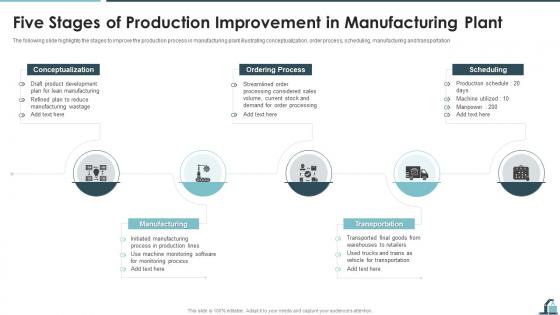
The following slide highlights the stages to improve the production process in manufacturing plant illustrating conceptualization, order process, scheduling, manufacturing and transportation.
People who downloaded this PowerPoint presentation also viewed the following :
Five Stages Of Production Improvement In Manufacturing Plant with all 6 slides:
Use our Five Stages Of Production Improvement In Manufacturing Plant to effectively help you save your valuable time. They are readymade to fit into any presentation structure.





FAQs for Five Stages Of Production Improvement
Key production efficiency metrics include Overall Equipment Effectiveness (OEE), throughput rates, cycle times, defect rates, and resource utilization percentages. These measurements enable manufacturers to streamline operations by identifying bottlenecks, minimizing waste, and optimizing workflows, with automotive and electronics companies finding that comprehensive metric tracking delivers faster production cycles and significantly reduced operational costs.
Lean manufacturing principles improve production processes by eliminating waste, implementing continuous flow systems, and establishing pull-based production schedules. These methodologies streamline operations through standardized work procedures, just-in-time inventory management, and employee-driven problem solving, with many manufacturing organizations finding significantly reduced lead times, lower operational costs, and enhanced product quality.
Technology revolutionizes production through automation, IoT sensors, predictive analytics, AI-driven optimization, and real-time monitoring systems. These solutions streamline manufacturing processes by minimizing downtime, optimizing resource allocation, and identifying inefficiencies before they escalate, with many organizations finding that strategic technology integration delivers significantly reduced waste and enhanced operational efficiency.
Employee training and development significantly enhances production improvement by upgrading technical skills, reducing operational errors, and increasing workflow efficiency across departments. Through targeted programs, organizations streamline processes, minimize waste, and accelerate output quality, with manufacturing and logistics companies finding that well-trained teams deliver faster turnaround times and lower production costs.
Strategies include demand forecasting optimization, supplier relationship management, inventory automation, logistics digitization, and real-time visibility systems. These approaches streamline operations by reducing lead times, minimizing stock disruptions, and enhancing coordination across networks, with manufacturers in automotive and electronics finding that integrated supply chain technologies ultimately deliver faster production cycles and significantly improved operational efficiency.
Quality control measures significantly enhance production efficiency by reducing defects, minimizing rework, streamlining workflows, and optimizing resource allocation throughout manufacturing processes. These systematic approaches enable organizations to deliver consistent products while reducing costs, with many companies in automotive, electronics, and pharmaceuticals finding that robust quality systems ultimately boost customer satisfaction, brand loyalty, and competitive advantage in increasingly demanding markets.
Implementation challenges include initial investment costs, employee resistance to change, integration complexities with legacy systems, and potential workflow disruptions during transition periods. However, these obstacles can be overcome through phased rollouts, comprehensive staff training programs, and strategic planning that emphasizes gradual integration, with many manufacturing and service organizations finding that early investment in change management ultimately delivers enhanced efficiency and competitive advantage.
Data analytics identifies production bottlenecks by analyzing real-time workflow data, monitoring equipment performance metrics, tracking cycle times, and measuring throughput rates across manufacturing stages. Through predictive algorithms and machine learning, manufacturers can pinpoint inefficiencies, predict maintenance needs, and optimize resource allocation, with many automotive and electronics companies finding significant cost reductions and faster production cycles.
Organizations can foster continuous improvement through employee empowerment programs, regular cross-functional team meetings, standardized feedback loops, performance metrics tracking, and innovation incentive systems. These practices streamline operational efficiency by encouraging frontline insights, identifying bottlenecks early, and promoting collaborative problem-solving, with many manufacturing and logistics companies finding that employee-driven improvements deliver significant cost reductions and enhanced productivity.
Cross-functional collaboration enhances production performance by breaking down silos, accelerating decision-making, and enabling real-time problem-solving across departments like engineering, quality control, and supply chain. Manufacturing organizations increasingly find that integrated teams streamline workflows, reduce bottlenecks, and minimize production delays, ultimately delivering faster time-to-market and improved operational efficiency.
**INPUT**: What are the best practices for managing inventory to optimize production processes? **OUTPUT**: Best inventory management practices include implementing just-in-time ordering, maintaining optimal safety stock levels, utilizing automated tracking systems, establishing supplier partnerships, and conducting regular demand forecasting analysis. These approaches streamline production workflows by reducing carrying costs, minimizing stockouts, and enhancing supply chain visibility, with manufacturing companies increasingly finding that strategic inventory optimization delivers faster turnaround times and improved operational efficiency. [Word count: 59 words]
Organizations effectively implement change management during production improvement initiatives by establishing clear communication channels, engaging stakeholders early, providing comprehensive training programs, and creating structured feedback mechanisms. Through phased implementation approaches, companies in manufacturing, pharmaceuticals, and automotive sectors streamline transitions while minimizing operational disruption, ultimately delivering enhanced productivity and sustained employee adoption across production environments.
Equipment maintenance significantly enhances production capacity by preventing unexpected breakdowns, reducing downtime, and optimizing machine performance through regular inspections and servicing. Well-maintained equipment delivers consistent output, extends asset lifespan, and minimizes costly emergency repairs, with manufacturing facilities often finding that proactive maintenance strategies increase overall equipment effectiveness by 15-25%.
Feedback loops can be established through real-time monitoring systems, regular performance reviews, employee suggestion programs, customer feedback integration, and cross-departmental collaboration meetings. These mechanisms enable manufacturers and service providers to identify bottlenecks, streamline processes, and enhance quality control, with many organizations finding that systematic feedback ultimately delivers faster response times and sustained competitive advantage.
Sustainability initiatives serve as catalysts for production improvement by driving resource efficiency, waste reduction, circular economy practices, and energy optimization strategies. These approaches enable manufacturers across automotive, electronics, and consumer goods sectors to achieve significant cost savings, enhance operational efficiency, and gain competitive advantage while meeting increasingly stringent environmental regulations.
-
The website is jam-packed with fantastic and creative templates for a variety of business concepts. They are easy to use and customize.
-
Unique research projects to present in meeting.