


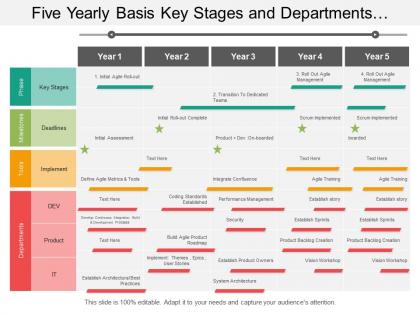
Five yearly basis key stages and departments agile transformation timeline




Try Before you Buy Download Free Sample Product
 Impress Your
 Audience
 100%
100% Editable
 Save Hours
 of Time


Bank balance grows with our Five Yearly Basis Key Stages And Departments Agile Transformation Timeline. Greater assets get added on.
People who downloaded this PowerPoint presentation also viewed the following :
Five yearly basis key stages and departments agile transformation timeline with all 5 slides:
Our Five Yearly Basis Key Stages And Departments Agile Transformation Timeline ensure you better yourself. Accomplish beyond your biggest dreams.

FAQs for Five yearly basis key stages and departments
Key phases involved in an agile transformation timeline include assessment and readiness evaluation, pilot team formation, framework implementation, scaling across departments, and continuous improvement integration. These phases typically span 12-18 months, with organizations like financial services and manufacturing finding that structured rollouts enable better adoption rates, reduced resistance, and ultimately sustainable cultural change that delivers faster project delivery and enhanced team collaboration.
Organizations determine their agile transformation starting point through comprehensive assessments evaluating current processes, team structures, cultural readiness, and existing project management methodologies. These evaluations include maturity assessments, stakeholder interviews, and workflow analysis across departments, with many companies finding that understanding their baseline capabilities, resistance points, and change readiness ultimately enables more strategic transformation planning and realistic timeline development.
Agile transformation success metrics include delivery velocity, cycle time reduction, customer satisfaction scores, team engagement levels, and business value delivered per sprint. These measurements enable organizations to track progress across technical performance, team dynamics, and customer outcomes, with many enterprises finding that combining quantitative delivery metrics with qualitative team feedback ultimately delivers comprehensive transformation insights and sustainable competitive advantage.
Leadership and management serve as transformation catalysts, strategic vision setters, cultural change champions, and resource allocators throughout agile adoption. These roles enable organizational alignment by removing impediments, fostering cross-functional collaboration, and modeling agile behaviors, with many enterprises finding that committed leadership accelerates transformation timelines and delivers sustainable competitive advantages.
Organizations can assess their current culture through employee surveys, stakeholder interviews, team collaboration audits, decision-making process reviews, and cross-functional workflow analysis. These assessment methods enable leadership to identify cultural barriers, communication gaps, and resistance points, while revealing existing collaborative strengths, ultimately delivering a strategic baseline for transformation planning and change management prioritization.
Common agile transformation challenges include resistance to cultural change, inadequate leadership support, insufficient training, unclear roles and responsibilities, and difficulty measuring progress. Organizations typically encounter initial skepticism during adoption phases, coordination issues as teams scale, and integration complexities with existing processes, with many companies finding that sustained coaching and iterative improvements ultimately deliver smoother transitions and enhanced operational efficiency.
Agile transformation typically takes 18-36 months from initiation to full adoption, depending on organizational size, complexity, and cultural readiness. While smaller teams may see meaningful changes within 6-12 months, enterprise-wide transformations require sustained commitment, with many organizations finding that continuous improvement and cultural shifts extend well beyond initial implementation phases.
Agile transformation frameworks include Scrum for iterative development, Kanban for workflow visualization, SAFe for enterprise scaling, LeSS for large-scale coordination, and DevOps for delivery acceleration. These methodologies streamline project management by enhancing collaboration, reducing bottlenecks, and improving delivery predictability, with many organizations finding that combining multiple frameworks delivers greater operational efficiency and competitive advantage.
Teams should approach training through continuous learning cycles, hands-on workshops, cross-functional collaboration sessions, mentoring programs, and iterative skill assessments. These development strategies enhance team adaptability, accelerate transformation adoption, and build sustainable agile capabilities, with many organizations finding that investing in comprehensive skill development ultimately delivers faster project delivery, improved team collaboration, and stronger competitive positioning.
Stakeholder engagement is critical for agile transformation success, ensuring alignment, buy-in, and sustained change across organizational levels. Active stakeholder involvement accelerates adoption timelines, reduces resistance, and enhances communication flows, with many organizations finding that early and continuous engagement ultimately delivers smoother transitions, better resource allocation, and stronger competitive positioning.
Feedback loops can be effectively integrated through regular retrospectives, stakeholder surveys, pulse checks with development teams, continuous performance monitoring, and cross-functional review sessions. These mechanisms enable organizations to identify bottlenecks early, adjust strategies dynamically, and maintain momentum throughout the transformation, with many companies finding that structured feedback cycles accelerate adoption and improve outcomes.
Tools supporting agile transformation include Jira for project management, Confluence for documentation, Slack for team communication, Azure DevOps for development workflows, and Trello for visual task tracking. These platforms streamline collaboration, enhance transparency, and automate reporting processes, with many organizations finding that integrated tool ecosystems accelerate sprint cycles and ultimately deliver improved project visibility and team productivity.
Organizational size significantly impacts agile transformation timelines, with smaller companies typically completing transitions in 6-12 months while larger enterprises require 18-36 months or more. Larger organizations face complex coordination challenges across multiple departments, legacy systems integration, and extensive change management requirements, while smaller teams can pivot quickly and implement agile practices seamlessly, ultimately delivering faster organizational agility.
**INPUT**: What strategies can be implemented to ensure sustainability after the transformation is complete? **OUTPUT**: Sustainability strategies include continuous coaching, regular retrospectives, embedding agile metrics into performance reviews, establishing communities of practice, and maintaining executive sponsorship. These approaches streamline long-term adoption by reinforcing cultural change, monitoring progress through data-driven insights, and ensuring leadership commitment, with many organizations finding that ongoing investment in training and feedback loops ultimately delivers sustained competitive advantage.
Companies that have successfully transformed to agile methodologies demonstrate that leadership commitment, cultural change management, and gradual implementation are critical success factors. These organizations, from financial services to manufacturing sectors, find that investing in employee training, establishing clear communication channels, and maintaining flexibility during the transition ultimately delivers improved collaboration, faster product delivery, and enhanced customer responsiveness in an increasingly competitive marketplace.
-
Attractive design and informative presentation.
-
Innovative and Colorful designs.