


Five years migration planning roadmap for cloud platform




Try Before you Buy Download Free Sample Product
 Impress Your
 Audience
 100%
100% Editable
 Save Hours
 of Time


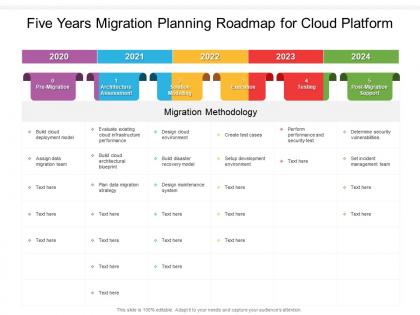
Visualize your work plan and communicate your ideas impactfully with our pre designed Five Years Migration Planning Roadmap For Cloud Platform. Showcase the detailed overview of the project, the key deliverables, and the milestones to be achieved with the help of our fully customizable PowerPoint layout. You can easily emphasize on the project goals and discuss all the activities involved in an easy to comprehend manner by utilizing our professionally designed PPT theme. This roadmap PowerPoint layout is a perfect strategic planning tool that can help in keeping the project on track. With our attractive PowerPoint theme, you can articulate the workflow, track the work progress, and have a clear vision of the goal to be achieved. Download this versatile Five Years Migration Planning Roadmap For Cloud Platform and save your hours of work.
People who downloaded this PowerPoint presentation also viewed the following :
Five years migration planning roadmap for cloud platform with all 2 slides:
Use our Five Years Migration Planning Roadmap For Cloud Platform to effectively help you save your valuable time. They are readymade to fit into any presentation structure.

FAQs for Five years migration planning roadmap
A cloud migration roadmap typically involves five key phases: assessment, planning, migration, optimization, and security. These phases enable organizations to evaluate current infrastructure, design a tailored migration strategy, execute the move to the cloud, fine-tune performance and resource allocation, and ensure robust security measures throughout the process. Many businesses find that a phased approach minimizes disruption and maximizes the benefits of cloud adoption, ultimately leading to improved operational efficiency and cost savings.
Organizations assess their current infrastructure by first identifying all applications, systems, and data dependencies. Then, they analyze the performance, scalability, and security of these components to determine which can be migrated directly to the cloud, which require modifications, and which might need to be retired. This comprehensive analysis, often conducted with cloud migration specialists, helps organizations understand the scope of the project, identify potential roadblocks, and develop a tailored migration roadmap, ultimately ensuring a smooth and successful transition to the cloud.
Selecting a cloud service provider involves considering several critical factors, including security protocols, data residency requirements, scalability options, pricing models, and support services. These elements are essential for ensuring seamless integration, robust security, and cost-effectiveness, with many organizations finding that a thorough evaluation of these factors leads to successful cloud adoption and optimized IT infrastructure.
Choosing the right cloud deployment model depends on your organization's unique needs and resources. Businesses can identify the best fit by carefully evaluating factors like data security requirements, scalability needs, budget constraints, and existing IT infrastructure. Public cloud offers cost-effectiveness and flexibility, while private cloud provides enhanced security and control. Hybrid cloud combines the benefits of both, allowing businesses to tailor their approach based on specific workloads. Many financial institutions, for example, utilize hybrid cloud to manage sensitive customer data in a private environment while leveraging public cloud for less critical applications, ultimately striking a balance between security and cost optimization.
Data security is a paramount concern when developing a cloud migration strategy, as it involves transferring sensitive information to a third-party provider. A robust strategy must incorporate comprehensive security measures, including encryption, access controls, and regular vulnerability assessments, to safeguard data throughout the migration process and ensure compliance with industry regulations. With many organizations finding that cloud providers offer advanced security features, a well-defined security framework can minimize risks and enable a smooth and secure transition to the cloud.
Migrating to the cloud can be seamless with careful planning, ensuring minimal downtime. Organizations can achieve this by implementing phased migrations, leveraging robust backup and recovery solutions, and utilizing advanced tools for data replication and synchronization. With many organizations finding that this approach minimizes service disruptions, cloud migration can be a smooth transition, ultimately leading to increased operational efficiency and reduced risk.
A successful cloud migration requires a strategic combination of tools and technologies, including cloud migration platforms, data security and compliance solutions, application modernization tools, and monitoring and management software. These technologies enable organizations to streamline the migration process, ensure data integrity, optimize applications for the cloud environment, and continuously monitor performance, ultimately delivering enhanced scalability, reduced operational costs, and improved agility in an increasingly competitive landscape.
Cloud migration prioritization should focus on applications that offer the most significant benefits and have the least complexity. Organizations should consider factors like application criticality, potential cost savings, and alignment with business goals. By starting with mission-critical applications or those with clear cost reduction opportunities in sectors like finance or healthcare, organizations can demonstrate early wins and build momentum for wider cloud adoption, ultimately accelerating their digital transformation journey.
Optimizing cloud costs post-migration involves several best practices, including right-sizing resources to match actual usage, leveraging serverless computing for scalable and cost-effective workloads, implementing automated cost monitoring and optimization tools, and negotiating favorable pricing agreements with cloud providers. By adopting these strategies, organizations can minimize unnecessary expenses while maximizing the value of their cloud investments, ultimately leading to improved operational efficiency and cost savings.
Cloud migration requires comprehensive staff training to ensure a smooth transition and maximize benefits. Businesses can achieve this by implementing a multi-pronged approach, including interactive workshops on cloud fundamentals, hands-on training with specific cloud platforms, and ongoing mentorship programs with experienced cloud professionals. This comprehensive training equips employees with the necessary skills and knowledge to leverage cloud technologies effectively, ultimately leading to increased operational efficiency and enhanced productivity.
Cloud migration presents several challenges, including data security concerns, application compatibility issues, network infrastructure limitations, and resistance to change from employees. These challenges can be mitigated by implementing robust security measures, thoroughly testing applications for compatibility, upgrading network infrastructure to accommodate cloud demands, and providing comprehensive training and support to employees throughout the transition process. With careful planning and execution, companies can successfully navigate these challenges and realize the full benefits of cloud adoption.
Compliance with regulations significantly impacts the cloud migration roadmap by necessitating thorough assessments and security measures. Financial institutions, for example, must adhere to strict data privacy regulations like GDPR, requiring robust encryption and access controls during migration. This careful planning ensures smooth transitions while minimizing risks and maintaining regulatory adherence, ultimately enabling organizations to confidently leverage the benefits of cloud computing.
Organizations can use several methodologies to evaluate cloud migration success post-implementation, including Return on Investment (ROI) analysis, key performance indicator (KPI) tracking, and user satisfaction surveys. ROI analysis quantifies the financial benefits of the migration, while KPIs measure operational efficiency and performance improvements, like reduced downtime or faster application response times. User satisfaction surveys gather feedback on the impact of the migration on day-to-day workflows and overall user experience, providing valuable insights into adoption and usability.
Cloud-native services empower businesses to significantly enhance their operations post-migration by offering scalability, flexibility, and agility. Through containerization technologies like Docker and Kubernetes, organizations can streamline application deployment and management, enabling faster innovation cycles and improved resource allocation. Financial services firms, for example, are leveraging cloud-native architectures to accelerate loan processing and fraud detection, while retail businesses are using it to personalize customer experiences and optimize inventory management. Ultimately, embracing cloud-native services delivers operational efficiency, cost savings, and a competitive edge in today's dynamic market.
Ongoing cloud management and optimization require a multi-faceted strategy that includes continuous monitoring, resource allocation fine-tuning, and security enhancements. This involves leveraging cloud-native tools for performance analysis, cost optimization dashboards, and automated security protocols, allowing organizations to minimize operational expenses, maximize resource utilization, and ensure robust security posture. Financial institutions, for example, are increasingly adopting these strategies to streamline operations, enhance data security, and meet stringent regulatory compliance requirements.
No Reviews