


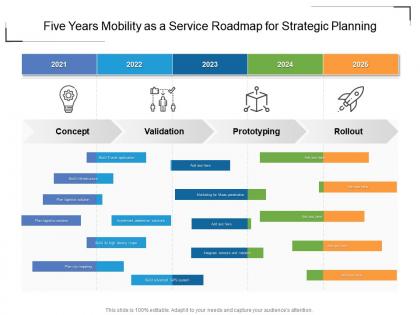
Five years mobility as a service roadmap for strategic planning




Try Before you Buy Download Free Sample Product
 Impress Your
 Audience
 100%
100% Editable
 Save Hours
 of Time


Visualize your work plan and communicate your ideas impactfully with our pre designed Five Years Mobility As A Service Roadmap For Strategic Planning. Showcase the detailed overview of the project, the key deliverables, and the milestones to be achieved with the help of our fully customizable PowerPoint layout. You can easily emphasize on the project goals and discuss all the activities involved in an easy to comprehend manner by utilizing our professionally designed PPT theme. This roadmap PowerPoint layout is a perfect strategic planning tool that can help in keeping the project on track. With our attractive PowerPoint theme, you can articulate the workflow, track the work progress, and have a clear vision of the goal to be achieved. Download this versatile Five Years Mobility As A Service Roadmap For Strategic Planning and save your hours of work.
People who downloaded this PowerPoint presentation also viewed the following :
Five years mobility as a service roadmap for strategic planning with all 2 slides:
Use our Five Years Mobility As A Service Roadmap For Strategic Planning to effectively help you save your valuable time. They are readymade to fit into any presentation structure.

FAQs for Five years mobility as a service roadmap
MaaS components include integrated payment systems, multimodal journey planning, real-time transportation data, unified mobile platforms, and seamless service coordination across transit modes. These technologies streamline urban mobility by combining public transit, ride-sharing, bike-sharing, and micro-mobility options into single applications, with many cities finding that integrated approaches reduce congestion while delivering enhanced user experiences and operational efficiency.
Municipalities can integrate MaaS solutions with existing public transportation networks by implementing unified payment systems, developing comprehensive data-sharing platforms, establishing standardized APIs across transport modes, and creating seamless passenger information systems. Through strategic partnerships with private mobility providers, cities like Helsinki and Vienna have successfully combined buses, trains, bike-shares, and ride-hailing services, ultimately delivering enhanced user experiences while optimizing resource allocation across their transportation ecosystems.
Technology platforms serve as the foundational infrastructure for MaaS ecosystems, enabling seamless integration of transportation modes, real-time data processing, user interface management, and payment systems. These platforms streamline operations by connecting buses, trains, ride-shares, and bike-shares into unified networks, with cities like Helsinki and Barcelona finding that integrated platforms deliver enhanced user experiences and operational efficiency.
MaaS improves accessibility for marginalized communities by providing affordable, integrated transportation options, flexible payment systems, multilingual interfaces, and routes connecting underserved areas to essential services. Through digital platforms and partnerships with community organizations, cities can deliver equitable mobility solutions that reduce transportation barriers, enhance job access, and improve healthcare connectivity, ultimately creating more inclusive urban environments.
MaaS platforms face significant data privacy and security challenges including personal location tracking, payment information protection, cross-platform data sharing vulnerabilities, user behavior profiling, and multi-vendor integration risks. These challenges require robust encryption protocols, transparent consent mechanisms, and comprehensive cybersecurity frameworks, with many transportation authorities finding that strategic privacy-by-design approaches ultimately deliver enhanced user trust and regulatory compliance.
Public-private partnerships enhance MaaS offerings by combining government infrastructure access with private sector innovation, shared data systems, and integrated payment platforms. These strategic collaborations enable cities like Helsinki and Singapore to deliver seamless multimodal transportation experiences, reduce operational costs, and accelerate service deployment, ultimately creating comprehensive mobility ecosystems that benefit both commuters and urban development.
MaaS reduces traffic congestion and emissions by optimizing route planning, promoting shared mobility options, integrating public transit systems, and encouraging multimodal transportation choices. Through real-time data analytics and seamless payment systems, cities like Helsinki and Amsterdam streamline urban mobility, ultimately delivering fewer private vehicles on roads, reduced carbon footprints, and enhanced air quality for residents.
MaaS providers can generate revenue through subscription fees, transaction commissions, advertising partnerships, data monetization, and premium service tiers. These models work by capturing value from user subscriptions, taking percentage cuts from transport operators, selling targeted advertising space, and offering enhanced features, with many urban mobility companies finding that diversified revenue streams, particularly combining monthly subscriptions with data insights, deliver sustainable operations.
User feedback and data analytics enable MaaS providers to optimize route efficiency, enhance service reliability, and personalize transportation options through real-time usage patterns, satisfaction surveys, and predictive modeling. Transit authorities and mobility companies increasingly leverage this data-driven approach to reduce wait times, improve multimodal connections, and deliver seamless user experiences, ultimately creating more responsive and competitive transportation ecosystems.
Helsinki's MaaS Global and Singapore's smart mobility initiatives exemplify successful implementations, demonstrating seamless public-private partnerships, comprehensive transit integration, and user-centric app design. These programs streamline urban transportation by combining multiple transport modes, reducing car dependency, and enhancing operational efficiency, with cities increasingly finding that strategic stakeholder alignment and robust digital infrastructure ultimately deliver improved mobility experiences and sustainable urban development.
Regulatory frameworks significantly influence MaaS adoption by establishing data sharing standards, interoperability requirements, and integration policies that enable seamless multi-modal transportation services. Through supportive regulations, cities like Helsinki and Vienna have streamlined operator partnerships, reduced bureaucratic barriers, and enhanced user experiences, while restrictive frameworks can limit scalability, ultimately determining whether MaaS solutions deliver competitive urban mobility advantages.
Strategies to encourage MaaS adoption include targeted pricing models, seamless app interfaces, comprehensive transportation options, personalized journey planning, and strategic partnerships with local transit authorities. These approaches work by addressing demographic-specific barriers like cost sensitivity among students, accessibility needs for seniors, and convenience preferences for professionals, with many cities finding that pilot programs in diverse neighborhoods ultimately deliver higher engagement rates and broader community acceptance.
MaaS catalyzes last-mile delivery innovation by integrating multiple transportation modes, real-time data analytics, and dynamic routing algorithms into unified platforms. Through seamless coordination between autonomous vehicles, drones, micro-transit, and traditional delivery methods, logistics companies streamline operations, reduce costs, and enhance customer experiences, while retailers and e-commerce platforms leverage these integrated networks to offer faster, more flexible delivery options in increasingly competitive markets.
AI and blockchain present transformative implications for MaaS development, including predictive demand forecasting, automated route optimization, secure payment processing, transparent data sharing, and seamless multi-modal integration. These technologies enable transportation providers to deliver personalized user experiences, reduce operational costs, and enhance service reliability, with many smart cities finding that this strategic combination ultimately drives greater adoption and competitive advantage in increasingly connected mobility ecosystems.
Electric and autonomous vehicles integrate into MaaS roadmaps by enhancing operational efficiency, reducing environmental impact, and enabling seamless multimodal transportation networks. These technologies streamline fleet management through predictive maintenance, optimize route planning, and deliver cost-effective services, with cities like Helsinki and Barcelona finding that strategic integration ultimately creates sustainable, user-centric mobility ecosystems.
-
Understandable and informative presentation.
-
Colors used are bright and distinctive.
-
Very unique and reliable designs.