


Food And Beverage Products Market Fit Pyramid





Try Before you Buy Download Free Sample Product
 Impress Your
 Audience
 100%
100% Editable
 Save Hours
 of Time


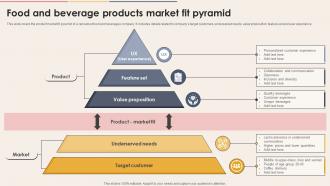
This slide covers the product market fit pyramid of a renowned food and beverages company. It includes details related to companys target customers, underserved needs, value proposition, feature set and user experience.
People who downloaded this PowerPoint presentation also viewed the following :
Food And Beverage Products Market Fit Pyramid with all 6 slides:
Use our Food And Beverage Products Market Fit Pyramid to effectively help you save your valuable time. They are readymade to fit into any presentation structure.





FAQs for Food And Beverage Products
Key trends shaping the food and beverage market include plant-based alternatives, sustainable packaging, personalized nutrition, functional foods, and direct-to-consumer delivery models. These developments streamline supply chains, enhance customer experiences, and reduce environmental impact, with many restaurants, grocery chains, and food manufacturers finding that embracing these trends delivers competitive advantage and increased market share.
Companies can effectively assess consumer preferences through market research surveys, focus groups, regional sales data analysis, social media sentiment tracking, and local partnership insights. These methods enable food and beverage businesses to identify cultural taste preferences, purchasing behaviors, and dietary restrictions across markets, with many organizations finding that combining digital analytics with on-ground consumer testing delivers deeper regional understanding and competitive advantage.
Sustainability drives market fit for food and beverage products by meeting consumer demand for environmentally responsible choices, reducing operational costs through efficient resource management, and differentiating brands in competitive markets. Companies implementing sustainable packaging, sourcing practices, and production methods enhance brand loyalty, attract eco-conscious consumers, and achieve regulatory compliance, ultimately delivering stronger market positioning and long-term profitability.
Emerging technologies impact food and beverage market fit by enabling personalized nutrition, streamlining supply chain transparency, and accelerating product development cycles. Through AI-driven consumer insights and IoT monitoring, companies enhance quality control, reduce waste, and deliver targeted products faster, with many food manufacturers finding that data analytics significantly improves customer satisfaction and operational efficiency.
Brands can differentiate through unique flavor profiles, sustainable packaging, targeted nutritional benefits, premium ingredient sourcing, and innovative product formats that address specific consumer needs. Companies like Beyond Meat revolutionized plant-based proteins while craft breweries succeed through local ingredients and artisanal processes, with many food brands finding that authentic storytelling combined with functional benefits creates lasting competitive advantage in increasingly crowded market segments.
Packaging design significantly influences consumer purchasing decisions through visual appeal, brand recognition, convenience features, and perceived quality cues that communicate value propositions at point-of-sale. In competitive retail environments, food and beverage companies leverage strategic color schemes, sustainable materials, and functional innovations to differentiate products, ultimately driving brand loyalty and increased sales conversion rates.
Effective methods include consumer taste panels, focus groups, limited market tests, digital surveys, and prototype sampling events. These approaches enable food and beverage companies to gather authentic feedback, assess market demand, and refine formulations before full-scale launch, with many brands finding that combining multiple testing methods delivers stronger product-market fit and reduces costly market failures.
Brands can leverage social media to understand their target demographic through analytics tools, engagement monitoring, sentiment analysis, direct feedback collection, and behavioral tracking across platforms. Food and beverage companies use these insights to identify flavor preferences, dietary trends, and purchasing patterns, enabling them to tailor product development and marketing strategies while building stronger customer relationships and competitive advantage.
Analyzing competitors in the food and beverage market reveals key insights including pricing strategies, product positioning, distribution channels, marketing approaches, and emerging consumer trends. Through competitive analysis, food and beverage companies can identify market gaps, optimize their product portfolios, and enhance customer engagement strategies, ultimately delivering improved market positioning and sustainable competitive advantage in an increasingly dynamic industry landscape.
Product labeling is crucial for market fit, serving as the primary communication tool between brands and consumers through clear ingredient lists, nutritional information, allergen warnings, and compelling brand messaging. In the competitive food and beverage landscape, effective labels build consumer trust, ensure regulatory compliance, and differentiate products, with many successful brands finding that transparent, informative labeling significantly enhances customer loyalty and purchasing decisions.
Customer feedback enables food and beverage companies to refine offerings through menu optimization, portion adjustments, ingredient modifications, pricing strategies, and seasonal adaptations. These insights streamline product development by identifying popular flavors, dietary preferences, and service improvements, with many restaurants and food manufacturers finding that systematic feedback integration ultimately delivers enhanced customer satisfaction and increased market competitiveness.
Catering to dietary restrictions presents challenges including complex menu development, specialized ingredient sourcing, cross-contamination prevention, staff training requirements, and higher operational costs. However, restaurants and food manufacturers increasingly find that accommodating gluten-free, vegan, and allergen-conscious consumers delivers competitive advantage, expands customer base, and builds brand loyalty in today's health-conscious market.
Cultural differences significantly shape food and beverage consumer behavior through dietary restrictions, flavor preferences, meal timing customs, purchasing rituals, and social dining expectations. Restaurants and beverage companies increasingly adapt their offerings by region, with McDonald's serving rice burgers in Asia and Starbucks offering regional flavors, ultimately delivering localized experiences that enhance market penetration and customer loyalty.
Price points serve as critical market entry barriers and positioning tools, determining accessibility, perceived value, competitive differentiation, and target demographic alignment for new food and beverage products. Strategic pricing enables brands to capture market share through premium positioning or volume-based strategies, with many food companies finding that flexible pricing models ultimately deliver broader market penetration and sustained consumer adoption.
Brands can incorporate health trends by reformulating existing products with natural ingredients, developing functional foods with added nutrients, creating transparent labeling, offering portion-controlled options, and maintaining familiar flavors. Companies like PepsiCo and Nestlé have successfully reduced sodium and sugar while preserving taste profiles, ultimately delivering healthier products that retain consumer loyalty and competitive market positioning.
-
Thank you for offering such fantastic custom design services. The team is really helpful and innovative. In a very short time, I received my personalized template.
-
The slides come with appealing color schemes and relevant content that helped me deliver a stunning presentation without any hassle!