


Forecasting Techniques For Project Manpower Planning




Try Before you Buy Download Free Sample Product
 Impress Your
 Audience
 100%
100% Editable
 Save Hours
 of Time


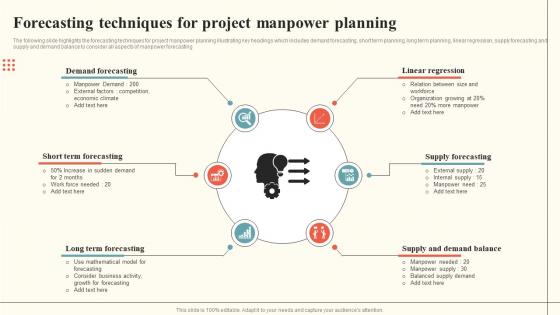
The following slide highlights the forecasting techniques for project manpower planning illustrating key headings which includes demand forecasting, short term planning, long term planning, linear regression, supply forecasting and supply and demand balance to consider all aspects of manpower forecasting.
People who downloaded this PowerPoint presentation also viewed the following :
Forecasting Techniques For Project Manpower Planning with all 6 slides:
Use our Forecasting Techniques For Project Manpower Planning to effectively help you save your valuable time. They are readymade to fit into any presentation structure.





FAQs for Forecasting Techniques For
The most commonly used forecasting techniques include time series analysis, regression modeling, moving averages, exponential smoothing, and scenario planning. These methods enhance decision-making by analyzing historical data, identifying market trends, and predicting future performance across sectors like retail inventory management and financial planning, ultimately delivering strategic insights and competitive advantage in an increasingly data-driven business environment.
Qualitative forecasting methods rely on expert judgment, market research, and subjective insights, while quantitative methods use historical data, statistical models, and mathematical algorithms. While quantitative approaches excel in stable environments with abundant data, qualitative methods prove invaluable for new product launches, emerging markets, and unprecedented situations, with many organizations finding that strategic combination of both delivers more accurate, comprehensive forecasting results.
Historical data and trends serve as the foundation for forecasting accuracy by providing patterns, seasonal variations, cyclical behaviors, and baseline metrics that algorithms analyze to predict future outcomes. Through comprehensive historical analysis, organizations in retail, manufacturing, and financial services can identify demand patterns, market fluctuations, and customer behaviors, ultimately enhancing prediction reliability and strategic planning effectiveness.
Machine learning enhances traditional forecasting by processing vast datasets, identifying complex patterns, and adapting to changing conditions in real-time. Through advanced algorithms, organizations streamline demand planning, optimize inventory management, and improve financial projections, while reducing human error and computational time, ultimately delivering more accurate predictions and competitive advantage in increasingly dynamic markets.
Time series analysis offers advantages including trend identification, seasonal pattern recognition, automated forecasting capabilities, and historical data utilization for predictive modeling. However, it presents limitations through assumptions of data stationarity, difficulty handling external factors, and reduced accuracy during volatile periods, with many organizations finding that combining time series with other forecasting methods delivers more robust predictions and strategic planning outcomes.
Organizations should consider scenario forecasting during periods of high uncertainty, strategic planning initiatives, risk management assessments, market entry decisions, and regulatory changes. This approach enables companies to prepare for multiple potential futures by modeling various outcomes, with many financial institutions, healthcare systems, and manufacturing firms finding that scenario analysis enhances decision-making resilience and competitive positioning.
External factors like economic indicators significantly impact forecasting reliability by introducing volatility, shifting market conditions, and altering consumer behavior patterns that models must continuously adapt to accommodate. While these indicators present challenges for accuracy, they also enhance forecasting depth when properly integrated, with many financial institutions and retail organizations finding that incorporating GDP trends, inflation rates, and employment data ultimately delivers more robust predictions and strategic competitive advantage.
Seasonality significantly impacts retail demand forecasting by creating predictable patterns around holidays, weather changes, and shopping cycles that require specialized analytical approaches. Retailers use historical data analysis, seasonal decomposition models, and adaptive algorithms to anticipate fluctuations, with many fashion and grocery chains finding that accurate seasonal forecasting reduces inventory costs while improving customer satisfaction.
Determining the appropriate forecasting technique involves analyzing data availability, industry volatility, seasonal patterns, and required accuracy levels. Industries like retail benefit from seasonal models, while manufacturing often uses trend analysis and financial services leverage econometric methods, with many organizations finding that combining multiple techniques ultimately delivers enhanced accuracy and competitive advantage.
Best practices for combining forecasting methods include using ensemble approaches, weighting models based on historical accuracy, applying different techniques to various time horizons, and regularly updating model combinations based on performance metrics. Through strategic combination, organizations in retail, manufacturing, and financial services enhance prediction accuracy, reduce forecast errors, and improve decision-making capabilities, ultimately delivering more reliable insights and competitive advantage.
Businesses effectively communicate forecasts through clear visual presentations, executive summaries with key assumptions, scenario planning with risk assessments, and regular update schedules. These approaches enhance stakeholder understanding by translating complex data into actionable insights, addressing uncertainty transparently, and providing context for decision-making, ultimately building trust and enabling strategic alignment across organizations.
**INPUT**: What tools and software are recommended for improving forecasting processes? **OUTPUT**: Recommended forecasting tools include Excel with advanced functions, specialized software like SAS Forecast Server, IBM SPSS, R with forecasting packages, and cloud-based platforms like Tableau and Power BI. These technologies streamline data analysis, automate model selection, and enhance visualization capabilities, with many organizations finding that integrated platforms ultimately deliver faster insights and more accurate predictions across departments. [Word count: 58 words]
Organizations can assess forecasting accuracy through statistical measures like Mean Absolute Error, Root Mean Square Error, and Mean Absolute Percentage Error, alongside tracking forecast bias and seasonal variations. By comparing predicted versus actual results across different time horizons, companies in retail, manufacturing, and financial services enhance demand planning, inventory management, and strategic decision-making, ultimately delivering improved operational efficiency and competitive advantage.
Ethical forecasting considerations include transparency about data sources and methodologies, acknowledgment of uncertainty levels, avoiding bias in model selection, protecting stakeholder privacy, and clearly communicating limitations. Organizations across sectors like healthcare, finance, and public policy find that ethical forecasting practices build stakeholder trust, reduce liability risks, and ultimately deliver more credible decision-making frameworks.
Collaborative forecasting methods enhance supply chain management by improving demand accuracy, reducing inventory costs, and strengthening supplier relationships through shared data visibility. These approaches enable manufacturers, retailers, and distributors to synchronize production planning, minimize stockouts, and optimize resource allocation, with many organizations finding that collaborative processes deliver faster response times and ultimately create competitive advantage in increasingly complex markets.
-
A library of engaging, customizable and content-ready templates.
-
I was never satisfied with my own presentation design but SlideTeam has solved that problem for me. Thank you SlideTeam!