


Four arrows for sequential process flow flat powerpoint design




Try Before you Buy Download Free Sample Product
 Impress Your
 Audience
 100%
100% Editable
 Save Hours
 of Time


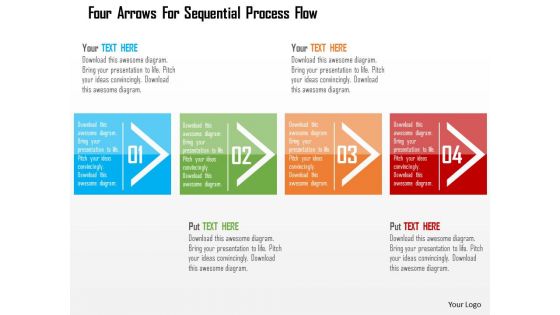
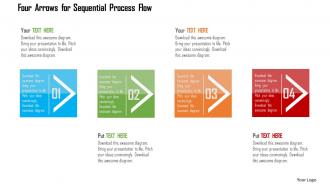
Using a PowerPoint presentation that describes process flow has never been easier. With our four arrows for sequential process flow flat PowerPoint design, any professional can master the explanation for depicting the sequence of different stages involved in a process. With this PPT template, things can get simpler for companies that operate within the ambit of marketing or sales industry. Usually, companies and their employees look out for PPT diagrams that can help them render presentation explain how a particular process completes itself. In this presentation template, we have infused four arrows through which you can signify the starting point and the finishing point of a specific process. The arrows are in sequence and you can introduce variations in terms of their color patterns and sizes. As the PowerPoint template allows addition of text, it gives a lot of context to each and every arrow and thus the overall process becomes a visual delight imparting necessary knowledge through text. Function in harmony with our Four Arrows For Sequential Process Flow Flat Powerpoint Design. They excel at building cohesiveness.
People who downloaded this PowerPoint presentation also viewed the following :
Four arrows for sequential process flow flat powerpoint design with all 5 slides:
Allow a feeling of comfort to flow with our Four Arrows For Sequential Process Flow Flat Powerpoint Design. They enable you to handle any fatigue.
FAQs for Four arrows for sequential process flow
Map out what you're doing now first - that's where you'll spot the messy parts. You need clear start/stop points and logical steps that actually make sense. Decision points should have real criteria, not just "use your judgment" (ugh). Build in feedback loops because catching problems early beats dealing with disasters later, obviously. Each step needs an owner and a way to measure if it worked. Oh, and document everything so people aren't constantly asking "wait, what comes next?" Don't forget handoffs between team members - those always get screwed up otherwise.
Dude, seriously grab a whiteboard first - it'll save you so much headache. When you map stuff out visually, all the connections between steps become super obvious. Flowcharts, timelines, even just sticky notes work great. You'll spot weird bottlenecks and redundant steps that would be impossible to catch from text alone. I'm kind of obsessed with the box-and-arrow method honestly, it's so simple but works for everything. Missing pieces jump out at you too when it's all laid out. Way better than trying to hold some complex process in your head while reading through paragraphs of descriptions.
Assembly lines and patient care are perfect examples - each step has to happen in order. You'll find this works great in food production and pharma too since skipping steps creates safety nightmares. Banking does loan approvals this way, and honestly, most software development follows similar patterns. The thing is, it only makes sense when one screwup early ruins everything downstream. If your process has clear dependencies and you need quality checkpoints, sequential flows will save you tons of trouble. Even logistics companies swear by it.
Honestly, digital tools completely changed how I approach process design. You can map everything out visually first - way better than trying to keep it all in your head. Drag and drop the steps around, spot where things get stuck, then run simulations to test changes without breaking anything real. I mostly use Lucidchart but there's tons of options. The collaboration part is huge too since everyone can jump in and edit together. Oh, and you don't lose work when someone accidentally erases the whiteboard! Start by digitizing whatever process you're working on, then play around with different versions.
Don't try mapping everything at once - you'll drown in details. Skip the decision points (those diamonds) and you're screwed. People always forget error handling too, which is honestly just asking for trouble later. Be specific with your steps instead of writing vague stuff like "process data" - say "validate email format" or whatever it actually does. Walk through it linearly first, then get fancy. Oh, and ditch the internal jargon unless everyone knows what you're talking about. Best trick? Have someone else test your flow. You'll miss obvious gaps every time.
So basically sequential means doing one thing at a time - finish step A, then move to step B. Parallel is when you can run multiple things at once. Like with laundry, you could wash-dry-fold in order, or you could throw in a second load while the first one's still drying. Way faster that way. Sequential's definitely easier to debug when something goes wrong though - I've learned that the hard way lol. If your tasks depend on each other, go sequential. Independent tasks? Parallel's your friend.
Start with cycle time - it's the easiest to track and shows you exactly how long each item takes from beginning to end. You'll also want to measure throughput (items completed per day/hour) and lead time, which includes waiting around. Bottleneck analysis is huge because there's literally always some step that's dragging everything down. I'd also track your work-in-progress levels and defect rates at each stage. Honestly, cycle time gives you the biggest bang for your buck when you're just getting started - everything else builds from there.
Honestly, I'd bake feedback right into your process from the start. Get stakeholders involved when you're mapping everything out initially - they'll catch stuff you miss. Then set up review checkpoints between your major steps so people can actually weigh in before you've gone too far down the wrong path. Skip the marathon meetings though, async feedback is way less painful for everyone. Once you roll things out, don't just disappear - do quick pulse checks or whatever works to spot problems early. The trick is making it part of the actual workflow, not something you tack on later when things go sideways.
So break those big sequential flows into smaller chunks that can run parallel to each other. Add buffer stages between the major phases too. Map out your current process first and look for natural spots where you can actually split things up - honestly, way fewer steps need strict ordering than people think. Most of the "this has to happen first" stuff is just how it's always been done. Build in review checkpoints and make sure teams know how to hand things off cleanly. Oh, and identify which dependencies are real vs which ones are just tradition. That's the key.
Honestly, workflow tools are game-changers for this stuff. Map out your whole process digitally first - you'll spot problems right away. The automation part is clutch because it handles all those tedious handoffs between steps. Real-time tracking means you catch bottlenecks before they screw everything up. I probably spend way too much time nerding out over the analytics, but the data shows you exactly which steps always take forever. Then you know where to actually focus your fixes instead of guessing. Start simple though - just getting everything mapped out digitally will show you tons of opportunities.
Here's what I'd try - break those big sequential chunks into smaller pieces that actually fit your sprints. Map out your current process and see which handoffs are genuinely blockers versus ones that are just... habit? Like, maybe you can start user testing while features are still getting polished. Some steps probably can overlap or run parallel if you really think about it. The trick is figuring out which dependencies actually matter and which ones don't. Honestly, half the battle is just shifting how you think about "done" - does everything need to be 100% finished before the next team touches it? Start with shorter feedback loops and see what happens.
Honestly, once you notice them, sequential flows are literally everywhere. Toyota's assembly lines are the obvious example - each station builds off the last one. Healthcare does it too: intake, diagnosis, treatment, discharge. Same with software dev - requirements to testing to deployment. Even McDonald's (I mean, their system actually works pretty well) has this whole burger sequence down to a science. Here's what I'd do: map out whatever process you're dealing with first. Then look for the handoff points between steps - that's usually where things get messy and you can make improvements.
Honestly, flowcharts are your best friend here - way better than drowning people in paragraphs. Start with the end result first, then work backwards through each step. I've found that using their everyday work terms (not the technical jargon) makes a huge difference. Colors help separate different phases or teams involved. One thing that works really well? Ask them to explain it back to you. You'll instantly see where they got confused and can fix those spots. Also, keep it conversational - like you're just walking them through it over coffee rather than giving some formal presentation.
Work backwards from your end goal - that's honestly the easiest way to catch all the steps. Keep your descriptions short and use action verbs, nobody's got time for lengthy explanations. Decision points are huge, mark wherever the process could branch off. Oh and definitely test it on someone fresh - they'll spot the gaps you're blind to. I learned that one the hard way! Number everything and add timing details if relevant. The real win? When someone can follow your process without texting you questions every five minutes.
So you basically have to bake all that compliance stuff right into your workflow from day one - can't just slap it on later. Map out where your sign-offs happen, who's approving what, all that documentation nonsense. Yeah it's annoying but trust me, way better than scrambling to fix things after the fact. Find your critical control points first, then build everything around those required stops. Oh and make sure you know exactly what records you're generating at each step. Short version: design the whole thing with regulations in mind or you'll hate yourself later.
-
Easy to edit slides with easy to understand instructions.
-
Easy to edit slides with easy to understand instructions.