


Big Data And Its Types Powerpoint Presentation Slides




Try Before you Buy Download Free Sample Product
 Impress Your
 Audience
 100%
100% Editable
 Save Hours
 of Time


Big Data is a massive collection of data that continues to increase dramatically over time. It is a data set that is so vast and complicated that no standard data management technologies can effectively hold or handle it. Grab our efficiently designed Big Data and its Types template that provides details about the problems experienced by organizations to manage big data and their solutions. It further highlights the top sources of big data analytics, architecture, and workflow of extensive data management. This presentation covers sections for the different types of data, multiple resources of big data analytics, working of big data analytics, technologies, etc. It also comes with a ready-made checklist for big data analytics management. Additionally, this PPT talks about the impacts of extensive data management on business processes and their benefits. Furthermore, this template includes a training program for comprehensive data management, budget planning, and big data analytics applications in different sectors such as healthcare, education, automobile, finance, etc. Lastly, this deck comprises a dashboard for comprehensive data management. Download it now.
People who downloaded this PowerPoint presentation also viewed the following :
Content of this Powerpoint Presentation
Slide 1: This slide displays title i.e. 'Big Data and its Types' and your Company Name.
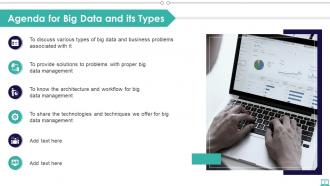
Slide 2: This slide presents agenda.
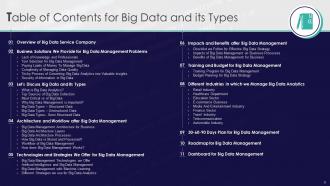
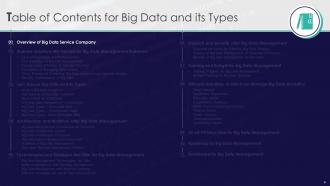
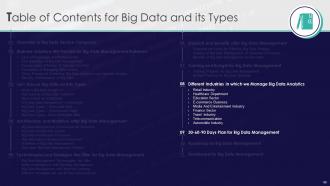
Slide 3: This slide exhibits table of contents.
Slide 4: This slide depicts title for one topic that is to be covered next in the template.
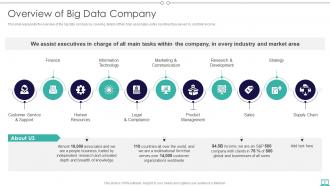
Slide 5: This slide represents the overview of the big data company by covering details of their total associates, entire countries they served in, and total income.
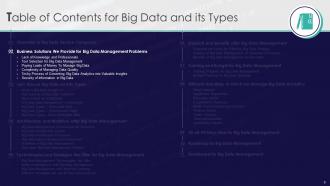
Slide 6: This slide depicts title for six topics that are to be covered next in the template.
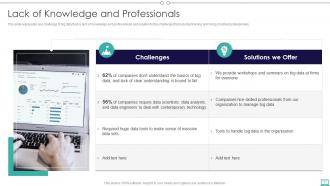
Slide 7: This slide represents one challenge of big data that is lack of knowledge and professionals and solution to this challenge.
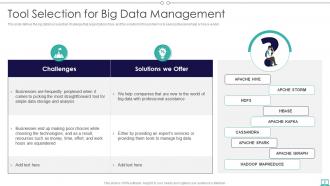
Slide 8: This slide defines the big data tool selection challenge that organizations face.
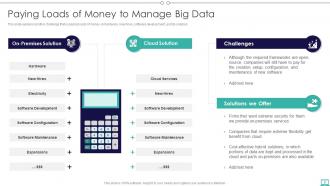
Slide 9: This slide explains another challenge that is paying loads of money on hardware, new hires, software development, and its solution.
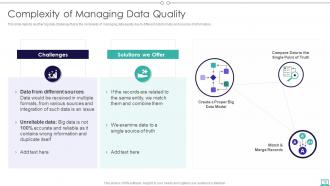
Slide 10: This slide depicts another big data challenge that is the complexity of managing data quality due to different data formats and sources of information.
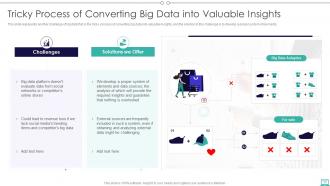
Slide 11: This slide represents another challenge of big data that is the tricky process of converting big data into valuable insights.
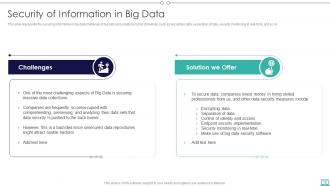
Slide 12: This slide represents the securing information in big data challenge of big data and solutions to this challenge.
Slide 13: This slide depicts title for seven topics that are to be covered next in the template.
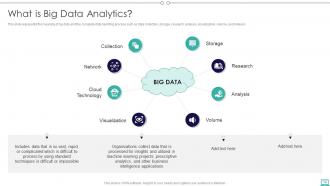
Slide 14: This slide represents the meaning of big data and the complete data handling process such as data collection, storage, research, etc.
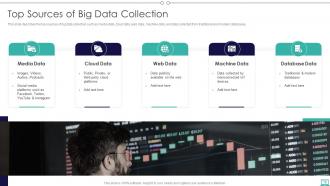
Slide 15: This slide describes the top sources of big data collection such as media data, cloud data, web data, machine data, etc.
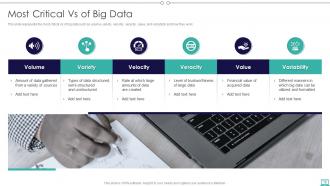
Slide 16: This slide represents the most critical Vs of big data such as volume, variety, velocity, veracity, value, and variability and how they work.
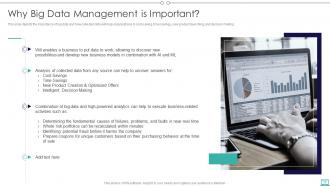
Slide 17: This slide depicts the importance of big data and how collected data will help organizations in cost-saving, time savings, etc.
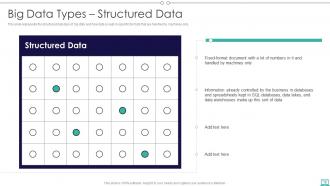
Slide 18: This slide represents the structured data type of big data and how data is kept in specific formats that are handled by machines only.
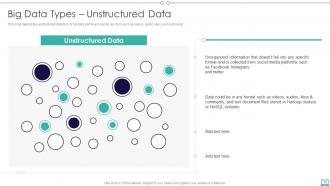
Slide 19: This slide depicts the unstructured data form of big data and how it can be any form such as videos, audio, likes, and comments.
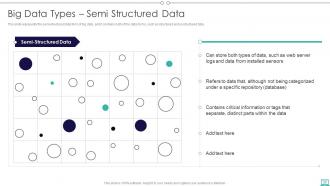
Slide 20: This slide represents the semi-structured data form of big data, and it contains both of the data forms, such as structured and unstructured data.
Slide 21: This slide depicts title for six topics that are to be covered next in the template.
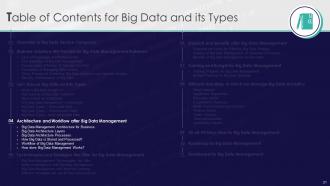
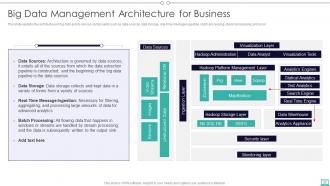
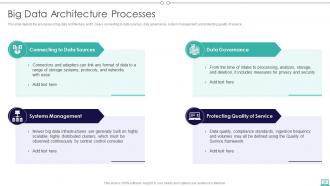
Slide 22: This slide explains the architecture of big data and its various components such as data sources, data storage, etc.
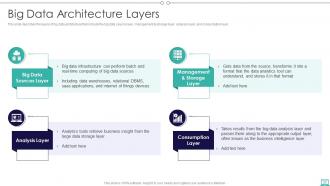
Slide 23: This slide describes the layers of big data architecture that include the big data source layer, management & storage layer, etc.
Slide 24: This slide depicts the processes of big data architecture.
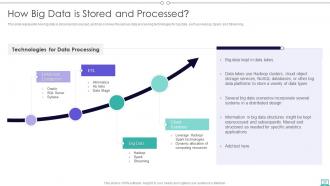
Slide 25: This slide represents how big data is stored and processed.
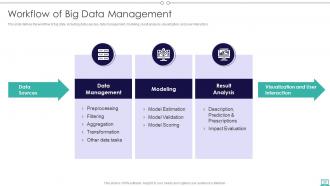
Slide 26: This slide defines the workflow of big data, including data sources, data management, modeling, result analysis, visualization, and user interaction.
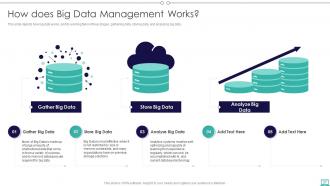
Slide 27: This slide depicts how big data works, and its working falls in three stages: gathering data, storing data, and analyzing big data.
Slide 28: This slide depicts title for four topics that are to be covered next in the template.
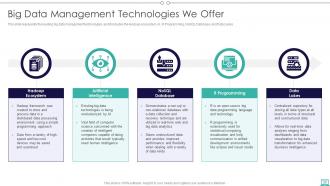
Slide 29: This slide represents the leading big data management technologies, and it includes the Hadoop ecosystem, AI, etc.
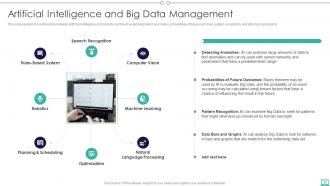
Slide 30: This slide explains the relationship between artificial intelligence and big data and how it would help detect anomalies, etc.
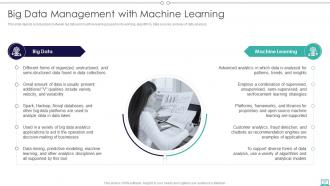
Slide 31: This slide depicts a comparison between big data and machine learning based on its working, algorithms, data sources, and way of data analysis.
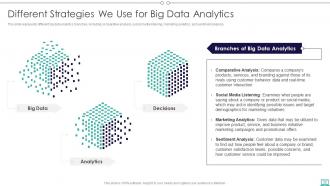
Slide 32: This slide represents different big data analytics branches, including comparative analysis, social media listening, etc.
Slide 33: This slide depicts title for three topics that are to be covered next in the template.
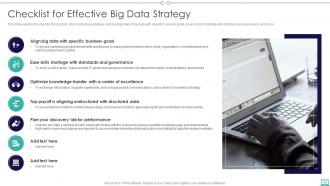
Slide 34: This slide explains the checklist for big data.
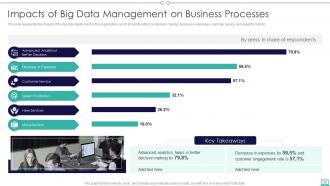
Slide 35: This slide represents the impacts of the big data deployment on the organization.
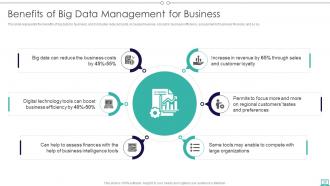
Slide 36: This slide represents the benefits of big data for business, and it includes reduced costs, increased revenue, etc.
Slide 37: This slide depicts title for two topics that are to be covered next in the template.
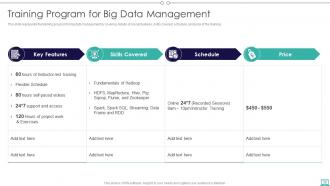
Slide 38: This slide represents the training program for big data management by covering details of crucial features, skills covered, schedule, etc.
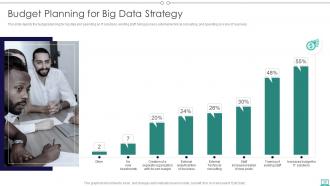
Slide 39: This slide depicts the budget planning for big data and spending on IT solutions, existing staff, hiring process, etc.
Slide 40: This slide depicts title for ten topics that are to be covered next in the template.
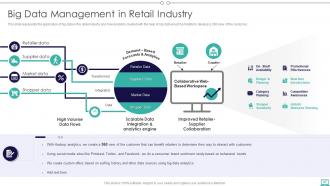
Slide 41: This slide represents the application of big data in the retail industry.
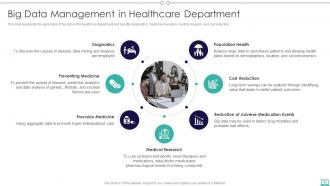
Slide 42: This slide represents the application of big data in the healthcare department and benefits diagnostics, medicine prevention, etc.
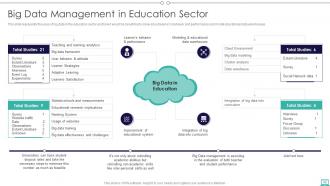
Slide 43: This slide represents the uses of big data in the education sector.
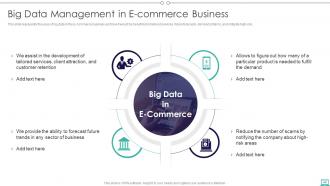
Slide 44: This slide represents the uses of big data in the E-commerce business and how it would be beneficial in tailored services, future forecasts, etc.
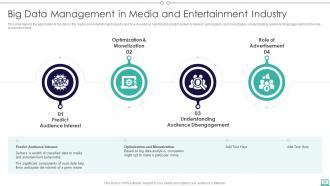
Slide 45: This slide depicts the application of big data in the media and entertainment industry.
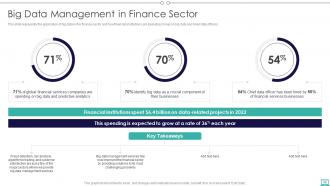
Slide 46: This slide represents the application of big data in the finance sector and how financial institutions are spending money on big data and hired data officers.
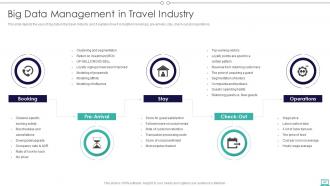
Slide 47: This slide depicts the uses of big data in the travel industry, and it explains how it is helpful in bookings, pre-arrivals, stay, check-out and operations.
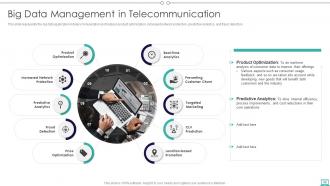
Slide 48: This slide represents the big data application in telecommunication and helps in product optimization, increased network protection, etc.
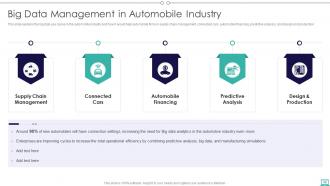
Slide 49: This slide explains the big data use cases in the automobile industry and how it would help automobile firms in supply chain management, etc.
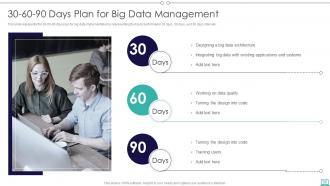
Slide 50: This slide represents the 30-60-90 days plan for big data implementation by representing the tasks performed in 30 days, 60 days, and 90 days intervals.
Slide 51: This slide depicts title for one topic that is to be covered next in the template.
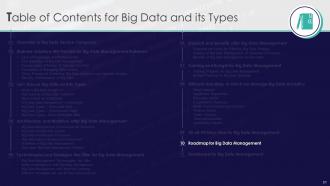
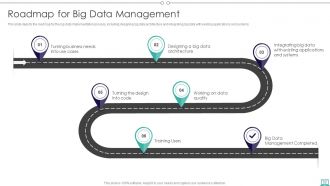
Slide 52: This slide depicts the roadmap for the big data implementation process, including designing big data architecture and integrating big data.
Slide 53: This slide depicts title for one topic that is to be covered next in the template.
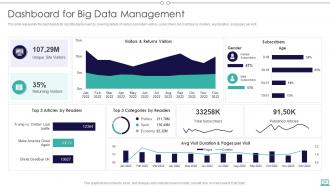
Slide 54: This slide represents the dashboards for big data deployment by covering details of visitors and return visitors, subscribers, etc.
Slide 55: This is the icons slide.
Slide 56: This slide presents title for additional slides.
Slide 57: This slide shows about your company, target audience and its client's values.
Slide 58: This slide presents your company's vision, mission and goals.
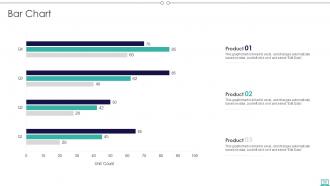
Slide 59: This slide exhibits quarterly bar charts for different products. The charts are linked to Excel.
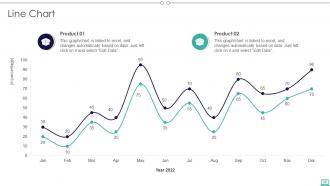
Slide 60: This slide exhibits monthly line charts for different products. The charts are linked to Excel.
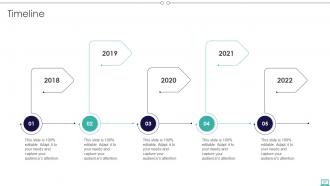
Slide 61: This slide exhibits yearly timeline.
Slide 62: This slide highlights comparison of products based on selects.
Slide 63: This slide showcases financials.
Slide 64: This slide exhibits ideas generated.
Slide 65: This is thank you slide & contains contact details of company like office address, phone no., etc.
Big Data And Its Types Powerpoint Presentation Slides with all 70 slides:
Use our Big Data And Its Types Powerpoint Presentation Slides to effectively help you save your valuable time. They are readymade to fit into any presentation structure.







FAQs for Big Data And Its Types
Honestly, most big data comes from stuff we do every day without thinking about it. Your phone's probably the worst offender - GPS tracking, app usage, all those sensors running constantly. Social media and web browsing create huge amounts too, plus IoT devices if you have smart home stuff. Business-wise, you've got transaction records, customer databases, operational systems churning out data 24/7. Streaming and gaming platforms are insane data generators (Netflix probably knows your viewing habits better than you do). The weird part? Most of this happens passively just because we exist online. Figure out which sources actually matter for what you're trying to do first.
Honestly, big data is a game changer because you're not just winging it anymore. You can actually see what customers do across millions of interactions instead of making educated guesses. Like, forget trusting your gut when you've got real patterns showing you exactly what's happening. The cool part? You can predict stuff before it happens and personalize everything at scale. Operations get smoother, you spot market shifts early - it's pretty nuts compared to just looking at last quarter's numbers. My advice though: don't go crazy trying to analyze everything at once. Pick one decision you make all the time and see what data might help.
Honestly, the big ones are privacy and consent issues - people have no clue how much data gets scraped up about them. Algorithmic bias is huge too, like when hiring algorithms discriminate against women or minorities. That stuff keeps me up at night tbh. Data breaches are always lurking around the corner, and most companies are terrible at being upfront about what they're actually doing with your info. Oh, and here's my rule of thumb - would you be cool with someone doing this exact same thing with YOUR data? If not, don't do it.
Honestly, build those quality checks straight into your pipeline from the start. Don't even think about treating it as an afterthought - I've watched teams try to retroactively clean everything and it's such a mess. Set up automated rules that catch duplicates, missing data, all that stuff as it comes in. Profile your current data first so you know what "normal" actually looks like. Then monitor continuously around those baselines. Oh, and definitely establish who can touch what data-wise. The whole point is catching problems early before they snowball into bigger headaches.
Honestly, AI is like having a data detective that never gets tired. It'll dig through huge datasets and find patterns you'd miss completely - or spend weeks looking for. Your messy customer data? Machine learning cleans it up automatically and starts predicting trends. The cool part is these models actually get better over time as they process more stuff. I'd just pick one dataset that's been driving you crazy and test out an AI analytics tool. Way easier than trying to tackle everything at once, trust me.
Look, data privacy and big data are constantly butting heads. Companies want to hoover up everything because insights = money, but most people don't realize how their stuff gets used. The more datasets you combine, the trickier privacy gets - patterns emerge that nobody expected. My advice? Do a privacy impact assessment before you collect anything major. Also think about anonymization early, plus consent stuff and GDPR compliance. Trust me, dealing with this upfront beats scrambling later when regulators come knocking.
Interactive dashboards are honestly a game-changer - people love being able to click around and explore the data on their own. Heat maps work really well for spotting patterns, especially with geographic stuff. Don't dump massive tables on people though (like seriously, who wants to scroll through 50k rows?). If your data updates a lot, streaming visualizations are pretty cool. Always add filters so users can zero in on what they actually care about. Tableau and Power BI are solid choices, or D3.js if you're feeling technical.
Dude, big data is seriously changing everything in healthcare right now. Hospitals can actually predict which patients might get readmitted before they even show symptoms - it's wild. All that info from health records, genetic data, and monitoring devices helps doctors make way better calls. Machine learning spots things in medical scans that doctors might miss, so cancer gets caught earlier. Oh, and drug discovery is way faster now too. If you're getting into healthcare tech, definitely focus on making different data systems work together. Privacy stuff is huge though - don't mess that up.
Honestly, the data cleanup is what kills most projects - takes forever and it's mind-numbing work. Good luck finding people who actually know what they're doing with this stuff too, because skilled folks are crazy expensive right now. Your current systems definitely weren't designed for big data, so that's another headache waiting to happen. Oh, and don't even get me started on trying to pull clean data from like 5 different sources. Start with something small first. Get your data processes sorted before you go crazy with it.
Look, you don't need massive amounts of data to beat the big guys. Google Analytics and customer surveys are your best friends here - plus whatever you can pull from social media. Big companies actually get bogged down by all their data anyway, so being smaller helps you move faster. Tools like Mailchimp or HubSpot won't break the bank and they'll automate personalized stuff based on how customers behave. I'd honestly start with just one data source and see what happens. Sometimes less is more, you know? The trick isn't collecting everything - it's being quick with what you've got.
So you're looking at Hadoop for distributed storage, plus Spark for processing - way faster than MapReduce, trust me on that one. NoSQL databases like MongoDB or Cassandra handle unstructured data really well. For real-time streaming, Kafka's your go-to, along with Storm or Flink. Honestly though? Cloud platforms like AWS or Google Cloud have been game-changers since they deal with all the infrastructure mess for you. Then you've got Tableau or Power BI to visualize everything. My advice - figure out your data volume first, then pick tools that actually fit instead of whatever's trending right now.
So companies basically stalk your online behavior - browsing history, what you buy, your social posts - then use that data to predict what you'll want next. Pretty wild how they can guess your needs before you even realize them. You'll see these crazy targeted ads that feel like they're reading your mind. From their side though, they can slice up audiences super precisely and tweak ad budgets on the fly. Even prices change based on demand patterns now. I mean, personalized recommendations are nice and all, but sometimes it crosses into creepy territory where you feel totally exposed.
Honestly, the biggest thing I'm seeing everywhere is AI and ML getting baked into big data platforms. Real-time processing used to be this fancy feature, but now it's just expected. Edge computing is blowing up too - makes sense since nobody wants to ship all their data to some distant server farm. Most companies have ditched their on-prem setups for cloud-native stuff at this point. Oh, and data governance is actually getting serious attention now (probably because of all those privacy regulations breathing down everyone's neck). If you're starting any projects, I'd definitely go with tools that can handle streaming data and won't get you in trouble with compliance.
Data warehouses are like your organized filing cabinet - everything's cleaned up and sorted. Data lakes? More like that messy desktop folder where you dump everything. Warehouses work great when you need fast reporting on structured data. Lakes are better if you're storing tons of random stuff - videos, logs, sensor data, whatever - and don't know how you'll use it yet. Honestly, most companies end up needing both eventually. Pick warehouses for speed and reliability. Go with lakes when you want flexibility to throw in any data type without processing it first.
Dude, the whole big data + IoT thing is exploding right now. Smart cities are actually happening, factories can predict when machines break before they do, and your smartwatch might catch health problems you don't even notice yet. 5G is cool but honestly just the start - edge computing is where it gets wild because devices won't need to ping the cloud for every little decision. Processing happens right there. Way faster responses. Oh, and if you're doing any IoT stuff, figure out your data plan first or you'll be completely overwhelmed by all the info streaming in.
-
Designs have enough space to add content.
-
I joined SlideTeam last month and there’s no doubt that I tend to find our bond only strengthening over time. Best place to find world-class themes, templates, and icons.