


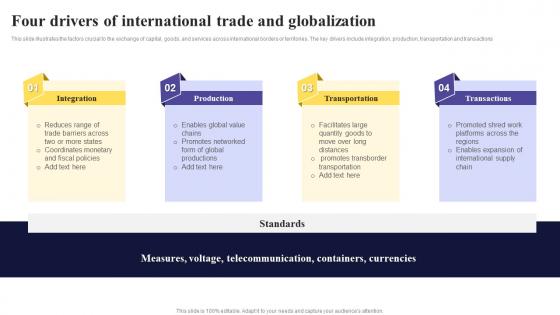
Four Drivers Of International Trade And Globalization




Try Before you Buy Download Free Sample Product
 Impress Your
 Audience
 100%
100% Editable
 Save Hours
 of Time


This slide illustrates the factors crucial to the exchange of capital, goods, and services across international borders or territories. The key drivers include integration, production, transportation and transactions
People who downloaded this PowerPoint presentation also viewed the following :
Four Drivers Of International Trade And Globalization with all 6 slides:
Use our Four Drivers Of International Trade And Globalization to effectively help you save your valuable time. They are readymade to fit into any presentation structure.





FAQs for Four Drivers Of International
**INPUT**: What are the primary factors that have accelerated globalization in the past two decades? **OUTPUT**: Primary globalization accelerators include technological advancement, trade liberalization, digital communication networks, supply chain optimization, and reduced transportation costs. These developments streamline international commerce by enabling faster transactions, seamless cross-border collaboration, and enhanced market access, with many multinational corporations finding that strategic global integration delivers competitive advantages and operational efficiency. [Word count: 52 words]
Trade agreements strengthen bilateral relations by establishing clear frameworks for commerce, reducing tariffs, and creating dispute resolution mechanisms that build mutual trust and economic interdependence. These partnerships enhance diplomatic cooperation, facilitate knowledge exchange, and create shared economic interests, with many nations finding that robust trade relationships ultimately serve as stabilizers during political tensions, delivering stronger alliances and sustainable prosperity.
Technology streamlines global trade through digital payment systems, automated logistics tracking, blockchain-enabled supply chains, AI-powered demand forecasting, and real-time communication platforms. These innovations enhance operational efficiency by reducing transaction costs, minimizing shipping delays, and enabling seamless cross-border partnerships, with many multinational corporations finding that integrated tech solutions ultimately deliver faster market entry and competitive advantage.
E-commerce has revolutionized traditional trade by enabling direct manufacturer-to-consumer relationships, automating supply chain processes, and eliminating geographical barriers through digital marketplaces. This transformation streamlines inventory management, reduces intermediary costs, and accelerates transaction speeds, with retailers like Amazon and Alibaba demonstrating how digital platforms ultimately deliver enhanced customer experiences and global market access.
Emerging markets serve as both significant demand sources and manufacturing hubs, contributing over 40% of global GDP and driving trade through rapid industrialization, growing consumer bases, and competitive production costs. Countries like China, India, and Brazil increasingly shape global supply chains by offering cost-effective manufacturing while simultaneously creating substantial import demand, ultimately reshaping traditional trade patterns and delivering new growth opportunities for multinational corporations.
Cultural exchanges accelerate globalization by creating demand for foreign products, fostering cross-border partnerships, and building consumer familiarity with international brands and services. Through cultural diplomacy, international education, and digital connectivity, businesses increasingly adapt offerings to diverse markets, streamline global operations, and deliver localized experiences, ultimately enhancing competitive advantage in interconnected economies.
Increased global trade creates environmental challenges through carbon emissions from transportation, packaging waste, resource depletion, and pollution from manufacturing processes. However, many organizations are addressing these through sustainable supply chain practices, carbon offset programs, and green logistics solutions, with companies increasingly finding that environmentally responsible trade practices deliver both regulatory compliance and competitive advantage in today's sustainability-focused marketplace.
Political stability significantly enhances trade relations by reducing investment risks, ensuring contract enforcement, providing regulatory predictability, and maintaining consistent trade policies that encourage long-term partnerships. Stable regions like Singapore and Switzerland attract substantial foreign investment and become preferred trading partners, while political uncertainty can disrupt supply chains and deter international business, ultimately making stability a competitive advantage in global markets.
Consumer behavior shapes global trade patterns through demand preferences, purchasing power variations, cultural influences, and digital shopping habits. These behavioral drivers enable companies to identify emerging markets, adapt product offerings across regions, and optimize supply chains, with many multinational corporations finding that understanding local consumer preferences ultimately delivers competitive advantage and sustainable market expansion.
Small businesses entering global markets face regulatory compliance complexities, cultural adaptation requirements, supply chain logistics challenges, currency fluctuation risks, and limited financial resources for international expansion. These obstacles present both barriers and strategic opportunities, with many companies finding that partnering with local distributors, leveraging digital platforms, and focusing on niche markets enables competitive positioning while minimizing operational costs and accelerating market entry.
Tariffs and trade barriers significantly impact international commerce by increasing costs, reducing market access, and creating competitive imbalances across global supply chains. While these measures can protect domestic industries, they often lead to higher consumer prices and reduced efficiency, with many multinational companies finding that strategic diversification and adaptive pricing models help navigate these increasingly complex trade environments.
Multinational corporations influence trade policies through strategic lobbying, regulatory capture, industry associations, and direct government engagement with policymakers. These companies leverage their economic significance, employment impact, and expertise to advocate for favorable tariff structures, tax incentives, and regulatory frameworks, with many finding that coordinated advocacy ultimately delivers competitive advantages and market access expansion.
Fair trade influences globalization by promoting ethical sourcing, sustainable supply chains, and equitable producer compensation, reshaping how multinational corporations approach international commerce. This movement enables companies to enhance brand reputation while supporting developing economies, with many retail and food service organizations finding that fair trade practices deliver improved customer loyalty, regulatory compliance, and long-term supplier relationships in an increasingly conscious marketplace.
Trade wars present both immediate challenges and long-term structural shifts for global economic stability, including disrupted supply chains, reduced international investment, increased consumer costs, and slower GDP growth across affected regions. While protectionist measures initially aim to strengthen domestic industries, many economists find that prolonged trade tensions ultimately undermine competitive advantage, innovation, and market efficiency, with developing economies often experiencing disproportionate impacts on their growth trajectories.
Labor mobility enhances global trade by enabling skill transfers, reducing labor costs, and creating knowledge networks across borders. Through migration patterns, multinational corporations access specialized talent pools, emerging markets develop technical capabilities, and supply chains become more efficient, while countries like Singapore and Dubai increasingly leverage diverse workforces to strengthen their positions as global trading hubs.
-
Out of the box and creative design.
-
I had them make a presentation for an office retirement party. They were very helpful in understanding what we wanted and delivered the perfect presentation. Highly recommended!