


Four goals layout powerpoint topics




Try Before you Buy Download Free Sample Product
 Impress Your
 Audience
 100%
100% Editable
 Save Hours
 of Time


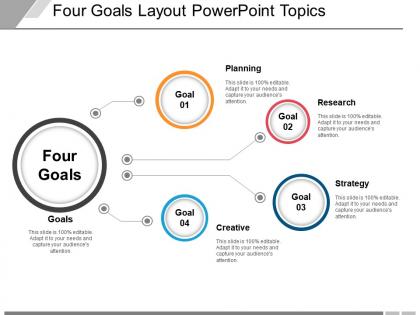
Introducing Four Goals Layout PowerPoint Topic. This template shows the features involved in goal setting which helps you to attain your motive in the best possible manner. With the help of this slide, you can plan your objective and measure your success appropriately. The four goals PowerPoint slide involves a plan designed to motivate an individual to target their aim. This template emphasizes on the complexity and vision related to the goal which helps in time management in order to reach the aim. The slide contains four major properties like setting up of goals, short term, long term and lifetime goals which helps in balancing the level of performance and persistence related to the specified task. This PowerPoint presentation also includes some high-grade icons showcasing relevant information about the significance of planning and plotting in order to achieve the aim. This slide consists of numerous points depicting the frames and phases which helps you to split your preferences respectively. Therefore, download this ready to use PPT and accomplish your objective.
People who downloaded this PowerPoint presentation also viewed the following :
Four goals layout powerpoint topics with all 5 slides:
Give them a clear idea of what to expect with our Four Goals Layout Powerpoint Topics. They will get a clear career breakdown.
FAQs for Four goals
An effective "Four Goals" layout includes clear visual hierarchy, balanced spacing, consistent formatting, compelling icons or graphics, and concise goal statements. These components work together by enhancing audience comprehension, creating memorable visual anchors, and streamlining complex strategic information, with many organizations finding that well-designed goal presentations significantly improve stakeholder alignment and project clarity.
The "Four Goals" layout enhances audience engagement by creating clear visual hierarchy, streamlining complex information into digestible segments, and establishing logical flow that guides attention systematically. This structured approach enables presenters to maintain focus across diverse topics while delivering comprehensive coverage, with many organizations finding that audiences retain information better and participate more actively when objectives are visually segmented and strategically presented.
Strategic objectives, quarterly targets, project milestones, and performance metrics work exceptionally well in four goals layouts, along with vision statements, core values, marketing campaigns, and process improvements. These layouts excel at presenting balanced information sets like departmental priorities, product features, service offerings, and competitive advantages, with many organizations finding that this format creates clear visual hierarchy while enabling audiences to quickly grasp and retain key strategic initiatives.
Visual hierarchy guides viewers through a four goals layout by using size variations, strategic color placement, consistent spacing, and directional flow elements. Through deliberate contrast and positioning, organizations streamline information processing, enhance message retention, and ensure equal emphasis across all four objectives, while maintaining visual balance that ultimately delivers clearer communication and stronger audience engagement.
Common pitfalls include overcrowding each goal with excessive details, creating unequal visual weight between sections, using inconsistent formatting across goals, and failing to establish clear connections between objectives. These design mistakes can confuse audiences and dilute message impact, with many organizations finding that balanced spacing, uniform typography, and logical goal sequencing ultimately deliver clearer communication and stronger strategic alignment.
Color psychology enhances Four Goals layouts by assigning specific colors to evoke desired emotions and behaviors for each goal, creating visual hierarchy through contrasting hues, and using warm colors for action-oriented objectives while cool colors support analytical goals. Many organizations find that strategic color choices, such as blue for trust-building goals and red for urgency-driven targets, significantly improve audience engagement and goal comprehension.
**INPUT**: What tools or software are recommended for presentations with a "Four Goals" layout? **OUTPUT**: Recommended tools include PowerPoint, Google Slides, Keynote, Canva, and Prezi, each offering quadrant templates and strategic layout options. These platforms streamline goal visualization by providing customizable frameworks, drag-and-drop functionality, and collaborative features, with many organizations finding that structured presentation software enhances clarity, accelerates stakeholder alignment, and ultimately delivers more impactful business communications. [Word count: 56 words]
Successful "Four Goals" presentations include strategic business plans outlining market expansion, operational efficiency, customer satisfaction, and revenue growth targets. Companies like tech startups presenting to investors, healthcare organizations showcasing patient care improvements, and retail chains demonstrating digital transformation initiatives effectively use this layout, with many finding that the structured approach enhances stakeholder understanding and accelerates decision-making processes.
Storytelling techniques enhance a Four Goals layout by creating narrative connections between objectives, establishing character-driven scenarios for each goal, and using sequential flow that mirrors story progression. Through problem-solution arcs, emotional hooks, and relatable examples, organizations can transform static goal presentations into compelling narratives, with many finding that stakeholders better understand strategic alignment and feel more invested in achieving outcomes.
A "Four Goals" layout enhances visual hierarchy, improves audience retention, creates balanced information distribution, and enables strategic prioritization compared to traditional bullet points. This structured approach streamlines complex presentations by organizing objectives into digestible quadrants, with many organizations finding that stakeholders better comprehend and remember key initiatives, ultimately delivering clearer communication and more actionable strategic outcomes.
The "Four Goals" layout accommodates complex information by creating distinct quadrants that organize content hierarchically, enabling audiences to process multiple objectives simultaneously without cognitive overload. This strategic framework enhances comprehension through visual compartmentalization and logical flow, with many organizations finding that complex strategic plans, project roadmaps, and operational frameworks become significantly more digestible and actionable.
Design elements to differentiate four goals include distinct color coding, varied iconography, contrasting typography weights, strategic white space allocation, and unique visual borders or frames. These visual techniques enhance comprehension by creating clear hierarchical distinctions, enabling viewers to quickly process individual objectives while maintaining overall layout cohesion, ultimately delivering more effective presentations and strategic communications.
Animations and transitions improve "Four Goals" presentations by revealing each goal sequentially, maintaining audience focus, and creating visual hierarchy that emphasizes progression and interconnection. Strategic transitions enable presenters to control pacing, build anticipation between goals, and enhance storytelling flow, with many organizations finding that animated reveals increase audience engagement and comprehension while delivering more impactful, memorable presentations.
Audience analysis fundamentally shapes each goal's content by revealing stakeholder priorities, comprehension levels, decision-making criteria, and preferred communication styles across different organizational segments. Through demographic, psychographic, and behavioral insights, presenters can tailor goal messaging, complexity, and supporting evidence to resonate with specific audiences, whether executives prioritizing ROI or technical teams focused on implementation details, ultimately delivering more persuasive and actionable presentations.
Peer feedback enhances "Four Goals" layout presentations by identifying unclear messaging, suggesting visual improvements, and validating goal prioritization and logical flow. Through collaborative review sessions, presenters can refine content hierarchy, strengthen supporting evidence, and ensure audience comprehension, with many organizations finding that peer input ultimately delivers more compelling presentations and improved stakeholder buy-in.
-
Great product with highly impressive and engaging designs.
-
Graphics are very appealing to eyes.