


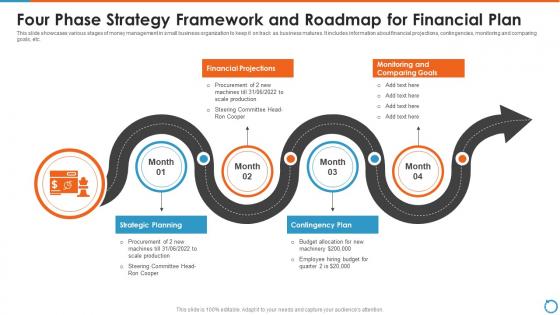
Four Phase Strategy Framework And Roadmap For Financial Plan




Try Before you Buy Download Free Sample Product
 Impress Your
 Audience
 100%
100% Editable
 Save Hours
 of Time


This slide showcases various stages of money management in small business organization to keep it on track as business matures. It includes information about financial projections, contingencies, monitoring and comparing goals, etc.
People who downloaded this PowerPoint presentation also viewed the following :
Four Phase Strategy Framework And Roadmap For Financial Plan with all 6 slides:
Use our Four Phase Strategy Framework And Roadmap For Financial Plan to effectively help you save your valuable time. They are readymade to fit into any presentation structure.





FAQs for Four Phase Strategy Framework And Roadmap
The Four Phase Strategy Framework comprises strategic analysis, strategy formulation, implementation planning, and performance evaluation phases. These components work systematically by assessing market conditions, defining clear objectives, establishing execution roadmaps, and monitoring outcomes, with many organizations finding that this structured approach streamlines decision-making processes and ultimately delivers measurable competitive advantage.
Organizations can effectively identify their current phase by conducting comprehensive assessments of their strategic maturity, operational capabilities, market position, and resource allocation against established benchmarks. Through systematic evaluation frameworks, stakeholder feedback sessions, and performance metrics analysis, companies can pinpoint their developmental stage, ultimately enabling more targeted strategic planning and resource optimization for accelerated growth.
Stakeholder analysis identifies key influencers, decision-makers, supporters, and potential resistors across all four phases, ensuring comprehensive engagement strategies tailored to each group's interests and influence levels. Through systematic mapping and assessment, organizations can prioritize stakeholder communication, anticipate concerns, and leverage champion relationships throughout planning, implementation, monitoring, and evaluation phases, ultimately delivering smoother project execution and stronger buy-in.
Success measurement in each phase requires specific metrics aligned with phase objectives, including milestone completion rates, resource utilization efficiency, stakeholder satisfaction scores, and performance indicators relevant to that phase's deliverables. Organizations typically establish baseline measurements, track progress against predetermined targets, and conduct comprehensive phase reviews that evaluate both quantitative outcomes and qualitative insights, ultimately ensuring each phase delivers its intended value before advancing to subsequent strategic implementation stages.
Organizations should avoid rushing through phases without proper stakeholder alignment, inadequate resource allocation, and failing to establish clear success metrics at each stage. Many companies also struggle with insufficient communication across departments and attempting to skip the foundational planning phase, ultimately compromising execution quality and strategic outcomes.
The Four Phase Strategy Framework adapts across industries by customizing each phase's specific activities, timelines, and success metrics to match sector requirements and regulatory environments. While manufacturing companies might emphasize operational efficiency and supply chain optimization, financial services organizations focus on compliance integration and risk management protocols, with healthcare institutions prioritizing patient outcomes and regulatory adherence, ultimately delivering scalable strategic approaches tailored to industry-specific challenges and opportunities.
Tools that complement the Four Phase Strategy Framework include SWOT analysis, balanced scorecards, OKRs (Objectives and Key Results), project management software, and performance dashboards. These methodologies enhance strategic planning by providing structured assessment capabilities, measurable goal-setting frameworks, and real-time tracking systems, with many organizations finding that this integrated approach streamlines execution and delivers measurable competitive advantage.
The framework facilitates alignment by establishing clear connections between high-level organizational objectives and tactical implementation across all four phases. Through systematic goal mapping, milestone tracking, and stakeholder coordination, organizations can ensure strategic initiatives directly support business priorities, while regular assessment points enable course corrections, ultimately delivering measurable progress toward organizational goals and enhanced strategic coherence.
The Four Phase Strategy Framework enhances team collaboration by establishing clear milestone checkpoints, standardizing communication protocols, and creating shared accountability across project phases. Through structured phase gates and defined deliverables, teams streamline coordination, minimize miscommunication, and maintain alignment on objectives, with many organizations finding that systematic frameworks ultimately deliver improved project outcomes and stronger cross-functional partnerships.
Companies like Microsoft have used four-phase approaches for cloud transformation, progressing through assessment, pilot programs, scaled implementation, and optimization phases. Similarly, Toyota applies phased frameworks in manufacturing improvements, while banks like JPMorgan Chase implement structured phases for digital transformation initiatives, ultimately delivering measurable improvements in operational efficiency, cost reduction, and competitive positioning across their organizations.
Feedback drives progression by identifying gaps between planned outcomes and actual results, enabling strategic adjustments before advancing to subsequent phases. Through systematic evaluation mechanisms, organizations can validate assumptions, refine approaches, and ensure each phase builds effectively on previous achievements, with many finding that structured feedback loops prevent costly misalignments and accelerate overall strategic success.
Transitioning between phases presents challenges including unclear exit criteria, resource reallocation difficulties, stakeholder resistance to change, timeline misalignments, and insufficient communication protocols. While banks and consulting firms often struggle with phase handoffs, organizations increasingly find that establishing clear governance structures, dedicated transition teams, and milestone validation processes ultimately delivers smoother implementations and sustained competitive advantage.
Technology supports the Four Phase Strategy Framework through project management platforms, data analytics tools, collaboration software, and automation systems that streamline planning and execution processes. These digital solutions enable organizations to track progress across all phases, facilitate real-time communication between teams, and generate actionable insights from performance data, ultimately delivering faster implementation cycles and more accurate strategic outcomes.
Team members should develop analytical skills for assessment phases, creative problem-solving for strategy formulation, project management capabilities for implementation, and data interpretation skills for evaluation. Cross-functional competencies like communication, collaboration, and adaptability prove essential throughout, with many organizations finding that teams combining technical expertise, strategic thinking, and change management experience deliver more comprehensive outcomes and sustainable competitive advantage.
The framework addresses market changes through continuous environmental scanning, strategic reassessment, and adaptive planning mechanisms that monitor competitor actions, regulatory shifts, and consumer behavior trends. This systematic approach enables organizations to pivot strategies dynamically, reallocate resources strategically, and maintain competitive positioning, with many companies finding that regular framework reviews deliver enhanced market responsiveness and sustained growth.
-
I am a big fan of their newsletters because that is how I found my perfect requirement at the time of urgency. Thank God, I kept opening those.
-
One word for SlideTeam–Versatile!