

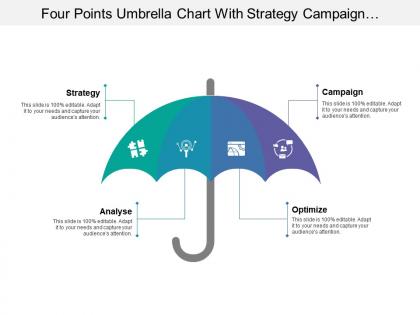
Four points umbrella chart with strategy campaign analyse and optimize




Try Before you Buy Download Free Sample Product
 Impress Your
 Audience
 100%
100% Editable
 Save Hours
 of Time


Demands escalate with our Four Points Umbrella Chart With Strategy Campaign Analyse And Optimize. Calls for your expertise will keep coming in.
People who downloaded this PowerPoint presentation also viewed the following :
Four points umbrella chart with strategy campaign analyse and optimize with all 5 slides:
Immediately dish out all the information with our Four Points Umbrella Chart With Strategy Campaign Analyse And Optimize. Be able to handle insatiable demands.

FAQs for Four points umbrella chart with strategy campaign
Honestly, focus on whether your main KPIs actually improved first - that's the real test. Track how fast you rolled things out and if you're using resources efficiently too. Stakeholder buy-in matters more than people think, plus you need to see if changes actually stick long-term. ROI is obvious but don't stress about it the first few months since strategic stuff takes forever to show up in numbers. Way better to watch leading indicators that predict what's coming vs lagging ones telling you old news. Pick maybe 3-5 metrics tied directly to your goals and check monthly - more than that gets messy fast.
Look, data analytics is basically what saves you from making decisions based on hunches and hoping for the best. Instead of guessing what customers want, you actually see their behavior patterns and what's driving sales. Market trends become way clearer too. It's honestly like getting superpowers for your business - sounds cheesy but true. You can spot opportunities early, predict potential problems, and test different strategies without burning through cash. Just make sure you're not getting distracted by metrics that look impressive but don't actually move the needle on your goals.
Honestly, competitive analysis is like your sanity check before making any big moves. Look at what's working for others in your space and what isn't - saves you from face-planting on stuff that's already been tried. I'd pick maybe 3-5 direct competitors and just... watch them. What are they doing quarterly? You'll spot gaps they're missing (hello, opportunity) and benchmark where you actually stand. The failures are almost more valuable than successes tbh. Don't operate in a bubble - I've seen too many startups do that and crash hard. Reality check first, strategy second.
Take a hard look at what your team can actually pull off right now - be brutal about it. Most companies start with grand strategy and then act shocked when reality hits differently. Pick one strategic goal and trace it backwards. What skills do you need? Resources? Better processes? Compare that to what you've got today. The gap is your roadmap. I'd focus on the biggest impact stuff first, but don't ignore what's actually doable. Build some quick wins while you're tackling the harder changes. Regular check-ins help too - nothing worse than realizing you're off track three months later.
Ugh, the worst thing you can do is chase every shiny trend when you see one good week of data. Been there! Pick like 2-3 metrics that actually matter to your customers and stick with them. Don't change everything at once either - you'll never know what worked. I see people optimizing one department while completely ignoring how it screws up another area. Makes no sense. Test stuff gradually instead. Oh, and here's something nobody talks about - sometimes focusing too much on efficiency kills your ability to innovate. Keep asking yourself what your customers actually want, not just what looks good on paper.
Honestly, just talk to your people more. Set up quarterly surveys or grab coffee with frontline staff - they're doing the actual work and see problems you don't. I can't tell you how many "genius" strategies I've watched crash because nobody asked if they were even doable. Get feedback at milestones, not after everything's locked in. Maybe start small? Pick 3-5 people from different departments who'll actually be straight with you and check in monthly. The informal conversations usually give you the best intel anyway.
Honestly, just pick one and stick with it - that's half the battle. Balanced Scorecard works if you need more than just financial metrics. SWOT's probably easiest to start with, though sometimes I think it's almost *too* basic. OKRs are solid for tracking what actually moves the needle. Strategy Maps get more detailed if that's your thing. The framework matters way less than being consistent with whatever you choose. I'd go with whichever one doesn't make your team's eyes glaze over when you bring it up.
Dude, the tech stuff available now is honestly game-changing for strategy work. Real-time analytics and AI can crunch way more data than any team could handle manually. Machine learning finds patterns you'd totally miss - it's actually kind of crazy what gets uncovered. Cloud computing lets you run multiple simulations at once without spending a fortune, which is clutch. Oh, and predictive modeling is getting scary good these days. The trick is not getting distracted by every new tool that pops up. Just focus on what'll actually help your specific situation.
So scenario planning is basically stress-testing your strategy by thinking through different "what if" situations before you dive in. You're not just planning for one future - you're building backup plans for stuff like economic crashes, new competitors showing up, supply chain mess-ups. Sounds super paranoid when I say it like that, but it actually saves you from panicking later. The whole point is figuring out which parts of your strategy are bulletproof and which ones fall apart easily. I'd start simple - just map out 3 or 4 realistic scenarios that could hit your business and see how your current plan holds up in each one.
Get them involved from day one - seriously, don't wait. Tell them exactly why you're doing this optimization and what's in it for them personally. Check in constantly (yeah, it feels like overkill but trust me). People get pulled in a million directions so you'll be repeating yourself a lot. Celebrate the small wins as they happen - builds momentum. Actually listen when they push back too, sometimes they're right about stuff you missed. Oh and don't treat this like you're the expert doing work *for* them. Make it collaborative or you'll hit walls later.
Quarterly reviews are your baseline, but honestly that's kinda slow these days. I'd say every 3-6 months for the big picture stuff, then monthly check-ins to catch any weird trends. Annual reviews? Forget it - companies that do that get smoked when markets shift overnight. Tech moves way faster than manufacturing obviously, so adjust based on your space. Set up some basic dashboard to track your key numbers monthly. Oh and don't overthink the small tweaks between those bigger quarterly sessions. Sometimes you just gotta pivot when something's not working.
Honestly, you can't survive in fast-moving industries without being agile. Market conditions change overnight - just look at how COVID flipped everything. Tech companies that pivoted quickly? They crushed it. The slow ones got left behind. Your strategy becomes this constant cycle of testing and tweaking instead of some dusty five-year plan nobody follows. I mean, streaming basically murdered cable TV in what, a decade? Maybe less. Build flexibility into your planning from the start. That way when disruption hits - and it will - you're already moving while everyone else is still figuring out what happened.
Honestly, benchmarking is like a gut check for your strategy. You'll see exactly where you stand against competitors and catch gaps you didn't even know existed. Plus you can totally "borrow" what's working for other companies in your space. Way better than just making up random goals, right? The trick is comparing the right stuff - pick maybe 3-5 direct competitors and throw in one company you actually aspire to be like. Track their moves regularly. Just make sure you're not comparing apples to oranges with companies that aren't really in your lane.
Honestly, culture is everything when it comes to strategy stuff. Teams that shut down when things get messy? Your optimization plans are dead in the water. I've seen this happen - people just won't adapt if they're scared of failing. But when you've got psychological safety and everyone's cool with testing things out, strategies actually work. Data-driven cultures are gold for this. Before you dive into any big changes, check if your team's mindset even matches what you're trying to do. Sometimes you gotta fix the people side first, which sounds obvious but... yeah.
Think of global trends as your crystal ball - they show you where things are heading before your local market catches on. Like, if everyone's going crazy for sustainability worldwide, you better start weaving that into your strategy now, even if your town hasn't fully embraced it yet. Your customers will expect it eventually anyway. I always tell people to pick 2-3 big trends in their industry and figure out how they'll mess with (or help) their local game plan. You can't just optimize in your little bubble anymore - that global stuff trickles down faster than you think.
-
Best way of representation of the topic.
-
Great designs, Easily Editable.