


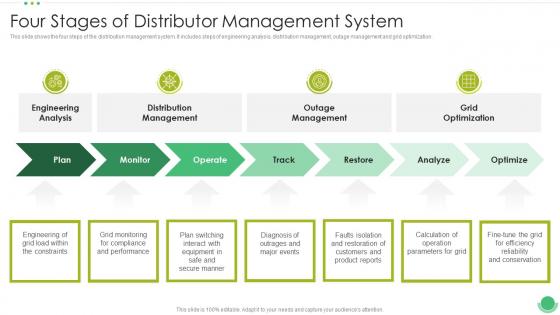
Four Stages Of Distributor Management System




Try Before you Buy Download Free Sample Product
 Impress Your
 Audience
 100%
100% Editable
 Save Hours
 of Time


This slide shows the four steps of the distribution management system. It includes steps of engineering analysis, distribution management, outage management and grid optimization.
People who downloaded this PowerPoint presentation also viewed the following :
Four Stages Of Distributor Management System with all 6 slides:
Use our Four Stages Of Distributor Management System to effectively help you save your valuable time. They are readymade to fit into any presentation structure.





FAQs for Four Stages Of
Key features of an effective Distributor Management System include real-time inventory tracking, automated order processing, performance analytics, commission management, and territory mapping capabilities. These technologies streamline operations by reducing manual errors, accelerating order fulfillment, and enhancing distributor relationships, with many organizations finding that integrated systems ultimately deliver improved efficiency and stronger competitive positioning.
A Distributor Management System improves supply chain efficiency by automating order processing, providing real-time inventory visibility, and streamlining communication between manufacturers and distributors. These systems enable faster order fulfillment, reduce stockouts and overstock situations, and enhance demand forecasting accuracy, with many retail and manufacturing companies finding significantly lower operational costs and improved customer satisfaction rates.
Real-time data enables effective distributor management by providing instant visibility into inventory levels, sales performance, order status, and market trends across the distribution network. This immediate access streamlines decision-making, enhances supply chain coordination, and improves demand forecasting, with many organizations finding that real-time insights ultimately deliver faster response times and stronger distributor relationships.
A Distributor Management System enhances communication by providing centralized platforms for real-time messaging, automated order updates, shared inventory visibility, and performance tracking dashboards. Through integrated communication tools, manufacturers can streamline partner onboarding, deliver instant product updates, and coordinate promotional campaigns, while distributors receive immediate support and market intelligence, ultimately strengthening collaboration and accelerating revenue growth.
Businesses should track sales volume, order accuracy, inventory turnover, payment timeliness, market penetration rates, and customer satisfaction scores to evaluate distributor performance comprehensively. These metrics enable organizations to identify top-performing partners, streamline supply chain operations, and optimize territory management, with many companies finding that regular performance monitoring ultimately delivers stronger partnerships and improved market reach.
Automation in a Distributor Management System reduces operational costs by streamlining order processing, minimizing manual data entry errors, and accelerating inventory turnover cycles. Through automated workflows, distributors eliminate redundant administrative tasks, reduce labor expenses, and enhance supply chain efficiency, with many retail and manufacturing organizations finding that automated systems deliver 20-30% cost reductions while improving customer service responsiveness.
Companies face integration complexities with existing systems, data migration issues, user resistance to new processes, and initial setup costs when implementing Distributor Management Systems. While these challenges require careful planning and training investments, organizations across retail, manufacturing, and consumer goods find that strategic implementation ultimately delivers streamlined operations, enhanced distributor relationships, and improved supply chain visibility.
A Distributor Management System supports compliance by automating regulatory reporting, maintaining detailed audit trails, and ensuring adherence to industry standards through built-in compliance workflows. These systems streamline documentation requirements, track regulatory changes, and generate real-time compliance reports, with many organizations finding that automated compliance monitoring significantly reduces regulatory risks while enhancing operational transparency.
A Distributor Management System enhances risk management through real-time inventory tracking, automated compliance monitoring, credit limit controls, performance analytics, and fraud detection capabilities. By streamlining supplier assessments, payment monitoring, and regulatory compliance across multiple channels, organizations can minimize financial exposure, reduce operational disruptions, and maintain stronger partnerships, ultimately delivering greater supply chain resilience and competitive advantage.
Integration with existing ERP systems enhances Distributor Management Systems by synchronizing financial data, automating order processing, and streamlining inventory management across all business functions. This strategic combination eliminates data silos, reduces manual data entry errors, and enables real-time visibility into distributor performance, ultimately delivering improved operational efficiency and faster decision-making capabilities for growing enterprises.
Cloud-based Distributor Management Systems offer scalability, automatic updates, lower upfront costs, and remote accessibility, while on-premise systems provide greater data control, customization options, and enhanced security for sensitive operations. Many distributors find that cloud solutions streamline implementation and reduce IT overhead, though organizations with complex compliance requirements often prefer on-premise deployments for strategic data governance.
A Distributor Management System facilitates better inventory management by providing real-time stock visibility, automated reorder alerts, and demand forecasting capabilities across multiple locations. Through centralized tracking and analytics, distributors can minimize stockouts, reduce carrying costs, and optimize warehouse efficiency, while seamlessly coordinating with suppliers and retailers to maintain optimal inventory levels throughout their distribution network.
Companies like Hindustan Unilever, Coca-Cola, and Procter & Gamble have transformed their distribution networks using DMS platforms, achieving 30-40% reduction in order processing times and enhanced supply chain visibility. These implementations streamlined inventory management, automated distributor onboarding, and improved demand forecasting, with many organizations finding that real-time analytics and centralized operations ultimately deliver better distributor relationships and competitive market advantage.
User-friendly interfaces significantly accelerate DMS adoption by reducing training time, minimizing resistance to change, and enabling faster user onboarding across organizations. Intuitive dashboards and streamlined navigation help distributors, sales teams, and administrators quickly access critical inventory data, order processing tools, and performance analytics, ultimately delivering higher system utilization rates and improved operational efficiency.
**INPUT**: What trends are shaping the future of Distributor Management Systems in the digital age? **OUTPUT**: Key trends shaping Distributor Management Systems include AI-powered analytics, cloud-based platforms, mobile accessibility, IoT integration, and blockchain transparency. These technologies streamline operations by automating inventory tracking, enhancing real-time communication, and delivering predictive insights, with many organizations finding that strategic digitalization ultimately enables faster decision-making and competitive advantage. *[Word count: 54 words]*
-
One-stop solution for all presentation needs. Great products with easy customization.
-
The designs by SlideTeam are honestly the best I have seen so far. Will be definitely coming back for more.