


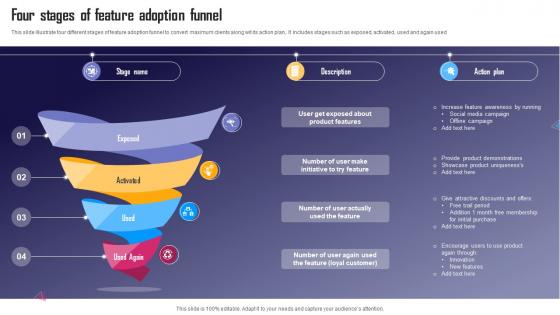
Four Stages Of Feature Adoption Funnel




Try Before you Buy Download Free Sample Product
 Impress Your
 Audience
 100%
100% Editable
 Save Hours
 of Time


This slide illustrate four different stages of feature adoption funnel to convert maximum clients along wit its action plan,. It includes stages such as exposed, activated, used and again used
People who downloaded this PowerPoint presentation also viewed the following :
Four Stages Of Feature Adoption Funnel with all 6 slides:
Use our Four Stages Of Feature Adoption Funnel to effectively help you save your valuable time. They are readymade to fit into any presentation structure.





FAQs for Four Stages Of
Strategies include user onboarding tutorials, personalized template recommendations, interactive design workshops, feedback collection systems, and gamification elements. Through targeted email campaigns and in-app notifications, organizations can highlight template benefits while providing customization guides, ultimately driving adoption rates higher and enabling teams to create more compelling, professional presentations faster.
Feedback loops can be established through in-app surveys, usage analytics, user interviews, A/B testing, and feature-specific feedback widgets integrated directly into the interface. These mechanisms enable organizations to capture real-time user sentiment, identify adoption barriers, and iterate rapidly, with many companies finding that continuous feedback cycles ultimately enhance user satisfaction and accelerate feature refinement across their platforms.
**INPUT**: What metrics are most effective in measuring the adoption rate of new presentation features? **OUTPUT**: Effective metrics include feature usage frequency, user activation rates, time-to-first-use, retention rates after initial adoption, and task completion rates with new features. These measurements enable organizations to assess user engagement patterns, identify training needs, and optimize feature rollouts, with many companies finding that combining usage analytics with user feedback surveys ultimately delivers comprehensive insights into adoption success and areas requiring additional support. [Word count: 60 words]
User training significantly impacts template adoption by building user confidence, reducing implementation barriers, and accelerating proficiency with advanced features. Through structured onboarding and hands-on workshops, organizations streamline template integration, minimize resistance to new tools, and enhance presentation quality, with many companies finding that comprehensive training programs deliver faster user adoption and improved communication outcomes.
Community building significantly enhances feature adoption by creating peer-to-peer learning environments, fostering user advocacy, and providing collaborative feedback channels that accelerate feature discovery and mastery. Through active forums and user groups, organizations like Slack and HubSpot enable knowledge sharing, reduce onboarding friction, and build feature champions, ultimately delivering higher engagement rates and sustained product growth across their user base.
Personalization significantly enhances user satisfaction by enabling customized workflows, relevant content suggestions, and industry-specific templates that align with individual preferences and business needs. Organizations implementing personalized template systems experience higher engagement rates, reduced learning curves, and faster project completion times, with many finding that tailored experiences drive sustained adoption and improved productivity outcomes.
Common barriers include overwhelming interface complexity, insufficient onboarding guidance, fear of disrupting established workflows, time constraints for learning, and lack of clear value demonstration. Many organizations find that users resist adopting new presentation features when training resources are inadequate or when the benefits aren't immediately apparent, ultimately requiring strategic change management and comprehensive support systems.
A/B testing enables template functionality assessment by creating control and variant groups, measuring user engagement metrics, tracking completion rates, and analyzing behavioral patterns across different feature sets. Through systematic testing, organizations can identify which functionalities enhance user experience, reduce abandonment rates, and increase template utilization, with many finding that data-driven insights significantly improve feature adoption and overall platform effectiveness.
Storytelling enhances new template features by creating emotional connections, demonstrating real-world applications, and illustrating transformation journeys that resonate with users' challenges. Through narrative-driven presentations, organizations showcase how specific features solve problems in sectors like healthcare, finance, and consulting, ultimately helping users visualize success and accelerate adoption rates.
**INPUT**: What type of user support is most beneficial during the initial rollout of new templates? **OUTPUT**: The most beneficial user support includes live training sessions, comprehensive documentation, dedicated help desks, interactive tutorials, and peer mentoring programs. These approaches streamline adoption by addressing immediate questions, reducing learning curves, and building user confidence, with many organizations finding that combining multiple support channels ultimately delivers faster implementation and higher engagement rates.
Visual aesthetics significantly influence feature adoption by enhancing user engagement, reducing learning curves, and creating positive first impressions that encourage exploration. Well-designed interfaces with intuitive layouts, clear iconography, and appealing color schemes help users quickly understand functionality, while organizations implementing visually appealing presentation tools often find higher adoption rates and improved user satisfaction across teams.
Long-term retention after feature adoption depends on intuitive design, consistent value delivery, seamless integration with existing workflows, and ongoing user support. Through strategic onboarding, regular feedback collection, and continuous feature refinement, organizations enhance user satisfaction, minimize abandonment rates, and ultimately build stronger product loyalty, with many companies finding that personalized experiences significantly improve retention outcomes.
Collaborations enhance feature adoption by leveraging partner networks, cross-promotional opportunities, and shared customer bases to expand reach and credibility. Strategic partnerships with complementary businesses, industry influencers, and technology integrators create multiple touchpoints for feature discovery, with many organizations finding that collaborative marketing efforts deliver faster user onboarding and higher engagement rates.
Competitor analysis reveals that successful feature adoption relies on gradual rollouts, comprehensive user education, clear value communication, and robust feedback loops throughout implementation phases. Many organizations find that competitors who combine strategic timing with intensive user training, personalized onboarding experiences, and continuous iteration based on user behavior data achieve significantly higher adoption rates and sustained engagement.
Innovative marketing tactics include interactive video tutorials, gamified feature challenges, peer showcase competitions, contextual in-app prompts, and collaborative webinar series. These approaches enhance user engagement by demonstrating real-world applications, encouraging hands-on exploration, and fostering community adoption, with many organizations finding that peer-driven demonstrations and contextual learning significantly accelerate feature integration across teams.
-
I have just started downloading templates for my presentations and I must say this is a great design. It helped accelerate my presentation design process and made it more visually appealing.
-
Excellent work done on template design and graphics.