


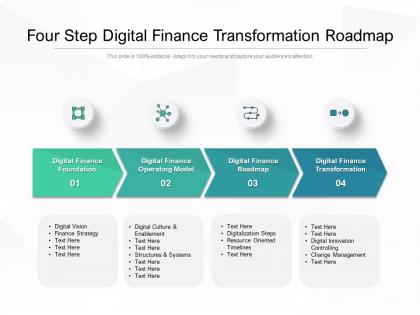
Four step digital finance transformation roadmap




Try Before you Buy Download Free Sample Product
 Impress Your
 Audience
 100%
100% Editable
 Save Hours
 of Time


Judge the fallout with our Four Step Digital Finance Transformation Roadmap. Assess the aftermath of the event.
People who downloaded this PowerPoint presentation also viewed the following :
Four step digital finance transformation roadmap with all 2 slides:
Assess the aftermath of the event with our Four Step Digital Finance Transformation Roadmap. Be able to judge the fallout.

FAQs for Four step digital
Key drivers behind digital finance transformation include changing customer expectations for seamless digital experiences, increased regulatory compliance requirements, competitive pressure from fintech innovations, operational cost reduction needs, and data security demands. These factors compel financial institutions to modernize legacy systems, automate processes, and enhance customer touchpoints, with many banks finding that digital transformation ultimately delivers faster service delivery, improved operational efficiency, and stronger competitive positioning in an increasingly digital marketplace.
Organizations can measure digital finance transformation success through key performance indicators including process automation rates, transaction processing speed, cost reduction percentages, error rate improvements, and user adoption metrics. These measurements enable finance teams to track operational efficiency gains, enhanced reporting accuracy, and improved compliance outcomes, with many companies finding that comprehensive dashboards ultimately deliver measurable ROI and competitive advantage.
Data analytics enhances financial decision-making by providing real-time insights, predictive modeling, risk assessment capabilities, and performance benchmarking throughout digital transformation initiatives. These analytical tools enable organizations to optimize resource allocation, identify cost-saving opportunities, and measure transformation ROI more accurately, with many financial institutions finding that data-driven approaches accelerate decision cycles while minimizing implementation risks.
Finance teams can effectively address cybersecurity challenges through multi-layered security frameworks, real-time monitoring systems, employee training programs, and robust data encryption protocols. These strategic approaches enable organizations to streamline digital operations while maintaining security integrity, with many financial institutions finding that proactive cybersecurity measures ultimately deliver enhanced customer trust and competitive advantage.
Cloud-based ERP systems, robotic process automation, artificial intelligence, advanced analytics platforms, and API-enabled integration tools are most critical for finance modernization. These technologies streamline operations by automating routine tasks, enhancing data accuracy, and enabling real-time financial insights, with many organizations finding that strategic implementation ultimately delivers faster reporting cycles and improved decision-making capabilities.
Digital finance transformation significantly enhances regulatory compliance and reporting through automated data collection, real-time monitoring systems, and standardized reporting frameworks. These technologies streamline compliance processes by reducing manual errors, accelerating audit trails, and ensuring consistent documentation, with financial institutions finding that digital solutions ultimately deliver faster regulatory responses and improved transparency while minimizing compliance costs.
Common pitfalls include insufficient change management, inadequate data governance, rushing implementation timelines, underestimating training requirements, and poor system integration planning. Organizations avoid these challenges by establishing comprehensive change management protocols, investing in robust data quality frameworks, and adopting phased rollout strategies, with many financial institutions finding that dedicated transformation teams and stakeholder engagement ultimately deliver smoother transitions and sustainable results.
Cloud computing enhances finance departments by providing scalable infrastructure, real-time data analytics, automated reporting systems, and seamless integration capabilities across multiple platforms. Through cloud-based solutions, organizations streamline financial processes, reduce operational costs, and enable remote collaboration, with many banks and financial services firms finding that cloud adoption accelerates their digital transformation while delivering enhanced security and compliance.
Automation streamlines financial processes by eliminating manual data entry, accelerating transaction processing, and reducing human error across accounting, invoicing, and compliance tasks. Banks and financial institutions leverage automated systems for loan approvals, fraud detection, and regulatory reporting, ultimately delivering faster customer services, lower operational costs, and enhanced accuracy in an increasingly competitive marketplace.
Essential skills for finance professionals in digital environments include data analytics, financial modeling software proficiency, automation tools expertise, cybersecurity awareness, and digital communication platforms mastery. These competencies enable professionals to streamline reporting processes, enhance decision-making accuracy, and deliver faster insights, with many organizations finding that upskilled finance teams drive competitive advantage through improved operational efficiency.
Customer expectations drive finance transformation by demanding faster transactions, personalized services, seamless mobile experiences, 24/7 accessibility, and enhanced security across all touchpoints. Banks and financial institutions are responding by implementing AI-powered chatbots, instant payment systems, and predictive analytics, while many find that meeting these elevated expectations ultimately delivers competitive advantage and improved customer retention.
Strategies include demonstrating clear ROI projections, conducting pilot programs with measurable outcomes, providing comprehensive training programs, establishing cross-functional steering committees, and communicating tangible benefits like cost reduction and efficiency gains. These approaches streamline adoption by addressing stakeholder concerns, showcasing quick wins, and building confidence through transparent progress tracking, ultimately delivering organizational alignment and sustainable transformation success.
Organizations leverage artificial intelligence to enhance financial forecasting and budgeting through predictive analytics, automated data processing, real-time market analysis, and pattern recognition algorithms. These AI technologies streamline financial planning by identifying trends, reducing manual errors, and accelerating decision-making processes, with many banks and corporations finding that AI-powered forecasting delivers significantly improved accuracy and competitive advantage.
Finance leaders should monitor embedded finance integration, AI-driven predictive analytics, blockchain for settlements, real-time treasury management, and regulatory technology automation as key transformation trends. These developments enable organizations to deliver seamless customer experiences, reduce operational costs, and enhance decision-making speed, with many financial institutions finding that early adoption provides significant competitive advantages in an increasingly digital marketplace.
Digital finance transformation significantly expands finance leaders' roles from traditional accounting to strategic business partnership, data-driven decision making, and cross-functional collaboration. Through advanced analytics and automation, CFOs increasingly become growth advisors, risk strategists, and operational efficiency champions, with many organizations finding that transformed finance teams deliver faster insights, enhanced forecasting accuracy, and competitive market positioning.
No Reviews