

Framework Of Logistics And Supply Chain Management Transportation And Fleet Management




Try Before you Buy Download Free Sample Product
 Impress Your
 Audience
 100%
100% Editable
 Save Hours
 of Time


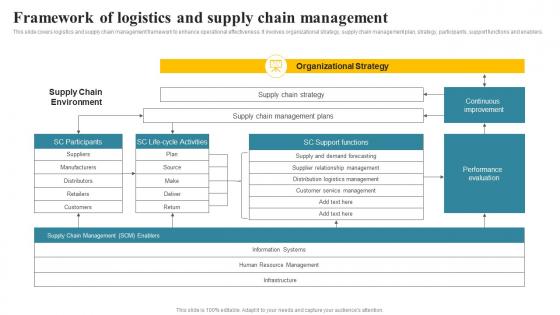
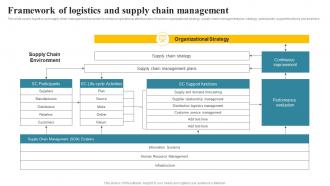
This slide covers logistics and supply chain management framework to enhance operational effectiveness. It involves organizational strategy, supply chain management plan, strategy, participants, support functions and enablers.
People who downloaded this PowerPoint presentation also viewed the following :
Framework Of Logistics And Supply Chain Management Transportation And Fleet Management with all 9 slides:
Use our Framework Of Logistics And Supply Chain Management Transportation And Fleet Management to effectively help you save your valuable time. They are readymade to fit into any presentation structure.








FAQs for Framework Of Logistics And Supply Chain Management Transportation
Logistics focuses on transportation, warehousing, and distribution of goods, while supply chain management encompasses the entire network from raw materials to end consumers, including procurement, manufacturing, and customer relationships. These terms are often confused because logistics is a critical component within supply chain management, with many organizations finding that effective supply chain strategies require seamless logistics coordination to deliver competitive advantage and operational efficiency.
AI and blockchain enhance supply chain efficiency by automating demand forecasting, optimizing route planning, and providing real-time visibility across operations. Through machine learning algorithms and distributed ledgers, companies streamline inventory management, reduce transportation costs, and improve delivery accuracy, while blockchain ensures transparency and traceability, ultimately delivering faster services and competitive advantage in increasingly complex global markets.
Major supply chain challenges include demand volatility, supplier disruptions, geopolitical uncertainties, transportation bottlenecks, inventory optimization, and increasing customer expectations for faster delivery. These complexities require strategic technology integration, diversified supplier networks, and enhanced visibility across operations, with many organizations finding that proactive risk management and digital transformation ultimately deliver greater resilience and competitive advantage.
Companies effectively manage supply chain risks through diversification, real-time monitoring, supplier assessment, scenario planning, and strategic partnerships. These approaches enable organizations to identify vulnerabilities, respond quickly to disruptions, and maintain operational continuity, with many manufacturers and retailers finding that proactive risk management ultimately delivers competitive advantage and enhanced customer satisfaction.
Inventory management serves as the strategic backbone of supply chain optimization by balancing demand forecasting, minimizing carrying costs, reducing stockouts, and streamlining warehouse operations. Through advanced inventory systems, manufacturers and retailers achieve faster order fulfillment, lower operational expenses, and enhanced customer satisfaction, while maintaining optimal stock levels that ultimately deliver competitive advantage and improved cash flow management.
Sustainability practices integrate into logistics through optimizing transportation routes, adopting renewable energy sources, implementing circular economy principles, utilizing eco-friendly packaging, and establishing green supplier partnerships. These approaches streamline operations while reducing environmental impact, with many manufacturers and retailers finding that sustainable supply chains ultimately deliver cost savings, enhanced brand reputation, and competitive advantage in increasingly environmentally-conscious markets.
Businesses should track key metrics including inventory turnover rates, order fulfillment accuracy, delivery time performance, supply chain costs, and supplier reliability scores. These measurements enable organizations to identify bottlenecks, optimize resource allocation, and enhance customer satisfaction, with many logistics companies finding that consistent monitoring ultimately delivers reduced operational costs and competitive advantage.
Demand forecasting is evolving through advanced analytics like machine learning algorithms, real-time data integration, predictive modeling, and IoT sensor networks. These technologies enable organizations to process vast datasets from multiple sources, identify complex patterns, and generate more accurate predictions, with retailers and manufacturers finding significantly improved inventory optimization, reduced stockouts, and enhanced customer satisfaction in increasingly dynamic markets.
Strategies to improve supplier relationships include transparent communication channels, collaborative planning processes, shared performance metrics, joint innovation initiatives, and long-term partnership agreements. These approaches streamline operations by building trust, reducing costs, and enhancing responsiveness, with many manufacturing and retail organizations finding that strategic supplier collaboration ultimately delivers competitive advantages and improved customer experiences.
Companies leverage JIT inventory systems to reduce costs by minimizing storage expenses, reducing waste from expired products, and decreasing tied-up capital in unused inventory. Manufacturing firms like Toyota and retail organizations streamline operations through precise demand forecasting, supplier partnerships, and automated reordering systems, ultimately delivering improved cash flow and operational efficiency.
Geopolitical events significantly disrupt global supply chains through trade restrictions, border delays, currency fluctuations, and infrastructure damage, forcing businesses to reassess their operational strategies. Companies increasingly adopt diversified supplier networks, regionalized sourcing, and strategic inventory buffers, with many manufacturers and retailers finding that flexible partnerships and scenario planning ultimately deliver greater resilience and competitive advantage.
Consumer expectations for faster delivery times fundamentally reshape logistics strategies by driving automation investments, regional distribution center expansion, and last-mile delivery innovations like drone technology and local partnerships. Companies increasingly adopt predictive analytics, real-time tracking systems, and flexible fulfillment networks to meet these demands, with many retailers finding that strategic warehouse positioning and carrier diversification ultimately deliver competitive advantage while managing operational costs.
Reverse logistics contributes to supply chain sustainability by reducing waste through product returns processing, enabling material recovery and recycling, minimizing environmental impact, and creating circular economy opportunities. Through strategic reverse logistics programs, companies like electronics manufacturers and automotive suppliers recover valuable components, reduce disposal costs, and enhance brand reputation, while ultimately delivering cost savings and competitive advantage in increasingly environmentally-conscious markets.
E-commerce fundamentally reshapes traditional supply chain practices by demanding faster fulfillment, direct-to-consumer distribution, real-time inventory visibility, and multi-channel integration capabilities. These requirements drive companies toward automated warehousing, predictive analytics, and flexible logistics networks, with many retailers finding that successful adaptation requires strategic partnerships with third-party logistics providers, ultimately delivering enhanced customer experiences and competitive advantage.
Supply chain network design optimizes facility locations, transportation routes, and distribution strategies to balance service requirements with operational costs. By strategically positioning warehouses closer to key customer segments, implementing hub-and-spoke distribution models, and leveraging cross-docking facilities, companies achieve faster delivery times while minimizing inventory holding costs, ultimately delivering enhanced customer satisfaction and improved profit margins.
-
I'm happy to discover your PowerPoint presentations and templates. They met my expectations precisely. Very innovative!
-
Great designs, Easily Editable.