


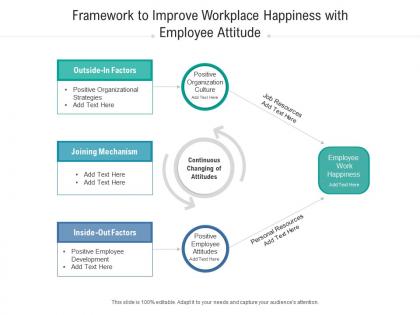
Framework to improve workplace happiness with employee attitude




Try Before you Buy Download Free Sample Product
 Impress Your
 Audience
 100%
100% Editable
 Save Hours
 of Time


Our Framework To Improve Workplace Happiness With Employee Attitude are topically designed to provide an attractive backdrop to any subject. Use them to look like a presentation pro.
People who downloaded this PowerPoint presentation also viewed the following :
Framework to improve workplace happiness with employee attitude with all 2 slides:
Use our Framework To Improve Workplace Happiness With Employee Attitude to effectively help you save your valuable time. They are readymade to fit into any presentation structure.
FAQs for Framework to improve workplace happiness
Organizations can implement pulse surveys, stay interviews, performance analytics, peer feedback systems, and engagement scorecards to measure employee engagement effectively. These strategies work by tracking sentiment trends, identifying retention risks, and monitoring productivity patterns, with many companies finding that combining multiple measurement approaches delivers deeper insights into workforce satisfaction and ultimately enables more targeted interventions for improving workplace culture.
Employee engagement correlates strongly with organizational performance through improved productivity, reduced turnover, enhanced customer satisfaction, and increased profitability. Engaged employees deliver higher quality work, drive innovation, and create better customer experiences, with many organizations finding that companies with highly engaged workforces outperform peers by 23% in profitability and demonstrate significantly lower absenteeism rates.
Leadership drives employee engagement through transparent communication, recognition programs, professional development opportunities, and creating psychological safety within teams. Effective leaders foster engagement by modeling organizational values, providing regular feedback, and empowering employees with decision-making authority, with many organizations finding that engaged leadership teams ultimately deliver higher retention rates and improved performance outcomes.
Companies can utilize technology to enhance employee engagement through mobile apps for real-time feedback, AI-powered analytics to identify disengagement patterns, gamification platforms for recognition programs, collaboration tools for remote connectivity, and personalized learning management systems. These technologies streamline communication, automate performance tracking, and deliver customized experiences, with many organizations finding that digital engagement platforms significantly boost participation rates while reducing administrative overhead.
Employee recognition significantly boosts engagement levels by increasing job satisfaction, motivation, and emotional connection to work, while reducing turnover and absenteeism. Through strategic recognition programs, organizations enhance productivity, strengthen team cohesion, and improve retention rates, with many companies finding that recognized employees demonstrate 31% higher performance and greater commitment to organizational goals.
**INPUT**: How do different generations in the workforce perceive and react to engagement efforts? **OUTPUT**: Different generations respond distinctly to engagement initiatives, with Baby Boomers valuing recognition and stability, Gen X prioritizing work-life balance and autonomy, and Millennials and Gen Z seeking purpose-driven work and continuous feedback. Organizations increasingly find that tailored engagement strategies, combining traditional recognition programs with flexible work arrangements and meaningful development opportunities, ultimately deliver higher retention rates and enhanced productivity across all generational cohorts. **Word count: 60 words**
Innovative remote engagement strategies include virtual coffee chats, gamified recognition platforms, digital wellness challenges, collaborative online workshops, and flexible project rotations across teams. These approaches enhance connection and motivation by fostering social interaction, celebrating achievements, and providing growth opportunities, with many organizations finding that personalized engagement initiatives significantly boost productivity and retention.
Effective feedback mechanisms can be structured through regular one-on-ones, 360-degree reviews, anonymous pulse surveys, peer recognition systems, and real-time performance dashboards. These approaches enhance engagement by creating transparent communication channels, fostering continuous development, and enabling timely course corrections, with many organizations finding that structured feedback ultimately delivers higher retention rates and improved productivity.
Company values and mission statements significantly influence employee engagement by creating purpose-driven work environments, fostering emotional connections to organizational goals, and establishing clear behavioral expectations that guide decision-making. When employees understand and align with these foundational elements, organizations experience enhanced retention, improved performance, and stronger workplace culture, with many companies finding that authentic values-driven leadership ultimately delivers competitive advantage through increased productivity and employee satisfaction.
**INPUT**: What specific training programs can enhance managers' ability to drive engagement? **OUTPUT**: Training programs include emotional intelligence development, active listening workshops, feedback delivery techniques, conflict resolution skills, and recognition best practices. These programs enhance managerial effectiveness by improving communication quality, building trust through transparency, and creating supportive work environments, with many organizations finding that trained managers achieve significantly higher team engagement scores.
Organizations can ensure inclusive employee engagement by implementing diverse feedback mechanisms, creating culturally sensitive recognition programs, offering flexible participation options, and establishing employee resource groups that represent various backgrounds and perspectives. These approaches enable companies to address different communication styles, cultural preferences, and work-life needs, while fostering belonging across all demographics, ultimately delivering higher participation rates and stronger organizational cohesion.
Employee engagement metrics should include employee satisfaction scores, retention rates, productivity measurements, absenteeism tracking, and internal promotion rates. These indicators work together by revealing engagement patterns across departments, identifying areas for improvement, and measuring strategic outcomes, with many organizations finding that consistent tracking ultimately delivers enhanced workplace culture and competitive advantage through improved performance.
Onboarding processes can be tailored through personalized welcome experiences, role-specific training modules, early goal-setting sessions, mentor assignments, and interactive cultural immersion activities. Companies across sectors like technology and healthcare find that customized onboarding approaches significantly reduce turnover, accelerate productivity timelines, and create stronger emotional connections, ultimately delivering higher retention rates and faster integration into company culture.
Organizations face resistance to uncertainty, communication breakdowns, decreased morale, loss of trust in leadership, and competing priorities during transitions. These challenges manifest differently across sectors, with healthcare workers experiencing burnout during system changes while retail employees struggle with new technology implementations, ultimately requiring strategic change management approaches that prioritize transparent communication and employee involvement to maintain engagement levels.
High employee engagement significantly reduces turnover costs while enhancing recruitment effectiveness by creating authentic employer brand ambassadors, improving workplace culture visibility, and generating positive employee testimonials. Engaged organizations typically see 40% lower turnover rates and attract higher-quality candidates through employee referrals, ultimately delivering stronger talent pipelines and competitive hiring advantages.
-
Use of icon with content is very relateable, informative and appealing.
-
The content is very helpful from business point of view.
-
Excellent Designs.
-
Use of different colors is good. It's simple and attractive.