


Fundamental concepts of ethical hacking ppt powerpoint presentation styles samples




Try Before you Buy Download Free Sample Product
 Impress Your
 Audience
 100%
100% Editable
 Save Hours
 of Time


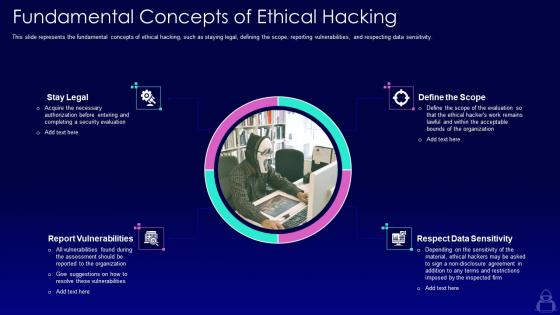
This slide represents the fundamental concepts of ethical hacking, such as staying legal, defining the scope, reporting vulnerabilities, and respecting data sensitivity.
People who downloaded this PowerPoint presentation also viewed the following :
Fundamental concepts of ethical hacking ppt powerpoint presentation styles samples with all 6 slides:
Use our Fundamental Concepts Of Ethical Hacking Ppt Powerpoint Presentation Styles Samples to effectively help you save your valuable time. They are readymade to fit into any presentation structure.





FAQs for Fundamental concepts of ethical hacking ppt powerpoint
The fundamental principles of ethical hacking include obtaining proper authorization, maintaining confidentiality, minimizing system disruption, and providing comprehensive documentation of vulnerabilities discovered. These principles ensure cybersecurity professionals enhance organizational security through controlled testing, responsible disclosure practices, and systematic vulnerability assessments, ultimately delivering stronger defenses while maintaining trust and legal compliance across industries.
Ethical hacking operates with explicit authorization and aims to strengthen security systems, while malicious hacking involves unauthorized access for personal gain or harm. Ethical hackers, often employed by banks, hospitals, and corporations, follow strict legal frameworks and disclosure protocols, ultimately delivering enhanced cybersecurity postures and competitive advantages through proactive vulnerability management.
The most recognized ethical hacking certifications include Certified Ethical Hacker (CEH), Offensive Security Certified Professional (OSCP), GIAC Penetration Tester (GPEN), Certified Information Systems Security Professional (CISSP), and CompTIA PenTest+. These credentials enhance career prospects by validating technical expertise, demonstrating commitment to ethical standards, and opening doors to cybersecurity roles across banking, healthcare, and technology sectors.
Common ethical hacking tools for penetration testing include Nmap for network scanning, Metasploit for vulnerability exploitation, Burp Suite for web application testing, Wireshark for network analysis, and Nessus for vulnerability assessment. These tools enable security professionals to identify system weaknesses, simulate real-world attacks, and strengthen organizational defenses, with many financial institutions and healthcare organizations finding that comprehensive penetration testing significantly reduces their cybersecurity risks.
Ethical hackers ensure client data confidentiality through non-disclosure agreements, secure data handling protocols, encrypted communication channels, isolated testing environments, and immediate data destruction after assessments. These professionals implement stringent access controls and compartmentalized information sharing, with many cybersecurity firms finding that robust confidentiality frameworks ultimately enhance client trust and deliver competitive advantage in an increasingly security-conscious business landscape.
Ethical hackers must obtain explicit written authorization before testing, ensure compliance with data protection laws like GDPR, and understand jurisdictional boundaries when systems cross international borders. Proper documentation, clear scope limitations, and adherence to industry frameworks help organizations avoid legal complications while conducting security assessments, ultimately delivering comprehensive protection and regulatory compliance.
Organizations create security awareness culture through regular training programs, simulated phishing exercises, clear security policies, ongoing communication campaigns, and recognition systems for security-conscious behavior. These initiatives work by making security everyone's responsibility, integrating awareness into daily workflows, and empowering employees to identify threats, with many companies finding that engaged staff become the strongest defense against cyberattacks, ultimately reducing breach risks significantly.
Ethical hackers play a crucial role in regulatory compliance by conducting penetration tests, vulnerability assessments, and security audits to identify data protection gaps before regulatory inspections occur. Through systematic testing of encryption protocols, access controls, and data handling procedures, healthcare organizations and financial institutions can demonstrate due diligence in protecting sensitive information, ultimately avoiding costly penalties while maintaining customer trust.
Common web application vulnerabilities ethical hackers encounter include SQL injection, cross-site scripting (XSS), broken authentication, insecure direct object references, and cross-site request forgery (CSRF). These security flaws enable hackers to streamline vulnerability assessments by targeting predictable weaknesses, with many financial services and e-commerce organizations finding that addressing these issues delivers enhanced customer trust and regulatory compliance.
Ethical hackers stay updated through vulnerability databases like CVE and NVD, security conferences, threat intelligence feeds, professional certifications, and collaborative platforms like GitHub and security forums. These resources enable continuous learning through real-time threat analysis, peer knowledge sharing, and hands-on research, with many cybersecurity professionals finding that combining formal training with active community participation delivers comprehensive threat awareness and competitive security expertise.
Ethical hacking engagements present dilemmas including scope boundaries when discovering vulnerabilities outside authorized areas, disclosure timing between finding critical flaws and reporting them, and balancing thoroughness with potential system disruption. These challenges require clear protocols, stakeholder communication, and documented boundaries, with many organizations finding that comprehensive pre-engagement agreements and regular status updates help navigate competing priorities while maintaining trust.
Ethical hacking strengthens cybersecurity posture by identifying vulnerabilities before malicious actors exploit them, testing security controls under real-world conditions, and validating incident response procedures. Through systematic penetration testing, organizations across healthcare, banking, and retail sectors discover critical weaknesses, enhance their security frameworks, and ultimately reduce breach risks while building more resilient defenses.
Ethical hackers should document findings through comprehensive vulnerability reports, detailed remediation recommendations, clear risk assessments, timestamped evidence collection, and executive summaries tailored for different stakeholders. These documentation practices enable organizations to prioritize security investments, streamline remediation workflows, and demonstrate compliance requirements, with many cybersecurity teams finding that structured reporting accelerates threat resolution and enhances overall security posture.
Ethical hacking enhances incident response by proactively identifying vulnerabilities, simulating real attack scenarios, and testing security protocols before actual breaches occur. Through penetration testing and vulnerability assessments, organizations streamline their response procedures, minimize downtime during security incidents, and strengthen threat detection capabilities, ultimately delivering faster recovery times and more robust defense mechanisms.
Emerging trends impacting ethical hacking include artificial intelligence-powered vulnerability detection, cloud security testing, IoT device penetration testing, blockchain security auditing, and machine learning-based threat simulation. These technologies enhance cybersecurity by automating vulnerability discovery, accelerating threat detection, and enabling comprehensive security assessments across complex digital infrastructures, with many organizations finding that AI-driven ethical hacking delivers faster, more thorough security evaluations.
-
The Designed Graphic are very professional and classic.
-
Enough space for editing and adding your own content.