


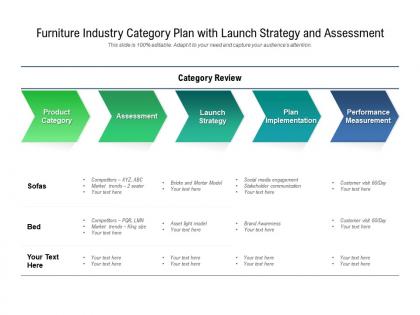
Furniture industry category plan with launch strategy and assessment




Try Before you Buy Download Free Sample Product
 Impress Your
 Audience
 100%
100% Editable
 Save Hours
 of Time


Our Furniture Industry Category Plan With Launch Strategy And Assessment are topically designed to provide an attractive backdrop to any subject. Use them to look like a presentation pro.
People who downloaded this PowerPoint presentation also viewed the following :
Furniture industry category plan with launch strategy and assessment with all 2 slides:
Use our Furniture Industry Category Plan With Launch Strategy And Assessment to effectively help you save your valuable time. They are readymade to fit into any presentation structure.

FAQs for Furniture industry category plan with launch
Key trends shaping the furniture industry today include sustainable materials, smart furniture integration, customization options, direct-to-consumer sales models, and augmented reality shopping experiences. These innovations streamline manufacturing processes, enhance customer engagement, and deliver personalized solutions, with many retailers finding that combining eco-friendly practices with digital technologies ultimately provides significant competitive advantages.
Market research informs furniture launch strategy by identifying target demographics, analyzing competitor pricing and positioning, understanding consumer preferences for materials and styles, and revealing distribution channel effectiveness. Through comprehensive research, furniture brands can strategically position products, optimize pricing strategies, and select ideal retail partnerships, ultimately delivering targeted marketing campaigns and product offerings that resonate with specific market segments.
Sustainability and eco-friendly materials serve as key differentiators in the modern furniture market, driving consumer purchasing decisions, brand loyalty, regulatory compliance, and operational efficiency. These strategic approaches enable manufacturers to reduce production costs, access premium market segments, and meet increasingly stringent environmental standards, with many furniture companies finding that sustainable practices ultimately deliver competitive advantage and enhanced customer trust.
Businesses should define their furniture target audience by analyzing demographics, lifestyle preferences, income levels, home ownership status, and design aesthetics preferences. Through market segmentation and consumer behavior research, furniture companies can identify specific customer groups like young professionals, growing families, or luxury homeowners, ultimately enabling targeted marketing strategies and product positioning that resonates with distinct purchasing motivations and budget considerations.
Effective promotional channels include social media platforms, showroom displays, interior design partnerships, trade publications, and influencer collaborations with home decor specialists. These channels enhance visibility by showcasing product aesthetics, enabling tactile experiences, and reaching targeted demographics, with many furniture retailers finding that combining digital marketing with physical showroom experiences ultimately delivers stronger customer engagement and higher conversion rates.
Collaborations with designers or influencers enhance furniture launches by expanding reach, building credibility, and creating authentic content that resonates with target audiences. These partnerships enable furniture brands to tap into established follower bases, showcase products in real-world settings, and generate user-generated content, ultimately delivering increased brand awareness and higher conversion rates.
Value-based pricing, competitive pricing analysis, psychological pricing, and bundling strategies prove most successful in furniture retail. These approaches work by positioning products strategically against competitors, creating perceived value through price anchoring, and offering package deals that increase average order values, with many furniture retailers finding that combining premium positioning with selective promotional pricing ultimately delivers sustainable margins while maintaining market competitiveness.
Storytelling is crucial for furniture branding as it transforms products into lifestyle aspirations, connecting emotionally with customers through narratives about craftsmanship, sustainability, and design philosophy. Through compelling brand stories, furniture companies differentiate themselves in competitive markets, build customer loyalty, and justify premium pricing, with many retailers finding that narrative-driven marketing significantly enhances customer engagement and sales conversion rates.
Direct-to-consumer models enable furniture companies to control brand narrative, pricing, and customer relationships while eliminating retailer margins and gaining valuable consumer data insights. Through online platforms and showrooms, companies like Wayfair and West Elm deliver personalized experiences, faster product iterations, and enhanced profit margins, ultimately building stronger customer loyalty in an increasingly competitive marketplace.
Social media campaigns elevate furniture launches by showcasing product aesthetics through high-quality visuals, engaging target demographics with lifestyle content, and enabling real-time customer interaction across platforms. Through strategic influencer partnerships and targeted advertising, furniture brands streamline brand awareness, generate qualified leads, and drive showroom traffic, with many retailers finding that integrated campaigns deliver significantly higher launch visibility and customer engagement.
Furniture launch success metrics include sales volume, market penetration rates, customer acquisition costs, inventory turnover, and brand awareness levels. These indicators help businesses evaluate performance by tracking revenue growth, distribution reach, and customer engagement across retail channels, with many furniture companies finding that combining financial metrics with customer satisfaction data ultimately delivers comprehensive insights into launch effectiveness and competitive positioning.
Spatial aesthetics enhance furniture marketing through virtual showrooms, augmented reality room visualization, and immersive design experiences that showcase products in realistic settings. These technologies enable customers to visualize furniture in their actual spaces, streamlining decision-making and reducing returns, while retailers deliver personalized experiences and ultimately gain competitive advantage in an increasingly digital marketplace.
New entrants face significant challenges including high capital requirements for manufacturing and inventory, established brand loyalty, complex supply chain management, and intense price competition from incumbents. While traditional retailers dominate physical showrooms and customer relationships, emerging companies can leverage direct-to-consumer models, innovative materials, and digital marketing strategies, ultimately delivering personalized experiences and cost efficiencies that established players struggle to match.
Customer feedback post-launch enables furniture companies to refine offerings through design modifications, material adjustments, quality improvements, and feature enhancements based on real usage patterns. Through systematic review collection and analysis, manufacturers can identify recurring issues like comfort concerns or durability problems, ultimately delivering more targeted products and stronger customer satisfaction, with many finding that feedback-driven iterations significantly reduce returns while enhancing market positioning.
**INPUT**: What innovations in technology can enhance the launch strategy for furniture products? **OUTPUT**: Technology innovations include augmented reality visualization, AI-powered design customization, virtual showrooms, 3D printing for prototypes, and IoT-enabled smart furniture features. These technologies streamline product development, enhance customer experiences through immersive previews, and enable personalized marketing campaigns, with many furniture retailers finding that AR visualization significantly reduces return rates while accelerating purchase decisions. [Word count: 58 words]
No Reviews