


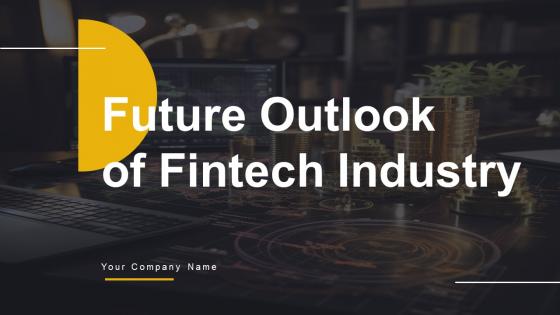
Future Outlook Of Fintech Industry FIO MM




Try Before you Buy Download Free Sample Product
 Impress Your
 Audience
 100%
100% Editable
 Save Hours
 of Time


Embark on a journey into the financial frontier with our comprehensive PowerPoint presentation, Future Outlook of Fintech Industry.Dive deep into the dynamic landscape of fintech, exploring market trends, stock market news, and global share market dynamics. Navigate the intricate world of online share markets, unraveling the latest stock market rates and examining informative graphs that depict market fluctuations. This presentation equips you with valuable insights into the evolving fintech sphere, offering a strategic perspective on the future of stocks and their impact on the global economy. Stay ahead in the financial game with our expertly crafted analysis and projections, ensuring you are well prepared for the next wave of opportunities in the fintech industr.
People who downloaded this PowerPoint presentation also viewed the following :
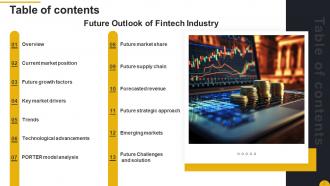
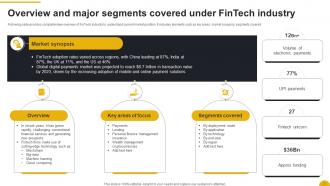
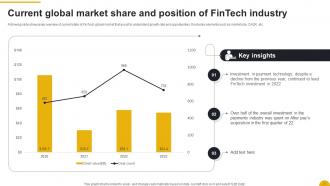
Future Outlook Of Fintech Industry FIO MM with all 24 slides:
Use our Future Outlook Of Fintech Industry FIO MM to effectively help you save your valuable time. They are readymade to fit into any presentation structure.










FAQs for Future Outlook Of Fintech
Key trends shaping fintech's future include artificial intelligence integration, embedded finance solutions, blockchain adoption, regulatory technology advancements, and open banking expansion. These innovations streamline operations by enhancing fraud detection, automating loan approvals, and personalizing customer experiences, with many financial institutions finding that strategic technology combinations ultimately deliver faster services and significant competitive advantages.
Artificial intelligence is revolutionizing fintech by enabling personalized financial services, automated risk assessment, intelligent fraud detection, and conversational banking interfaces. Through machine learning algorithms, financial institutions streamline loan approvals, enhance customer support with chatbots, and deliver predictive analytics for investment decisions, ultimately reducing operational costs while significantly improving customer experiences and competitive positioning.
Regulatory compliance serves as both a foundation and gateway for fintech scalability, establishing customer trust, enabling market expansion, and ensuring operational legitimacy across jurisdictions. While compliance requirements initially demand significant resource investment, startups that build robust regulatory frameworks early can scale more rapidly into new markets, attract institutional partnerships, and deliver sustainable financial services, ultimately gaining competitive advantage over less compliant competitors.
Fintech companies can leverage blockchain technology through smart contracts for automated loan processing, supply chain finance transparency, cross-border payment settlements, digital identity verification, and trade finance documentation. These applications enable banks and financial institutions to streamline operations, reduce fraud risks, and enhance customer trust, while delivering faster transaction processing and lower operational costs in an increasingly competitive financial landscape.
Integration presents both challenges and opportunities, with legacy system compatibility, regulatory compliance, and cultural resistance creating barriers, while enhanced customer experiences, operational efficiency, and competitive positioning offer significant advantages. Through strategic partnerships and phased implementations, many financial institutions find that combining traditional stability with fintech innovation ultimately delivers faster services, reduced costs, and stronger market positioning.
Embedded Finance is intensifying competition by enabling non-financial companies to offer banking services directly, forcing traditional fintech firms to pivot toward B2B partnerships, white-label solutions, and specialized infrastructure services. This shift creates opportunities for fintech companies to become behind-the-scenes enablers for retailers, healthcare providers, and e-commerce platforms, ultimately delivering broader market reach and recurring revenue streams.
Quantum computing presents both challenges and opportunities for fintech data security, potentially breaking current encryption methods while enabling quantum-resistant cryptography, advanced fraud detection, and real-time threat analysis. Financial institutions are increasingly investing in quantum-safe security protocols, with banks and payment processors finding that early adoption delivers competitive advantage and enhanced customer trust.
Fintech companies are addressing financial inclusion through mobile banking platforms, digital wallets, alternative credit scoring, microfinance solutions, and blockchain-based payment systems. These technologies streamline access by eliminating traditional banking barriers, reducing transaction costs, and enabling remote account management, with many rural communities and small businesses finding that mobile-first approaches deliver faster financial services and broader economic participation.
Digital currencies hold significant potential to revolutionize global finance by eliminating intermediaries, reducing cross-border transaction costs, and enabling 24/7 settlement capabilities that bypass traditional banking infrastructure. Through blockchain technology, financial institutions increasingly streamline international payments, enhance financial inclusion, and deliver faster remittances, with central banks worldwide exploring digital currencies to modernize monetary systems and maintain competitive advantage.
Customer expectations in fintech are increasingly centered on seamless, personalized experiences with instant transaction processing, 24/7 accessibility, enhanced security features, and intuitive mobile-first interfaces. Through AI-driven insights and real-time capabilities, financial institutions deliver faster loan approvals, predictive financial advice, and automated investment management, while customers demand transparency and control, ultimately driving competitive differentiation in an increasingly digital financial landscape.
Open banking presents both enhanced security opportunities and privacy considerations, requiring robust authentication protocols, encrypted data transmission, standardized API security frameworks, and granular consent management systems. While customers gain greater control over financial data sharing through explicit permissions, banks and fintech companies must implement comprehensive cybersecurity measures, with many institutions finding that strategic data governance ultimately delivers improved transparency and customer trust.
Fintech firms can utilize data analytics through machine learning algorithms, predictive modeling, behavioral analysis, transaction pattern recognition, and real-time risk assessment to deliver personalized financial services. These technologies enable customized product recommendations, dynamic pricing strategies, and tailored investment portfolios, while streamlining customer onboarding processes, ultimately enhancing user experiences and driving competitive advantage in increasingly digital markets.
Fintech companies should prioritize transparent communication, robust security protocols, regulatory compliance, user education initiatives, and responsive customer support to build trust. By implementing multi-factor authentication, obtaining relevant certifications, clearly explaining fees and processes, and maintaining consistent communication during transactions, these organizations enhance credibility while delivering seamless user experiences and competitive advantage in an increasingly scrutinized financial landscape.
Mobile payment systems are fundamentally transforming consumer expectations by delivering instant transactions, seamless shopping experiences, and integrated financial management tools. Through contactless payments and digital wallets, consumers increasingly prefer frictionless interactions over traditional banking methods, with retail and hospitality sectors finding that mobile-first approaches enhance customer loyalty while reducing operational costs.
Predicted shifts include increased capital allocation to digital banking platforms, mobile payment solutions, blockchain-based remittances, microfinance technologies, and regulatory technology innovations across emerging markets. These investments are driven by expanding smartphone penetration, growing financial inclusion demands, and supportive regulatory frameworks, with venture capitalists increasingly recognizing that emerging markets offer higher growth potential and scalable opportunities than saturated developed markets.
-
Excellent design and quick turnaround.
-
Wonderful ideas and visuals. I'm really pleased with the templates, which are unique and up to date.