


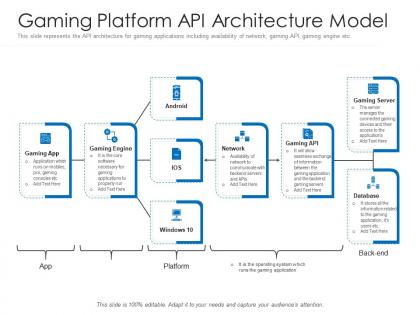
Gaming platform api architecture model




Try Before you Buy Download Free Sample Product
 Impress Your
 Audience
 100%
100% Editable
 Save Hours
 of Time


This slide represents the API architecture for gaming applications including availability of network, gaming API, gaming engine etc.
People who downloaded this PowerPoint presentation also viewed the following :
Gaming platform api architecture model with all 2 slides:
Use our Gaming Platform API Architecture Model to effectively help you save your valuable time. They are readymade to fit into any presentation structure.

FAQs for Gaming platform
Key components of a gaming platform API architecture model include user authentication services, game session management, real-time communication handlers, payment processing systems, and data analytics engines. These components work together by enabling secure player interactions, seamless multiplayer experiences, and efficient resource allocation, with many gaming companies finding that this integrated approach ultimately delivers faster performance and enhanced player engagement across diverse gaming environments.
RESTful APIs use multiple endpoints for different data requests, while GraphQL APIs provide a single endpoint with flexible query capabilities, reducing over-fetching and under-fetching issues common in gaming applications. In gaming platforms, GraphQL enables real-time player statistics, inventory management, and leaderboard updates through efficient data retrieval, while REST APIs excel in simpler, cacheable operations like authentication and basic game state management.
Gaming API security measures include multi-factor authentication, end-to-end encryption, rate limiting, token-based authorization, and real-time fraud detection systems. These protocols work together by securing user credentials, protecting payment transactions, and monitoring gameplay patterns, with many gaming platforms finding that layered security approaches ultimately deliver enhanced player trust and regulatory compliance.
Microservices architecture enhances gaming platform APIs by enabling independent scaling of game features, player authentication, matchmaking, and payment systems, while reducing system-wide failures through service isolation. This approach streamlines development cycles, facilitates faster feature deployment, and delivers improved player experiences through dedicated services for chat, leaderboards, and real-time gameplay, ultimately providing competitive advantage in increasingly dynamic gaming markets.
Authentication serves as the security foundation for gaming APIs, protecting user accounts, preventing cheating, and ensuring data integrity through methods like OAuth 2.0, JWT tokens, API keys, and multi-factor authentication. These security layers enable gaming platforms to deliver seamless user experiences while safeguarding player progress and in-game purchases, with many developers finding that robust authentication ultimately enhances player trust and engagement.
Game developers ensure scalability by implementing microservices architecture, load balancing, caching strategies, database optimization, and auto-scaling infrastructure. These approaches streamline performance by distributing traffic efficiently, reducing server load, and adapting to player demand fluctuations, with many gaming companies finding that strategic API design ultimately delivers seamless player experiences and competitive advantage in increasingly demanding gaming environments.
API versioning best practices for gaming platforms include semantic versioning, URL path versioning, header-based versioning, feature toggles, and gradual deprecation strategies. These approaches enable seamless updates by maintaining multiple API versions simultaneously, implementing careful rollout procedures, and providing clear migration timelines, with many gaming companies finding that strategic versioning ultimately delivers uninterrupted player experiences while enabling continuous platform evolution.
Gaming platforms utilize WebSockets by establishing persistent, bidirectional connections that enable instant data exchange between players and servers, supporting real-time chat, live game state updates, and synchronized player actions. Through WebSocket implementation, multiplayer games deliver seamless experiences with minimal latency, enhanced player engagement, and scalable architecture, with many gaming companies finding that this technology significantly improves competitive gameplay and user retention rates.
Strategies include content delivery networks, edge computing, database optimization, caching mechanisms, and asynchronous processing. These technologies streamline gaming experiences by reducing server response times, minimizing data transfer distances, and optimizing resource allocation, with many gaming platforms finding that strategic combinations ultimately deliver competitive advantages through faster, more responsive player interactions.
APIs facilitate cross-platform gaming experiences by enabling seamless data synchronization, unified player authentication, and consistent game state management across different devices and operating systems. Through standardized communication protocols, gaming platforms can share player progress, matchmaking services, and social features between mobile, console, and PC environments, ultimately delivering unified experiences that retain players and expand market reach across multiple gaming ecosystems.
Analytics can be integrated into gaming APIs through real-time event tracking, player behavior monitoring, performance metrics collection, in-game purchase analysis, and session data capture. These integrations enable gaming companies to understand player preferences, optimize game mechanics, personalize experiences, and enhance monetization strategies, with many developers finding that comprehensive analytics drive player retention and significantly boost revenue growth.
A well-designed API enhances user experience by enabling seamless cross-platform play, real-time multiplayer interactions, personalized content delivery, and instant social features like leaderboards and achievements. These integrations streamline gameplay mechanics, reduce loading times, and facilitate smooth data synchronization across devices, ultimately delivering consistent, engaging experiences that keep players connected and invested in the gaming ecosystem.
Common challenges in developing gaming APIs include latency issues, scalability bottlenecks, security vulnerabilities, data synchronization problems, and cross-platform compatibility concerns. These obstacles can be overcome through optimized server architecture, robust authentication protocols, and strategic caching mechanisms, with many gaming companies finding that implementing microservices and load balancing ultimately delivers faster response times and enhanced player experiences.
**INPUT**: What tools and frameworks are recommended for building and testing gaming APIs? **OUTPUT**: Recommended tools include Node.js, Unity Netcode, AWS GameLift, Docker for containerization, and testing frameworks like Postman, JMeter, and Swagger for API documentation. These technologies streamline development by enabling real-time multiplayer functionality, automated scaling, and comprehensive performance testing, with many gaming studios finding that strategic tool combinations ultimately deliver faster deployment cycles and enhanced player experiences. [Word count: 58 words]
Third-party developers can leverage gaming platform APIs by accessing game data, player profiles, achievements, and social features to create companion apps, stat trackers, tournament organizers, and community tools. Through these integrations, developers in mobile gaming, esports, and content creation sectors enhance player engagement, deliver personalized experiences, and build monetizable applications, ultimately expanding the platform's ecosystem while creating new revenue streams.
-
Thanks for all your great templates they have saved me lots of time and accelerate my presentations. Great product, keep them up!