

Go To Market Funnel With Key Performance Marketing Plan To Grow Product Strategy SS V




Try Before you Buy Download Free Sample Product
 Impress Your
 Audience
 100%
100% Editable
 Save Hours
 of Time


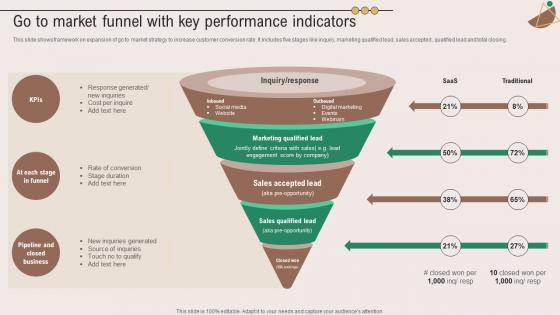
This slide shows framework on expansion of go to market strategy to increase customer conversion rate. It includes five stages like inquiry, marketing qualified lead, sales accepted , qualified lead and total closing.
People who downloaded this PowerPoint presentation also viewed the following :
Go To Market Funnel With Key Performance Marketing Plan To Grow Product Strategy SS V with all 9 slides:
Use our Go To Market Funnel With Key Performance Marketing Plan To Grow Product Strategy SS V to effectively help you save your valuable time. They are readymade to fit into any presentation structure.









FAQs for Go To Market Funnel With Key Performance Marketing Plan To Grow Product
Yeah so the basic stages are awareness, interest, consideration, purchase, retention - though honestly every marketing blog calls them something different which drives me nuts. B2B takes forever with all those decision-makers involved, while B2C customers usually just buy or bounce pretty fast. SaaS focuses on getting trial users to actually pay. Retail worries about discovery and people abandoning their carts (ugh). Enterprise throws in qualification calls and demos. Don't just copy some template though. Track where people actually drop off in YOUR funnel - that's what matters for your specific business.
Check who's already buying from you first - that data's pure gold. Create detailed buyer personas from actual customer interviews (yeah, it's boring but super worth it). Don't just say "small business owners" though. Get specific like "Series A SaaS founders dealing with churn issues." Way more helpful. Also peek at your competitors to see what they're missing. Honestly, most people try to target everyone and end up reaching no one. Pick one main persona and absolutely nail that market before you even think about expanding to others.
Honestly, don't overcomplicate this - pick different metrics for each stage. Top of funnel? Look at reach and impressions. Middle gets tricky with engagement rates and lead quality stuff. Bottom's all about close rates and what you're spending to get customers. Here's what I'd actually do though: start with just one metric per stage that connects to revenue. Way better than drowning in data you won't use. The cool part is watching how boosting awareness numbers eventually hits your conversions. Build up from there once you've got the basics down.
Your value prop is literally the foundation of your whole GTM funnel. When it's sharp and clear, everything clicks - prospects actually get it, your sales team knows what they're selling, marketing stops being just noise. I've watched teams spin their wheels for months because they tried being everything to everyone (classic mistake). Sharp messaging makes every touchpoint way more effective since you're reinforcing the same benefit. Test your current value prop with real customers first though. If they can't repeat it back or seem confused, that's your answer right there. Fix that and watch your funnel efficiency jump.
Look, competitive analysis is make-or-break for your GTM strategy. It directly impacts how you position and price everything. I've watched way too many launches crash because teams thought they already knew their competition (spoiler: they didn't). You've got to dig into what competitors do well and where they suck. Check out their websites, pricing models, customer reviews - basically become a detective for a week. This stuff will shape your messaging and help you spot market gaps. The goal? Figure out where you can actually win instead of just hoping for the best.
Get feedback everywhere - when people first hear about you, during sign-up, after they buy, the whole thing. Talk to folks who bounced and figure out why they left. I've watched companies miss super obvious problems because nobody bothered asking customers what sucked about their experience. Survey the people who didn't convert too - they'll tell you exactly where things went sideways. Then actually do something with what you learn! Tweak your messaging, fix the annoying parts of onboarding, maybe even change who you're targeting. Don't just collect responses and let them sit there though.
Honestly, the biggest mistake is trying to go after everyone instead of picking one specific customer type. You'll blow through your budget crazy fast. Most companies also skip actually validating their idea with real people - they just build stuff and hope it works, which is basically expensive gambling. Sales and marketing teams not talking to each other is another huge problem. Leads just disappear in the handoffs. Oh, and tracking vanity metrics instead of stuff that actually matters for your pipeline. Start narrow, test your messaging with actual prospects first, then nail down your funnel process.
Dude, tech is a game-changer for your GTM funnel. Marketing automation handles lead nurturing while you sleep. CRMs track everything seamlessly - no more lost prospects falling through cracks. AI tools can actually predict which leads will convert (pretty wild stuff). Analytics show you exactly where people drop off, which honestly saves so much guesswork. Sales tools automate follow-ups and personalize outreach without the manual grind. The trick is connecting everything so data flows between your marketing and sales teams. I'd start by mapping what you're doing now, then tackle the most annoying manual tasks first.
Cross-functional teams are huge for GTM - you literally can't pull it off alone. Product needs to have features ready, marketing handles demand gen, sales converts the pipeline, customer success keeps people around. Operations makes sure everything actually works behind the scenes. I've watched so many launches crash and burn because teams just did their own thing and forgot to talk to each other. It gets messy fast. When everyone's on the same page with timelines and messaging from the start, things actually go smoothly. Get all your key people together early and set up proper communication channels. Trust me on this one.
You've gotta meet people where they actually are in the buying process. Start with educational stuff - blog posts, webinars, whatever builds trust first. Then get more specific with case studies and demos that hit their real problems. Most companies totally blow this part by going straight into sales mode, which is annoying honestly. Free trials and consultations work great at the bottom of the funnel. Oh, and set up lead scoring so you actually know when someone's ready to buy instead of guessing. Map your content to each stage and automate the delivery. Makes everything way smoother.
Okay so three things you gotta nail after launch. Get users to that "aha moment" fast with good onboarding - like where they actually get why your product matters. Then be proactive about check-ins based on how people are using it. Most teams just wait for problems instead of catching them early, which is honestly backwards. Also set up ways to hear from users constantly - surveys, calls, whatever. The whole point is spotting who might bail before they do. I swear, timing these touchpoints right makes all the difference.
Honestly, data analytics is a game-changer for this stuff. You'll see exactly where people are bailing on your funnel and can actually fix those problem spots. Track your conversion rates at every stage, figure out which channels bring you the best leads, and test what messaging hits different with each audience segment. The really cool part? You can predict which leads will probably convert based on how they're behaving. Way better than just throwing stuff at the wall and hoping it sticks. Oh, and set up tracking for each stage first - can't improve what you can't see, you know?
Okay so market segmentation means you'll need different funnels for each audience - can't just throw everyone into the same bucket anymore. SMBs want quick, self-serve experiences while enterprise clients need way more hand-holding and relationship building. Each group has totally different pain points and buying habits, which is honestly kind of obvious once you think about it. Your messaging has to match what actually matters to them. I'd start by picking your top 2-3 segments and really mapping out how each one makes decisions. It's more work upfront but converts so much better than generic approaches.
Okay so you basically want different stories for different stages of your funnel. Start with problem-focused stuff at the top - those "wait, I never thought about this" moments work really well. Customer success stories are perfect for the middle stage (honestly my go-to because people connect with them). Then at the bottom, go heavy on transformation stories showing actual before/after results. The trick is matching the emotional vibe to where they are mentally. You'll want to test different angles though - what works for one audience might totally flop for another. Start empathetic, build aspiration, finish with proof.
Look, startups can't play the same game as big companies - you're just gonna lose. Pick one super specific audience first instead of trying to please everyone (I see this mistake constantly). Big companies throw money at five different channels? You focus on maybe two max, wherever your people actually are. The upside though? When something's not working, you can change direction in like two weeks instead of six months. Find your most promising group, test fast, see what sticks. Don't even think about expanding until you've really nailed that first segment. Way too many founders skip this step and wonder why nothing's working.
-
Excellent work done on template design and graphics.
-
Nothing beats the well-formatted and professionally designed templates offered. Kudos to SlideTeam for their amazing collection of PPT slides.