Product Advertising Funnel With Key Performance Indicators

Rating:
90%
Product Advertising Funnel With Key Performance Indicators
Slide 1 of 6
Favourites Favourites

Try Before you Buy Download Free Sample Product

Audience Impress Your
Audience
Editable 100%
Editable
Time Save Hours
of Time
The Biggest Sale is ending soon in
0
0
:
0
0
:
0
0
Rating:
90%
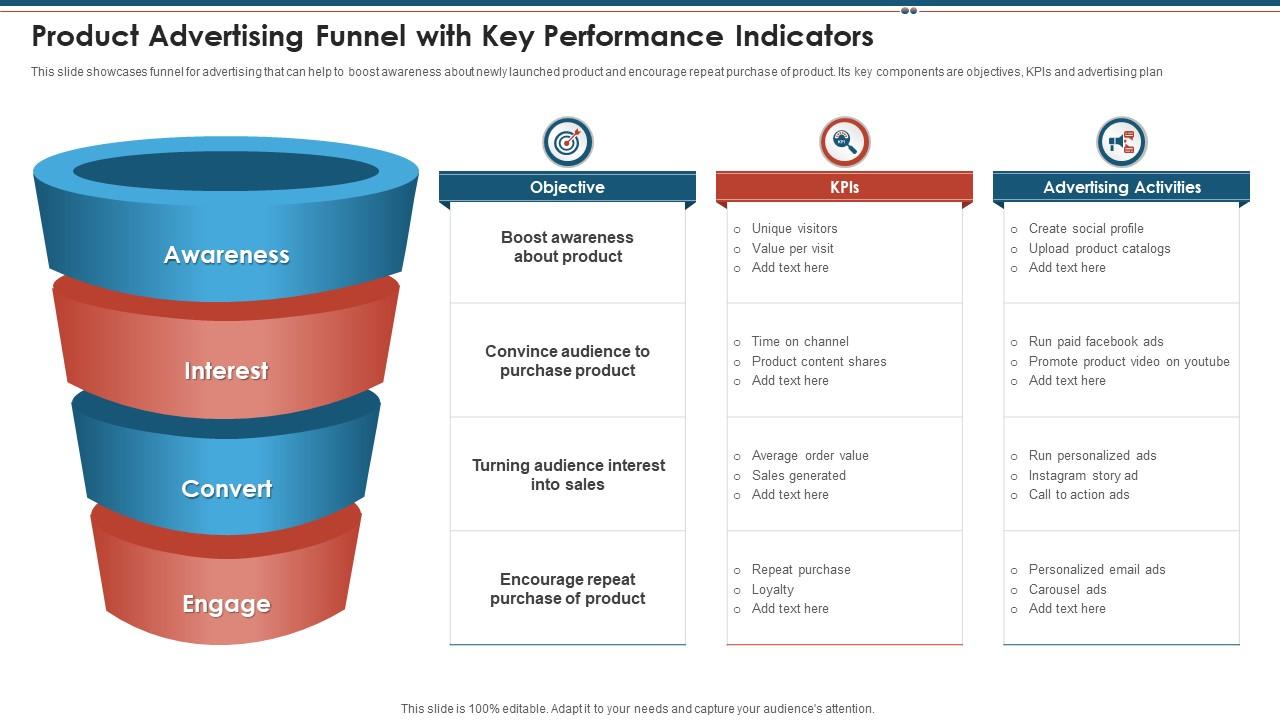
This slide showcases funnel for advertising that can help to boost awareness about newly launched product and encourage repeat purchase of product. Its key components are objectives, KPIs and advertising plan. Presenting our set of slides with Product Advertising Funnel With Key Performance Indicators. This exhibits information on three stages of the process. This is an easy to edit and innovatively designed PowerPoint template. So download immediately and highlight information on Awareness, Interest, Convert.

FAQs for Product Advertising Funnel With

So the main stages are still Awareness, Interest, Consideration, and Conversion. But product funnels are way more focused on showing off what your specific product actually does vs just building brand trust. You'll dive deeper into Interest and Consideration - like really proving your product works through demos and reviews. Regular sales funnels cast a wider net for relationships. Product ones? They're all about solving that one specific problem your thing fixes. Oh and here's what I've noticed - you end up optimizing each stage around product messaging, not just generic nurturing stuff. Map out where your current ads actually fit first.

Track different stuff at each stage - impressions for awareness, click-through rates when people show interest, conversions for actual purchases. Honestly, the hardest part is figuring out attribution between stages because that gets weird fast. Set up UTM parameters so you know where traffic's coming from, plus conversion pixels for retargeting. Cost-per-acquisition matters at every level. Google Analytics and your ad platforms handle most of this data. Just make sure you nail down your KPIs before launching - otherwise you'll get lost in meaningless vanity metrics. Map out one complete customer journey first, then expand your tracking.

Honestly, your whole funnel lives or dies by how well you know your customer personas. Think about it - a stressed-out mom scrolling Instagram at 11pm needs completely different messaging than some tech bro researching solutions during work hours. Both might want your product, but you can't talk to them the same way. I'd start by looking at your current personas and see how they move through each stage. What makes them aware? How do they research? What finally gets them to buy? Once you map that out, you'll spot the gaps pretty quick. It's like having a roadmap instead of just throwing content at the wall.

So basically you want to match platforms to where people are in buying mode. Facebook and TikTok work great for getting eyeballs with video content - super broad reach. Instagram Stories and LinkedIn are money for that middle stage when people are actually researching stuff. YouTube too, obviously. Twitter's weirdly good for jumping into conversations here. Then for the bottom funnel, hit them with retargeting on Facebook/Instagram and testimonials. I'd honestly start by just checking what platforms your customers already use instead of guessing.

Start with educational stuff - blog posts, how-to videos, that kind of thing. People don't even realize they have a problem yet, so you're just helping them learn. Then comes the comparison phase (honestly my favorite part) - case studies, demos, showing why you're better than competitors. Most people totally skip this middle bit but it's where the magic happens. Finally you hit them with testimonials and free trials when they're ready to buy. Oh, and don't do what everyone does - jumping straight to "buy now" when someone's still figuring out what their problem even is. Match your content to where their head's at.

Honestly, analytics completely changes how you approach your ad funnel. Instead of just throwing money at ads and hoping something sticks, you can actually see where people bail out. Track what content hits at each stage and which touchpoints convert. You'll catch weird patterns too - maybe your top-of-funnel ads crush it but your middle content sucks. The behavior segmentation is clutch for seeing which customer paths actually work. Oh, and you can finally stop wasting budget on channels that don't move people down the funnel. Just make sure you set up tracking at every stage first though.

Honestly? Most people overcomplicate the hell out of their funnels. You lose users at every single unnecessary step, so don't ask for their life story upfront or make them click through five pages when one works fine. Your ad and landing page need to match messaging-wise - I swear half the funnels I see completely ignore this and wonder why people bounce immediately. Also track stuff that actually matters, not just pretty numbers. Test one thing at a time or you'll never know what moved the needle. Start simple, then tweak based on what users are doing.

Here's what I've learned from running both - digital funnels let you actually see what's happening at every step. You can track someone from first click to purchase and spot exactly where they're bailing out. Traditional stuff? It's basically guesswork. Sure, you run a radio spot and maybe some print ads, but good luck connecting those dots. The cool part about digital is retargeting people who already showed interest - like that person who checked out your product page but didn't buy. You can hit them with a specific ad later. Honestly changed how I think about marketing. Map out your digital touchpoints first.

Retargeting's basically your second chance with people who already know you exist. Hit up website visitors with demos or helpful content first - gotta build that trust. Cart abandoners? Those are gold mines, seriously. Send them product reminders or throw in a discount. Past customers are perfect for upselling complementary stuff or getting them into loyalty programs. Oh, and you can build lookalike audiences from these segments too, which is pretty smart. The trick is matching your message to where they actually are in the process. Don't just spam everyone with identical ads - that's amateur hour.

A/B testing is huge for funnel optimization. You can't fix what you don't measure, you know? Test different stuff at each stage - ad creative for awareness, landing page headlines when they're considering, checkout flows for conversions. I've literally watched tiny changes double conversion rates at specific points (wild how much those small tweaks matter). Focus on one variable at a time though, otherwise you won't know what actually moved the needle. Oh and definitely start with wherever you're seeing the biggest drop-off first.

Your landing page has to match whatever your ad promised - like if you said 20% off, that better be the first thing people see. Make your headlines super clear about the benefits. Your CTA button needs to pop too. Here's the thing that drives me crazy - so many people send traffic to generic pages that have nothing to do with their ads. It's conversion suicide. Strip out the navigation menu and other random stuff. You want one action, that's it. Oh and definitely test different headlines. What sounds good to you might totally flop with actual users.

So basically you'll want different emails for each stage of your funnel. Awareness stuff should introduce benefits, consideration emails need social proof and comparisons, then hit them with urgency for the decision stage. Segment your list based on where people are - someone who grabbed your free guide is totally different from a cart abandoner, right? Automated drip campaigns work great for nurturing leads through each step. Oh, and don't sleep on retargeting past customers with upsells. First step though? Audit your current list and tag subscribers by funnel position. Trust me, it makes everything cleaner.

Start with the basics - track your funnel from top to bottom. Impressions and reach up top, then click-through rates and CPC in the middle. Bottom line? Conversion rate and cost-per-acquisition are what actually matter. Don't fall for vanity metrics (though big impression numbers do feel nice lol). The real gold is conversion rate vs. customer lifetime value compared to what you're spending to get them. Also watch how people flow between stages. Tons of clicks but no conversions? Something's broken. Get these core metrics locked down first - you can mess around with fancy attribution stuff later.

Look, customer feedback is basically your cheat sheet for spotting what's busted in your ad funnel. People saying your ads are confusing? Time to rework that awareness stage. Can't find your checkout button? Your conversion flow is probably a mess. I always set up surveys and keep tabs on reviews - social listening too if you're feeling fancy. Here's the thing though: collecting feedback is easy, actually doing something with it? That's where most people drop the ball. Track patterns at each stage and don't ignore the brutal honest stuff - it usually hurts but it's pure gold.

Honestly, AI and machine learning are crushing it right now with personalized targeting and real-time optimization. Voice search is changing how people find stuff - you gotta think about how they actually talk, not just keywords. AR demos are getting crazy good too, especially for retail. The whole cookie thing is forcing everyone to figure out new ways to track attribution since third-party data is basically dead. Oh, and dynamic creative tools are worth checking out - they'll automatically tweak your messaging based on where someone is in your funnel. Pretty cool stuff if you ask me.

Ratings and Reviews

90% of 100
Review Form
Write a review
Most Relevant Reviews
  1. 80%

    by Diego Gardner

    Easily Editable.
  2. 100%

    by Taylor Hall

    I looked at their huge selection of themes and designs. They appeared to be ideal for my profession. I'm sure I'll grab a few of them.

2 Item(s)

per page: