


Goal setting and achieving outline powerpoint show




Try Before you Buy Download Free Sample Product
 Impress Your
 Audience
 100%
100% Editable
 Save Hours
 of Time


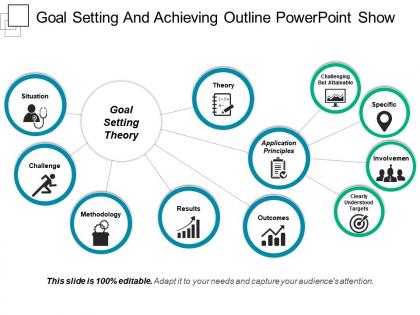
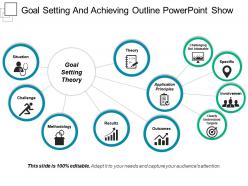
Achieve the greatest heights in your business by setting the correct goals using Goal Setting And Achieving Outline Powerpoint Show. With the help of goal setting PowerPoint show, a facilitator can easily provide a description of the goals and the ways to achieve them in a prescribed manner. The PowerPoint template includes a flow diagram that depicts the factor affecting the journey of setting and achieving in a timeframe. The factors mentioned in the PPT slide that affect the goal-setting theory are situation, challenge, methodology, results, outcomes along with some applications principles like involvement, specification, understandable targets, challenging but attainable goals. This slideshow can be used to explain how setting and achieving goals in an outline affects the intensity of growth of an organisation. Therefore, attain the maximum success in your field by setting the ideal goals with the help of goal setting PowerPoint show.
People who downloaded this PowerPoint presentation also viewed the following :
Goal setting and achieving outline powerpoint show with all 5 slides:
Activate the brains of children with our Goal Setting And Achieving Outline Powerpoint Show. They will bring out the genius in them.




FAQs for Goal setting and achieving
Critical components of effective goal-setting include specific objectives, measurable outcomes, realistic timelines, accountability mechanisms, and regular progress reviews. These elements work together by ensuring clarity, tracking advancement, and maintaining momentum, with many organizations finding that structured goal-setting frameworks enhance team alignment, resource allocation, and strategic execution, ultimately delivering improved performance and competitive advantage.
**INPUT**: How can I align my personal goals with my professional aspirations? **OUTPUT**: Aligning personal goals with professional aspirations involves identifying shared values, creating complementary timelines, and establishing metrics that serve both domains simultaneously. This strategic integration enables professionals to pursue career advancement while maintaining work-life balance, with many finding that aligned goals accelerate progress in both areas, ultimately delivering greater satisfaction and sustainable success. **Word count: 54 words**
Visualization enhances goal achievement by making abstract objectives tangible, increasing motivation through mental rehearsal, and programming the subconscious mind for success. Many high-performing athletes, executives, and organizations use visualization techniques to mentally practice successful outcomes, identify potential obstacles, and strengthen neural pathways, ultimately delivering improved focus, confidence, and strategic execution across personal and professional objectives.
SMART criteria enhance goal clarity by making objectives Specific, Measurable, Achievable, Relevant, and Time-bound, transforming vague aspirations into actionable targets. This structured approach enables organizations to track progress more effectively, allocate resources strategically, and maintain team alignment, with many businesses finding that SMART goals deliver improved accountability and measurable outcomes.
Common pitfalls include setting unrealistic timelines, creating vague objectives without measurable outcomes, neglecting to break large goals into actionable steps, and failing to establish regular review mechanisms. These challenges often derail progress across organizations, with many finding that addressing specificity, accountability, and realistic resource allocation ultimately delivers more consistent achievement and sustainable momentum.
Measuring goal progress effectively involves establishing specific metrics, regular check-in schedules, milestone tracking, percentage completion assessments, and outcome-based evaluations. Through digital dashboards and progress tracking tools, organizations increasingly find that weekly reviews, quarterly assessments, and data-driven adjustments enable faster course corrections, enhanced accountability, and ultimately deliver measurable results that drive competitive advantage.
Motivation techniques include regular progress tracking, celebrating small wins, creating accountability partnerships, visualizing successful outcomes, and breaking large goals into manageable milestones. These approaches work by maintaining momentum through consistent feedback loops, social support, and psychological reinforcement, with many professionals finding that combining multiple techniques creates sustained engagement and ultimately delivers higher achievement rates across long-term objectives.
Goal adjustment requires regularly reviewing progress, identifying specific obstacles or changed circumstances, and modifying timelines, scope, or strategies while maintaining core objectives. Successful goal adaptation involves breaking down barriers systematically, seeking alternative pathways, and leveraging new resources or partnerships, with many professionals finding that flexible goal frameworks ultimately deliver better outcomes than rigid adherence to original plans.
Short-term goals provide immediate motivation, quick wins, measurable progress, and skill-building opportunities, while long-term goals establish strategic vision, sustained direction, and meaningful achievements. Both approaches deliver complementary advantages, with many organizations finding that combining immediate milestone tracking with broader strategic planning enhances employee engagement, maintains momentum, and ultimately drives sustainable growth across departments.
Effectively communicating goals requires clear articulation of objectives, timelines, success metrics, and individual responsibilities, while ensuring alignment with broader organizational priorities. Through regular check-ins, visual dashboards, and structured updates, teams achieve better coordination and accountability, with many organizations finding that transparent goal communication increases project success rates and stakeholder engagement significantly.
Goal-setting tools include OKRs (Objectives and Key Results), SMART criteria, Gantt charts, project management platforms like Asana or Monday.com, and balanced scorecards. These frameworks streamline planning by providing structured templates, automated progress tracking, and collaborative features, with many organizations finding that integrated digital platforms enhance accountability and alignment across teams, ultimately delivering faster goal achievement and improved operational efficiency.
Prioritize multiple goals by categorizing them into short-term and long-term objectives, assessing their impact on your overall vision, and focusing on 3-5 key priorities at once. This strategic approach enables better resource allocation and reduces decision fatigue, with many professionals finding that systematic prioritization enhances productivity while maintaining clear progress momentum.
Accountability partnerships significantly enhance goal achievement by providing regular check-ins, mutual support, and external motivation to maintain consistency. Through shared commitment and progress tracking, partners create structured frameworks that increase follow-through rates, while many professionals finding that collaborative accountability delivers faster results, improved persistence, and ultimately greater success than pursuing goals independently.
Celebrate milestones by acknowledging progress through team recognition, performance reviews, and strategic check-ins that reinforce momentum while maintaining focus on larger objectives. These celebrations enhance motivation, build confidence, and sustain engagement throughout lengthy projects, with many organizations finding that regular milestone recognition ultimately delivers higher completion rates and stronger team cohesion.
Incorporating feedback into goal-setting involves establishing regular check-ins with mentors, colleagues, and stakeholders, creating measurable milestones for ongoing assessment, and building flexible adjustment mechanisms into your planning process. This strategic approach enables continuous course correction, enhanced accountability, and improved outcomes, with many professionals finding that structured feedback loops accelerate goal achievement while minimizing resource waste and strategic misalignment.
-
Easily Understandable slides.
-
Much better than the original! Thanks for the quick turnaround.