


Goods Freight Company Profile Pricing Structure For International Transport




Try Before you Buy Download Free Sample Product
 Impress Your
 Audience
 100%
100% Editable
 Save Hours
 of Time


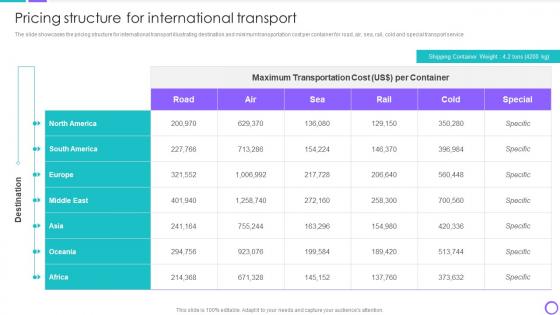
The slide showcases the pricing structure for international transport illustrating destination and minimum transportation cost per container for road, air, sea, rail, cold and special transport service
People who downloaded this PowerPoint presentation also viewed the following :
Goods Freight Company Profile Pricing Structure For International Transport with all 6 slides:
Use our Goods Freight Company Profile Pricing Structure For International Transport to effectively help you save your valuable time. They are readymade to fit into any presentation structure.





FAQs for Goods Freight Company Profile Pricing Structure
Primary factors influencing goods freight pricing include distance and route complexity, cargo weight and dimensions, fuel costs, equipment requirements, and seasonal demand fluctuations. These variables work together to determine transportation costs, with many logistics companies finding that strategic route optimization, efficient load management, and dynamic pricing models ultimately deliver competitive advantages while maintaining profitability in an increasingly complex market.
Distance significantly impacts freight pricing through fuel consumption rates, driver compensation requirements, vehicle wear calculations, and time-based operational costs. Longer routes require strategic pricing models that account for return logistics, cross-docking opportunities, and route optimization technologies, with many freight companies finding that distance-tiered pricing structures ultimately deliver better profit margins while maintaining competitive service rates.
Fuel prices directly impact freight costs through transportation expenses, surcharges, route optimization decisions, and operational overhead adjustments. When fuel costs rise, freight companies typically implement fuel surcharges, adjust pricing models, and optimize delivery routes to maintain profitability, with many logistics providers finding that strategic fuel management ultimately delivers competitive advantage and cost transparency for clients.
Shipment volume and weight are primary cost determinants in freight pricing, with carriers using dimensional weight calculations, tiered pricing structures, and capacity-based rates to establish charges. Larger, heavier shipments typically achieve better per-unit economics through economies of scale, while smaller loads face premium rates, ultimately enabling strategic shippers to optimize costs through consolidated shipments and volume commitments.
Seasonal fluctuations significantly impact freight pricing through demand spikes during peak periods, capacity constraints, and fuel cost variations. Companies strategically adjust rates by implementing dynamic pricing models, securing long-term contracts with key clients, and diversifying service offerings, with many logistics providers finding that flexible pricing structures ultimately enhance profitability while maintaining competitive advantage.
Domestic freight pricing typically focuses on distance, weight, and delivery speed, while international services include customs duties, port fees, currency fluctuations, and regulatory compliance costs. International shipments involve additional complexities like documentation requirements, insurance premiums, and multi-modal transportation coordination, with many logistics companies finding that global services require 30-40% higher operational overhead, ultimately demanding more strategic pricing approaches.
Tariffs and regulations significantly influence freight pricing through compliance costs, route restrictions, and cross-border fees that companies must factor into their models. Many freight companies adapt by implementing dynamic pricing structures that account for regulatory changes, customs duties, and international trade policies, ultimately passing these costs to customers while maintaining competitive margins in an increasingly complex global logistics environment.
Common pricing strategies employed by goods freight companies include distance-based pricing, weight-based pricing, dimensional weight pricing, fuel surcharges, and volume discounts. These approaches enable freight companies to optimize revenue by accounting for operational costs, route efficiency, and cargo characteristics, while major logistics providers increasingly combine multiple strategies to deliver competitive rates and maintain profitability in dynamic shipping markets.
Freight brokers influence pricing transparency by providing market rate comparisons, consolidating pricing information from multiple carriers, and offering digital platforms that display real-time quotes. Through their extensive networks, brokers enable shippers to compare costs across different transportation modes and routes, while standardizing pricing formats, ultimately delivering greater market visibility and competitive rate discovery in an increasingly complex logistics landscape.
Technology and automation significantly reshape freight company pricing structures by enabling dynamic pricing models, real-time cost calculations, automated route optimization, and data-driven operational efficiencies. These advancements allow companies to offer more competitive rates through reduced labor costs, fuel optimization, and predictive maintenance, while providing customers with transparent, usage-based pricing that ultimately delivers enhanced service reliability and cost-effectiveness.
Companies calculate additional fees through standardized rate tables, distance-based formulas, weight classifications, and service complexity assessments. These surcharges cover fuel costs, residential deliveries, oversized items, expedited services, and specialized handling requirements, with many freight providers using automated systems to ensure transparent pricing and streamline billing processes for enhanced customer experiences.
Pricing flexibility enables freight companies to accommodate diverse client needs, seasonal demand fluctuations, volume variations, and market conditions, ultimately enhancing customer satisfaction and loyalty. By offering customizable rate structures, volume discounts, and adaptive pricing models, companies can attract price-sensitive clients while retaining long-term partnerships, with many logistics providers finding that flexible pricing delivers competitive advantage and sustainable revenue growth.
Competitive pressures drive freight pricing changes through market differentiation, cost optimization, and service bundling strategies to retain customers and capture market share. Companies increasingly adopt dynamic pricing models, value-based service tiers, and technology-enhanced offerings, with many freight providers finding that flexible pricing structures combined with specialized services ultimately deliver competitive advantage and improved customer retention.
Goods freight companies typically offer standard delivery, expedited shipping, white glove service, temperature-controlled transport, and specialized handling for fragile items. These service levels create tiered pricing structures, with expedited and specialized services commanding premium rates, while standard delivery options provide cost-effective solutions, ultimately enabling businesses to balance budget constraints with operational requirements.
Customers can negotiate better freight rates by leveraging volume commitments, flexible scheduling, consolidated shipments, and long-term partnerships to demonstrate value to carriers. By understanding pricing components like fuel surcharges, accessorial fees, and seasonal fluctuations, businesses can propose win-win arrangements that reduce carrier costs while securing competitive rates, ultimately delivering significant transportation savings and improved supply chain efficiency.
-
My team has been relying on SlideTeam’s professional PPT designs for a while now. It has greatly sped up quality work at my organization. So thanks!
-
I am so thankful for all of the templates I've found on your site. They have saved me hours every week and helped make my presentations come alive. Keep up with these amazing product releases!