


Grab Business Strategies Grab Investor Funding Pitch Deck Ppt File Slideshow




Try Before you Buy Download Free Sample Product
 Impress Your
 Audience
 100%
100% Editable
 Save Hours
 of Time


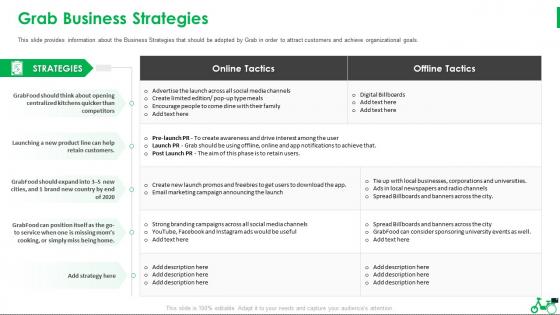
This slide provides information about the Business Strategies that should be adopted by Grab in order to attract customers and achieve organizational goals.
People who downloaded this PowerPoint presentation also viewed the following :
Grab Business Strategies Grab Investor Funding Pitch Deck Ppt File Slideshow with all 6 slides:
Use our Grab Business Strategies Grab Investor Funding Pitch Deck Ppt File Slideshow to effectively help you save your valuable time. They are readymade to fit into any presentation structure.





FAQs for Grab Business Strategies Grab Investor Funding Pitch Deck
Key components of a successful business strategy include clear vision and mission statements, comprehensive market analysis, competitive positioning, strategic objectives with measurable goals, and resource allocation frameworks. These elements work together by aligning organizational priorities, guiding decision-making processes, and enabling sustainable growth, with many companies finding that integrated strategic planning ultimately delivers competitive advantage and operational efficiency.
Small businesses can differentiate themselves through personalized customer service, niche specialization, local community engagement, innovative digital marketing, and flexible operational approaches that larger competitors cannot match. These strategies enable companies to build stronger customer relationships, respond quickly to market changes, and deliver tailored solutions, with many finding that authentic brand storytelling and specialized expertise ultimately create sustainable competitive advantages.
Customer feedback plays a crucial role in shaping business strategies by identifying market gaps, validating product decisions, and revealing customer pain points that drive strategic pivots. Through systematic feedback collection and analysis, companies across retail, hospitality, and financial services streamline their offerings, enhance customer experiences, and ultimately deliver competitive advantages that increase retention and market share.
Businesses utilize data analytics to inform strategic decisions by analyzing customer behavior patterns, market trends, operational performance metrics, and competitive intelligence to identify opportunities and risks. Through predictive modeling and real-time dashboards, companies streamline resource allocation, enhance customer targeting, and accelerate market responsiveness, with many organizations finding that data-driven strategies deliver measurable competitive advantages and improved profitability.
Cost leadership strategy delivers competitive advantage through lower production costs, economies of scale, operational efficiency, market share growth, and price flexibility during economic downturns. While this approach enables sustainable profitability and customer retention through competitive pricing, it also presents challenges including reduced profit margins, vulnerability to price wars, and potential quality perception issues, with many organizations finding that balancing cost control with value delivery ultimately determines long-term success.
Businesses can pivot their strategies by conducting comprehensive market analysis, diversifying product offerings, adopting flexible operational models, leveraging digital technologies, and realigning resource allocation with emerging opportunities. Through strategic agility and data-driven decision making, organizations in retail, healthcare, and financial services streamline operations while enhancing customer experiences, ultimately delivering competitive advantage in increasingly dynamic markets.
Aligning business strategies with company culture ensures sustainable execution, employee engagement, and authentic organizational growth. When strategies reflect core values and cultural strengths, companies streamline implementation, minimize resistance, and enhance performance, with organizations like Southwest Airlines and Patagonia demonstrating how cultural alignment delivers competitive advantage and long-term success.
Companies can measure business strategy success through key performance indicators like revenue growth, market share expansion, customer acquisition costs, operational efficiency metrics, and return on investment calculations. Financial services firms and retail organizations increasingly use balanced scorecards combining quantitative data with customer satisfaction scores, ultimately enabling strategic adjustments that deliver competitive advantage and sustainable growth.
Potential risks include market resistance to new approaches, resource misallocation, operational disruption, competitive retaliation, and technology integration challenges. While these risks present significant considerations, organizations increasingly find that strategic innovation delivers competitive advantage and market differentiation, with many companies in retail, financial services, and manufacturing successfully navigating implementation challenges through phased rollouts and adaptive management.
Strategic partnerships enhance growth potential by providing access to new markets, complementary resources, shared expertise, and expanded customer bases while reducing operational costs. Through strategic alliances, companies like technology firms partnering with healthcare organizations or retail brands collaborating with logistics providers can accelerate market entry, enhance service offerings, and achieve competitive advantages that would be difficult to attain independently.
Businesses can improve employee engagement and productivity through flexible work arrangements, professional development programs, recognition systems, transparent communication, and performance-based incentives. These strategies enhance workplace satisfaction by fostering autonomy, career growth, and meaningful feedback, with many organizations finding that engaged employees deliver higher performance, reduced turnover, and ultimately stronger competitive advantage.
Global economic factors significantly influence business strategy by affecting market demand, currency fluctuations, trade policies, supply chain costs, and competitive landscapes across regions. Companies adapt through diversified market entry, flexible pricing models, and strategic partnerships, with many multinational corporations finding that economic monitoring enables proactive strategy adjustments, ultimately delivering resilience and competitive advantage.
Technology integration transforms traditional business strategies by enabling data-driven decision making, automating routine processes, enhancing customer personalization, streamlining supply chain management, and facilitating remote collaboration capabilities. These digital solutions revolutionize how organizations operate across sectors like retail, manufacturing, and financial services, ultimately delivering faster market responsiveness, reduced operational costs, and sustainable competitive advantages.
Effective communication methods include town halls, interactive workshops, visual dashboards, regular updates, and departmental cascades that translate strategy into role-specific actions. These approaches enhance understanding by connecting strategic objectives to daily responsibilities, fostering employee engagement, and ensuring stakeholder alignment, with many organizations finding that transparent, multi-channel communication ultimately delivers stronger execution and competitive advantage.
Sustainability integrates into business strategy through operational efficiency improvements, supply chain optimization, stakeholder engagement initiatives, and innovation-driven product development. Companies in manufacturing, retail, and financial services find that sustainable practices reduce costs, enhance brand reputation, attract conscious consumers, and ensure regulatory compliance, ultimately delivering competitive advantage in an increasingly environmentally-aware marketplace.
-
My search for complete decks ended with SlideTeam. Such a surplus collection of HD PowerPoints. Moreover, their standard and widescreen formats have helped me in delivering bullseye presentations.
-
I’m not a design person, so I couldn’t make a presentation to save my life. Thankfully, they have all kinds of templates that I regularly use for my work.