


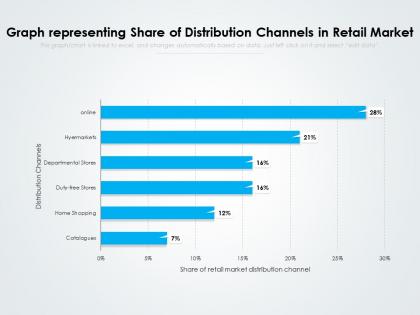
Graph representing share of distribution channels in retail market




Try Before you Buy Download Free Sample Product
 Impress Your
 Audience
 100%
100% Editable
 Save Hours
 of Time


Our Graph Representing Share Of Distribution Channels In Retail Market are explicit and effective. They combine clarity and concise expression.
People who downloaded this PowerPoint presentation also viewed the following :
Graph representing share of distribution channels in retail market with all 2 slides:
Give your audience a fulfilling experience. They will find our Graph Representing Share Of Distribution Channels In Retail Market elevating.
FAQs for Graph representing share of distribution channels
Primary retail distribution channels include direct-to-consumer, wholesale, retail partnerships, e-commerce platforms, and omnichannel approaches. These channels enable retailers to reach diverse customer segments by streamlining inventory management, expanding market reach, and enhancing customer experiences, with many organizations finding that strategic channel combinations ultimately deliver greater operational efficiency and competitive advantage.
Online retail channels differ from traditional brick-and-mortar stores through digital accessibility, automated inventory management, reduced overhead costs, and global reach capabilities, while physical stores offer tactile experiences and immediate product acquisition. These complementary approaches enable retailers to streamline operations across multiple touchpoints, with many organizations finding that strategic omnichannel integration ultimately delivers enhanced customer experiences and competitive advantage.
Wholesalers serve as crucial intermediaries between manufacturers and retailers, purchasing products in bulk, storing inventory, and distributing smaller quantities to retail outlets while providing market expertise and credit facilities. They streamline supply chains by reducing logistical complexity for manufacturers, enabling retailers to access diverse product ranges without managing multiple supplier relationships, ultimately delivering cost efficiencies and improved market reach across retail networks.
Retailers optimize supply chain distribution through demand forecasting analytics, automated inventory management systems, strategic warehouse positioning, vendor collaboration platforms, and real-time tracking technologies. These approaches streamline operations by reducing stockouts, minimizing transportation costs, and accelerating order fulfillment, with many retail organizations finding that integrated supply chain optimization ultimately delivers faster customer service and significant competitive advantage.
Customer preferences significantly influence distribution channel choices by driving demand for convenience, speed, personalization, and seamless experiences across multiple touchpoints. Retailers increasingly adopt omnichannel approaches, with many fashion and electronics companies finding that combining online platforms, physical stores, mobile apps, and social commerce delivers enhanced customer satisfaction while maintaining competitive advantage in an evolving marketplace.
Omnichannel strategies enhance retail distribution by integrating online, mobile, and physical touchpoints seamlessly, enabling consistent inventory visibility, unified customer profiles, and flexible fulfillment options like buy-online-pickup-in-store. Through synchronized systems, retailers streamline operations, reduce delivery times, and deliver personalized experiences across all channels, ultimately creating competitive advantage and increased customer loyalty.
Managing multiple distribution channels presents retailers with inventory synchronization complexities, inconsistent customer experiences across touchpoints, technology integration difficulties, and supply chain coordination challenges. While these obstacles require strategic investment, many retail organizations find that streamlined channel management ultimately delivers enhanced operational efficiency, improved customer satisfaction, and stronger competitive positioning in an increasingly omnichannel marketplace.
Technology revolutionizes retail distribution channel management by automating inventory tracking, enabling real-time demand forecasting, and streamlining supplier communications across multiple touchpoints. Through AI-powered analytics and cloud-based platforms, retailers optimize stock levels, reduce fulfillment times, and enhance customer experiences, while minimizing operational costs and ultimately delivering competitive advantage in an increasingly digital marketplace.
When selecting a distribution partner, consider their market reach, logistics capabilities, financial stability, brand alignment, and technological infrastructure. These factors collectively determine partnership success, with retailers finding that partners offering extensive geographic coverage, efficient warehousing systems, and compatible values ultimately deliver faster market penetration, reduced operational costs, and enhanced customer experiences across diverse retail segments.
Retailers can effectively measure distribution channel performance through key metrics including sales volume per channel, cost-per-acquisition, inventory turnover rates, customer satisfaction scores, and delivery timeframes. These measurements enable strategic resource allocation and operational optimization, with many retail organizations finding that comprehensive analytics across channels ultimately delivers enhanced customer experiences and competitive advantage.
Current trends shaping retail distribution include omnichannel integration, direct-to-consumer expansion, micro-fulfillment centers, sustainable logistics, and AI-powered inventory management. These strategies enable retailers to streamline operations, reduce delivery times, and enhance customer experiences, with many organizations finding that strategic channel diversification delivers competitive advantage in an increasingly complex marketplace.
Seasonal fluctuations significantly impact retail distribution planning by requiring flexible inventory management, adjusted warehouse capacity, and modified logistics schedules to handle demand peaks and valleys. Retailers increasingly employ predictive analytics and strategic partnerships with third-party logistics providers to optimize supply chains, ultimately delivering consistent customer experiences while minimizing costs during both high-demand holiday periods and slower seasons.
Strategies include route optimization software, local fulfillment centers, crowdsourced delivery networks, autonomous delivery vehicles, and smart locker systems. These technologies streamline operations by reducing delivery times, minimizing transportation costs, and enhancing customer convenience, with many retailers finding that strategic combinations of multiple approaches ultimately deliver competitive advantage and improved customer satisfaction.
Sustainability has become critically important in retail distribution channels, with consumers increasingly demanding environmentally responsible practices and regulatory pressures mounting across industries. Many retailers are redesigning their supply chains through carbon-neutral shipping, sustainable packaging, local sourcing networks, and circular economy models, ultimately delivering competitive advantage while reducing operational costs and enhancing brand loyalty.
Global sourcing creates complex distribution implications through extended supply chains, increased lead times, inventory management challenges, and regulatory compliance requirements across multiple markets. While these complexities demand sophisticated logistics coordination, they ultimately enable retailers to access cost-effective products, diversify supplier bases, and expand market reach, with many retail organizations finding that strategic global sourcing delivers significant competitive advantages despite operational complexity.
No Reviews