


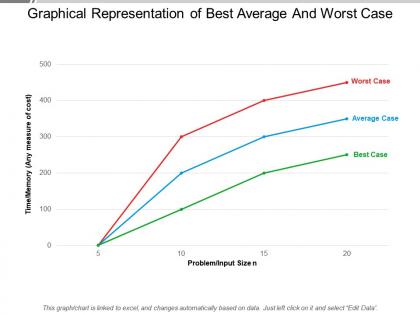
Graphical representation of best average and worst case




Try Before you Buy Download Free Sample Product
 Impress Your
 Audience
 100%
100% Editable
 Save Hours
 of Time


Inject a dose of good humor with our Graphical Representation Of Best Average And Worst Case. Allow everyone to experience jolly good fun.
People who downloaded this PowerPoint presentation also viewed the following :
Graphical representation of best average and worst case with all 6 slides:
Move heaven and earth with our Graphical Representation Of Best Average And Worst Case. They allow you to do everything feasible


FAQs for Graphical representation of best average
So you're mainly looking at two things: time complexity (how long it takes) and space complexity (how much memory it uses). Time complexity gets most of the attention - makes sense since nobody wants their code taking forever to run. But honestly, space complexity can bite you too, especially with huge datasets or when memory's tight. Both help you figure out how your algorithm handles bigger inputs, which is pretty key for design choices. Oh, and definitely check worst-case scenarios first. Average case is nice if you've got extra time.
So Big O notation is basically how you figure out which algorithm won't completely tank when your data gets huge. It ignores all the messy details and just shows you the pattern - like will it take twice as long with double the data (O(n)) or go completely nuts and take four times longer (O(n²))? Honestly, I used to think it was just academic BS until I had to process massive datasets. You're not measuring exact speed (that's all hardware dependent anyway), but how things scale up. When you're picking between approaches, just go with the better Big O for your data size. Trust me on this one.
So best-case is when your algorithm gets lucky - like finding what you're searching for right at the start. Worst-case? That's when everything goes wrong and you hit the maximum number of operations. Average-case tries to predict typical performance across different scenarios. Here's the thing though - most developers (myself included) get way too focused on worst-case scenarios. Sure, it gives you those hard performance guarantees, but honestly average-case tells you more about real-world behavior. That said, I'd still design around worst-case first. You don't want your system crashing when Murphy's law kicks in.
Yeah so basically you can usually trade space for time or vice versa. Like caching stuff vs recalculating it every time - classic tradeoff. Sometimes better memory usage actually speeds things up too (fewer cache misses and all that). First figure out what you're actually limited by. Memory tight? Focus there first. Got RAM to burn but need speed? Go wild with the memory usage. Honestly though, just profile both in your actual setup because what matters on paper doesn't always match reality. I've been surprised before.
Honestly, you can't really analyze algorithms without thinking about data structures first. They're what determine your time and space complexity. Like, choosing between an array, hash table, or binary tree? That decision alone can swing you from O(n) to O(log n) performance - which is massive with big datasets. Your algorithm could be super clever, but if you're using the wrong data structure underneath, performance will still suck. I always figure out the data structure first, then see how the algorithm performs with that specific setup. Makes the whole analysis way clearer.
Look, theory only gets you so far - you need to actually test your code on real data. Big O notation is great for understanding growth rates, but it totally ignores constant factors and how your CPU cache behaves. Real datasets are messy too, not like the clean examples in textbooks. Worst-case scenarios that theory obsesses over? They barely happen in practice. I learned this the hard way once when my "theoretically optimal" solution got crushed by something simpler. Run benchmarks with data that actually matches what you'll be working with. You might be shocked which algorithm wins.
Don't get tunnel vision on worst-case scenarios - average performance matters way more in practice. I see people confuse theoretical complexity with actual runtime all the time, which is super misleading. Watch out for expensive operations buried in library calls or recursion that you might miss if you're just looking at the main loop. Space complexity is huge too! I've definitely made the mistake of optimizing speed while completely destroying memory usage. Focus on the input sizes you'll actually deal with, not just abstract big-O stuff. Benchmark with real data whenever you can - it's honestly the only way to know for sure.
Big O notation is your best friend here - it shows how things slow down when your data gets massive. Run tests with bigger and bigger datasets, but honestly? Don't just trust the math. Real systems are weird and cache behavior will mess with you sometimes. Plot your results so you can actually see the growth pattern. Start with worst-case scenarios, then test with data sizes you'll realistically hit. Also ask yourself if your input will even scale that big in practice. Measure both runtime and memory usage as you go.
Honestly? Go with quadratic when your data's tiny and the simpler code won't make you want to cry later. Bubble sort is a perfect example - yeah it's O(n²) but debugging it is so much easier than some fancy linear algorithm. For small datasets, those constant factors actually matter more than the Big O stuff anyway. Sometimes you need specific features too, like how stable sorts work. I learned this the hard way trying to optimize everything upfront. Just test it with your actual data first - premature optimization is real and it sucks.
Honestly, start by profiling your code first - you'll be surprised where the actual slowdowns are versus what you expected. Once you find the real bottlenecks, that's where you attack. Swap out nested loops for hash tables if you can, or try divide-and-conquer instead of brute force approaches. Caching is your friend too - costs more memory but saves tons of computation time. Your choice of data structure matters way more than people think. Arrays vs linked lists vs trees can completely change your performance. Oh, and don't sleep on dynamic programming or greedy algorithms. They're game changers for certain problems.
Dude, the algorithm you pick literally makes or breaks your app's performance. I've watched entire systems crash because someone used bubble sort on a huge dataset - not pretty. When your user base grows, good algorithms just handle it smoothly. Bad ones? They'll eat your CPU alive and make everything crawl. The jump from O(n²) to O(n log n) sounds nerdy but it's huge with real data. Honestly, most people don't test with realistic data sizes. Run some profiles with actual volume and you'll see where you're bleeding resources.
Dude, slow algorithms will absolutely kill your user experience. People bounce fast when apps lag or freeze up. I learned this the hard way trying to fix performance issues after launch - what a nightmare. You really want to think about Big O complexity during design, not after. Even beast hardware won't save you if your algorithm sucks at scale. My advice? Load test early with real data volumes. Short bursts work fine, but sustained usage will expose the weak spots. Don't skip those code reviews either.
So for measuring how efficient your algorithms are, start with Big O notation - that's your O(n), O(log n) stuff. Gives you the theoretical picture of how things scale. But here's the thing - theory only gets you so far. Real-world testing with actual datasets matters way more than you'd think. Cache behavior and those pesky implementation details can totally mess with your expectations. I usually analyze the math first to weed out the obviously bad options, then benchmark whatever looks promising. Sometimes an O(n log n) algorithm beats an O(n) one because of constant factors or memory patterns.
So yeah, faster hardware changes things but the core math stays the same. Big O still matters tons - your O(n²) algorithm will always beat O(n³) once you hit bigger datasets, doesn't matter how fast your CPU is. But parallel processing and GPUs? Game changers honestly. They've made algorithms viable that were totally impractical before. Cache sizes mess with constant factors way more than we used to think about too. My take: nail down your asymptotic complexity first, then tweak for whatever hardware you're actually running on.
Dude, algorithm analysis is honestly a game-changer for debugging. You'll spot performance issues way quicker when you actually understand your code's complexity. Like, if something's running slow, you can immediately zero in on that O(n²) loop instead of randomly guessing. It saves so much time because you stop wasting effort on tiny optimizations that barely matter. Focus on the big wins first, you know? Plus you can predict if your code will completely die when you hit production scale - learned that one the hard way lol. Start with whatever functions you use most and work from there.
No Reviews