


Great place work score ppt powerpoint presentation ideas backgrounds cpb




Try Before you Buy Download Free Sample Product
 Impress Your
 Audience
 100%
100% Editable
 Save Hours
 of Time


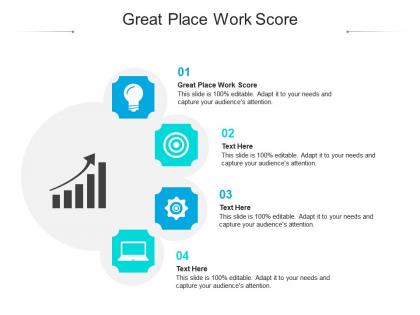
Our Great Place Work Score Ppt Powerpoint Presentation Ideas Backgrounds Cpb are topically designed to provide an attractive backdrop to any subject. Use them to look like a presentation pro.
People who downloaded this PowerPoint presentation also viewed the following :
Great place work score ppt powerpoint presentation ideas backgrounds cpb with all 2 slides:
Use our Great Place Work Score Ppt Powerpoint Presentation Ideas Backgrounds Cpb to effectively help you save your valuable time. They are readymade to fit into any presentation structure.
FAQs for Great place work score ppt powerpoint presentation
Factors contributing to a Great Place to Work Score include trust in leadership, respect and fairness, workplace culture, employee recognition, professional development opportunities, and work-life balance initiatives. These elements work together by fostering employee engagement, reducing turnover, and enhancing productivity, with many organizations finding that strategic focus on these areas delivers improved talent retention and competitive advantage in recruitment.
Organizations can effectively improve their Great Place to Work Score by enhancing trust through transparent communication, fostering recognition programs, promoting work-life balance, ensuring fair compensation, and creating inclusive development opportunities. Through strategic employee engagement initiatives, companies streamline feedback processes, enhance workplace culture, and deliver improved retention rates, with many organizations finding that these comprehensive approaches ultimately boost both employee satisfaction and competitive advantage.
Employee surveys form the foundation of the Great Place to Work Score, comprising approximately 70% of the overall assessment through the Trust Index Survey, which measures credibility, respect, fairness, pride, and camaraderie. These comprehensive surveys enable organizations to identify specific areas for workplace improvement, benchmark against industry standards, and demonstrate measurable progress in employee satisfaction, ultimately delivering enhanced retention rates and competitive talent acquisition advantages.
The Great Place to Work Score significantly influences recruitment and retention by serving as a credible third-party validation of company culture, employee satisfaction, and workplace excellence. Organizations with higher scores attract top talent more easily, reduce recruitment costs through enhanced employer branding, and experience lower turnover rates, with many companies finding that certified status ultimately delivers competitive hiring advantages and improved employee loyalty in an increasingly talent-focused market.
Leadership significantly impacts Great Place to Work scores through transparent communication, consistent recognition programs, inclusive decision-making processes, and fostering psychological safety across all organizational levels. Through authentic engagement strategies, leaders enhance employee trust, credibility, and respect metrics, with many organizations finding that accessible, empathetic leadership approaches ultimately deliver higher retention rates and stronger workplace culture scores.
Company culture directly influences Great Place to Work Scores through employee trust, respect, fairness, pride, and camaraderie metrics that the survey measures. Organizations with strong, inclusive cultures consistently achieve higher scores by fostering transparent communication, recognizing achievements, and prioritizing employee wellbeing, with many companies finding that cultural investments ultimately deliver improved retention, productivity, and competitive advantage in talent acquisition.
Companies should consider industry averages, regional standards, peer organization comparisons, year-over-year improvement trends, and dimension-specific benchmarks like trust, respect, and fairness scores. These benchmarks enable organizations to identify competitive positioning within their sector, set realistic improvement targets, and prioritize strategic initiatives, with many companies finding that consistent progress across multiple dimensions ultimately delivers enhanced employee retention and organizational performance.
Companies should reassess their Great Place to Work Score annually to maintain certification, though many organizations conduct quarterly pulse surveys and mid-year check-ins for continuous improvement. This regular evaluation enables businesses to track progress, address emerging workplace challenges, and adapt to changing employee expectations, with many finding that consistent monitoring ultimately enhances retention rates and strengthens their competitive advantage in talent acquisition.
Common pitfalls that negatively affect Great Place to Work Scores include inconsistent leadership communication, limited career development opportunities, inadequate recognition programs, poor work-life balance policies, and lack of transparency in decision-making. These challenges particularly impact employee trust and credibility dimensions, with many organizations finding that addressing management accessibility and creating inclusive workplace cultures significantly improves their overall certification rankings.
Organizations can communicate their Great Place to Work Score through website prominently featuring certifications, social media campaigns highlighting employee testimonials, press releases announcing achievements, recruitment materials showcasing workplace culture, and industry conference presentations. These communication strategies enhance employer branding, attract top talent, and strengthen customer trust, with many companies finding that transparent sharing of workplace recognition ultimately delivers competitive advantage in both talent acquisition and market positioning.
Maintaining a high Great Place to Work Score requires consistent employee engagement initiatives, transparent communication practices, competitive compensation reviews, professional development programs, and regular feedback mechanisms. These strategies work by fostering trust, recognition, and career growth opportunities, with many organizations finding that sustained investment in workplace culture, leadership training, and employee well-being ultimately delivers improved retention and competitive talent advantage.
Employee feedback enhances Great Place to Work Scores by identifying specific areas for improvement, addressing workplace concerns directly, and demonstrating leadership's commitment to positive change. Through targeted surveys and focus groups, organizations can streamline communication processes, enhance management practices, and improve workplace culture, with many companies finding that responsive feedback implementation ultimately delivers higher trust scores and competitive employer branding advantages.
A low Great Place to Work Score significantly undermines employee morale by creating distrust, reducing engagement, and fostering workplace dissatisfaction that can spread throughout the organization. This decline ultimately leads to higher turnover rates, decreased productivity, and difficulty attracting top talent, with many companies finding that addressing cultural gaps becomes increasingly critical for maintaining competitive advantage.
Diversity and inclusion significantly enhance Great Place to Work Scores by fostering trust, respect, and psychological safety among employees, creating environments where all team members feel valued and heard. Companies with strong D&I practices typically see improved collaboration, innovation, and employee engagement metrics, with many organizations finding that inclusive cultures directly correlate with higher workplace satisfaction and retention rates.
Technologies that assist companies in gathering Great Place to Work Score data include employee engagement platforms, pulse survey tools, sentiment analysis software, HR analytics systems, and feedback management applications. These solutions streamline data collection by automating surveys, analyzing employee responses, and tracking workplace sentiment trends, with many organizations finding that integrated platforms deliver comprehensive insights while reducing administrative burden and enhancing participation rates.
-
Amazing product with appealing content and design.
-
Great quality slides in rapid time.
-
Great product with highly impressive and engaging designs.