


Green Retail Business Transformation To Attract Eco Conscious Buyers Ppt Sample Sustainability CD





Try Before you Buy Download Free Sample Product
 Impress Your
 Audience
 100%
100% Editable
 Save Hours
 of Time


Green businesses are companies that incorporate environment-friendly initiatives and operate in a sustainable manner. Check out our professionally designed Green Retail Business Transformation to Attract Eco-Conscious Buyers PowerPoint presentation. This PPT helps retail businesses adopt practices and technologies that help transform into green businesses and leverage profitability while benefiting the planet. Our complete deck begins with an understanding of the shift in consumer demand towards sustainable and eco-friendly products and services. It further conducts a sustainability assessment to determine the gap in transitioning towards a green retail business. Additionally, this PPT implements a strategy for streamlining transition detailing, strategic actions, team, budget, timeline, and solutions to effectively implement the green retailing strategy. Moreover, our deck further implements the transformation strategy. These include stages such as sustainable store design and operations, green operations, and green product sourcing. The transformation strategy also includes packaging waste reduction and recycling, green marketing and customer engagement awareness programs, sustainable communication channels, and sustainable transportation. Lastly, this PPT module measures the impact of transitioning into green retail business through an increase in eco-conscious buyer engagement, green retail KPIs, and ROI. Download this PPT today to transform into a green retail business that attracts consumers while reducing the negative impact on the environment.
People who downloaded this PowerPoint presentation also viewed the following :
Content of this Powerpoint Presentation
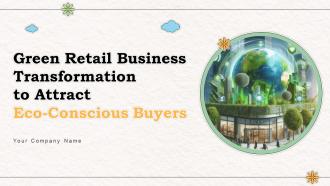
Slide 1: This slide introduces Green Retail Business Transformation to Attract Eco-Conscious Buyers. State your company name and begin.
Slide 2: This slide states Agenda of the presentation.
Slide 3: This slide shows Table of Content for the presentation.
Slide 4: This slide highlights title for topics that are to be covered next in the template.
Slide 5: This slide conducts a survey analysis to identify the need for retail business to transition into a green retailing business. It conducts survey among multiple groups of retail consumers , indicating a high rise in eco-conscious consumers in retail business.
Slide 6: This slide showcases the benefits of going green for a retail business. It includes benefits such as enhanced brand image & competitive edge, builds community relationships, saves money, boosts revenue, etc.
Slide 7: This slide highlights title for topics that are to be covered next in the template.
Slide 8: This slide help conduct a sustainability assessment to identify issues that are impacting business to transition into green retailing. It includes information about areas, current practices, indicators, sustainability issues, and impact.
Slide 9: This slide evaluates the current environmental footprint of various retail operations. It compares year-on-year emission per item of transport, operations, packaging, etc.
Slide 10: This slide identifies various improvement areas to transition into green retailing and become sustainable. It includes green product sourcing sustainable store design & operations, green marketing & customer engagement, etc.
Slide 11: This slide highlights title for topics that are to be covered next in the template.
Slide 12: This slide helps in setting sustainability goals and targets into a green retailing business. It includes goals such as product sourcing from sustainable suppliers, store design improvement, increase in customer awareness of sustainable practices, etc.
Slide 13: This slide presents a checklist for implementing a green strategy for transitioning into a sustainable retail business. It includes steps such as, begin with a vision, business operations, merchandise, supplies, advertising & marketing and transportation.
Slide 14: This slide presents an org. structure retail business that will help implement sustainable practices to seamlessly transition into green business. It includes rples such as, product department manager, store manager, buying manager, finance manager, etc.
Slide 15: This slide presents a six month timelines for transition into a green retailing business. It includes phases such as, sustainability audit, sustainability strategy development, green product sourcing, green marketing, etc.
Slide 16: This slide allocates budget for implementing initiatives for transforming business into a green retail. It includes information about category, activities, budget, actual, and variance.
Slide 17: This slide presents a training program to train employees on importance of sustainability and company's green vision to instill sustainability skills. It covers aspects such as, training objective, topics, method, responsible person and status.
Slide 18: This slide present solutions to address the key challenges of setting up a green retailing business. It addresses challenges such as, supply chain complexity, cost constraints, regulatory compliance, and technological integration.
Slide 19: This slide highlights title for topics that are to be covered next in the template.
Slide 20: This slide presents various types of sustainable materials for developing eco-friendly products. It categorizes materials in three types natural , renewable and non-toxic.
Slide 21: This slide helps in selecting eco-friendly product material by comparing materials based on certain sustainability criteria. It compares on the basis of efficient design, fitness for purpose, environmental impact, etc.
Slide 22: This slide presents a comparison table for selecting sustainable vendors to source sustainable material for retail business. It compares on the basis of criteria such as, environmental impact, social responsibility, ethical sourcing, energy efficiency, etc.
Slide 23: This slide showcases essential certification and labeling for sustainable products. It mentions eco-labels such as, GreenCircle certified, green products standards, and NSF sustainability certified.
Slide 24: This slide highlights title for topics that are to be covered next in the template.
Slide 25: This slide presents measures to ensure retail store energy efficiency. It includes initiatives such as switching to LED lighting, installing light timers & sensors, set up zones & times, conduct regular inspections, etc.
Slide 26: This slide presents a strategies and materials for incorporating green designing in retail stores reflecting eco-consciousness and sustainability. It includes details about, objective, description, material used, and impact.
Slide 27: This slide presents strategies for reducing retail-store waste to reduce environmental footprint and improve brand image. It includes initiatives such as, incentivize reusable bags, donate or discount damaged products, retail waste reduction, and implement buy-back program.
Slide 28: This slide showcases multiple sustainable payment options that retailers can offer at checkout stage. It includes options such as digital wallets, payment links, digital receipts, QR codes etc.
Slide 29: This slide highlights title for topics that are to be covered next in the template.
Slide 30: This slide implements a sustainable awareness campaign to educate customers about company's sustainable vision and values. It includes details about , campaign name, objective, duration, message, target audience, budget, and expected ROI.
Slide 31: This slide implements a green incentive program to create loyalty among retail consumers making sustainable choices. It includes details about sustainable actions, reward/incentive, implementation and partnerships.
Slide 32: This slide implements a in-store recycling program to reduce environmental waste. It includes programs such as , empties collection program, bring it back program, recycling and re-purposed program.
Slide 33: This slide presents green marketing communication channels to highlight company's sustainability initiatives and achievements. It includes channels such as , website, product packaging, and social media.
Slide 34: This slide presents strategic action plan for implementing eco-friendly POP displays that differentiate in the market and attract eco-conscious customers. It includes actions such as design sustainable POP displays, incorporate educational messaging, etc.
Slide 35: This slide highlights title for topics that are to be covered next in the template.
Slide 36: This slide compares various sustainable packaging alternatives to reduce packaging waste reduction and recycling. It compares packaging options such as paper, recycled plastic, mushroom , corrugated, and compostable mailers.
Slide 37: This slide present design principle to develop a packaging design for recyclability and minimize environmental impact of retail business. It includes practices such as, compatible design, single materials & polymers, contamination reduction, smart packaging adoption, etc.
Slide 38: This slide presents minimalist packaging strategies to effectively create minimalist packaging that caters to eco-conscious consumers. It includes steps such as, choose right packaging size 7 style, reduce packaging material, utilize eco-friendly packaging, etc.
Slide 39: This slide highlights title for topics that are to be covered next in the template.
Slide 40: This slide showcases various sustainable logistics solutions for sustainably efficient retail deliveries and transportation. It includes solutions such as electric cargo bikes, cargo delivery drones, reverse logistics, and logistics resource management software.
Slide 41: This slide showcase strategy to increase vehicle efficiency and reduce fuel consumption with route-optimization tools. It includes tools such as route optimization software, electric vehicle fleet management, optimization algorithms, etc.
Slide 42: This slide presents a plan for incentivizing sustainable delivery options at checkout to promote sustainability among customers and enhance brand image. It includes offer carbon-neutral shipping options, sustainable packaging options, etc.
Slide 43: This slide highlights title for topics that are to be covered next in the template.
Slide 44: This slide highlights the impact of a retail business adopting green practices on various key performance indicators (kpis) related to customer engagement. It includes number of repeat purchase, net promoter score and customer satisfaction score.
Slide 45: This slide analysis the positive impact on various business kpis after transitioning to green practices. It saw increase in customer foot traffic, decrease in waste generation, reduction in energy consumption, and enhanced brand reputation.
Slide 46: This slide calculates the return on investment of going green in retailing business. It includes information about sales, capital, investment, return and success such as enhanced brand image, morale, and loyalty.
Slide 47: This slide highlights title for topics that are to be covered next in the template.
Slide 48: This slide presents a case study of ecoChic apparel, a start-up brand of sustainable and ecofriendly clothing implemented sustainable practices to become a green business. It includes information about challenges, solutions, and results.
Slide 49: This slide contains all the icons used in this presentation.
Slide 50: This slide is titled as Additional Slides for moving forward.
Slide 51: This is Our Target slide. State your targets here.
Slide 52: This slide contains Puzzle with related icons and text.
Slide 53: This slide shows Post It Notes. Post your important notes here.
Slide 54: This is a Timeline slide. Show data related to time intervals here.
Slide 55: This is a Thank You slide with address, contact numbers and email address.
Green Retail Business Transformation To Attract Eco Conscious Buyers Ppt Sample Sustainability CD with all 63 slides:
Use our Green Retail Business Transformation To Attract Eco Conscious Buyers Ppt Sample Sustainability CD to effectively help you save your valuable time. They are readymade to fit into any presentation structure.










FAQs for Green Retail Business Transformation To Attract Eco Conscious Buyers Ppt
Key principles of sustainable retail practices include circular economy integration, energy-efficient operations, ethical sourcing, waste reduction strategies, and transparent supply chain management. These approaches enable retailers to minimize environmental impact while enhancing brand reputation, with many organizations finding that sustainable practices ultimately deliver cost savings, improved customer loyalty, and competitive advantage in an increasingly environmentally-conscious marketplace.
Retailers can effectively measure their carbon footprint through comprehensive auditing of energy consumption, supply chain emissions, transportation logistics, waste management, and facility operations. Through specialized software platforms and third-party sustainability assessments, organizations streamline data collection, identify reduction opportunities, and track progress toward net-zero goals, ultimately delivering operational transparency and competitive advantage in an increasingly eco-conscious marketplace.
Supply chain transparency serves as the foundation for green retail transformation by enabling traceability, accountability, and sustainable sourcing verification throughout the entire product lifecycle. Through blockchain technology and real-time tracking systems, retailers can monitor environmental impact, reduce waste, and communicate authentic sustainability credentials to consumers, ultimately building trust while meeting increasingly stringent environmental regulations and consumer expectations.
Technology enhances retail sustainability through IoT sensors for energy optimization, AI-powered inventory management to reduce waste, blockchain for supply chain transparency, smart logistics systems, and automated lighting controls. These solutions streamline operations by minimizing overstock, reducing energy consumption, and improving resource allocation, with many retailers finding that strategic technology adoption delivers both environmental benefits and significant cost reductions.
Sustainable packaging best practices include using biodegradable materials, minimizing packaging layers, incorporating recycled content, designing for reusability, and implementing right-sizing strategies. These approaches streamline waste reduction by cutting material costs, enhancing brand reputation, and meeting consumer expectations, with many retailers finding that sustainable packaging ultimately delivers competitive advantage while reducing environmental impact.
Consumer behavior significantly drives green retail initiatives through purchasing preferences for sustainable products, willingness to pay premiums for eco-friendly options, and demand for transparency in supply chains. Retailers respond by implementing sustainable packaging, sourcing ethical materials, and developing green product lines, with many finding that environmentally conscious consumers ultimately deliver higher loyalty and long-term profitability.
Retailers face challenges including higher upfront costs for sustainable materials, complex supply chain restructuring, consumer price sensitivity, regulatory compliance requirements, and staff training needs. While these obstacles require strategic investment, many retail organizations find that sustainable practices ultimately deliver cost savings through reduced waste, energy efficiency, and enhanced brand loyalty, creating long-term competitive advantage.
Retailers can educate customers about sustainability initiatives through in-store displays, digital campaigns, product labeling, staff training programs, and interactive workshops that highlight environmental benefits. These approaches enable businesses to build brand loyalty, increase customer engagement, and drive sales of eco-friendly products, with many retailers finding that transparent sustainability communication ultimately delivers competitive advantage and enhanced customer relationships.
Government regulations significantly accelerate green retail transformation by establishing mandatory sustainability standards, carbon emission limits, waste reduction requirements, and energy efficiency mandates. These policies create competitive advantages for early adopters while driving industry-wide changes, with retailers in Europe and California finding that compliance ultimately delivers cost savings, operational efficiency, and enhanced brand reputation in an increasingly environmentally conscious marketplace.
Retailers can balance profitability with environmental responsibility through energy-efficient operations, sustainable supply chains, waste reduction programs, and eco-friendly product offerings that attract conscious consumers. Many companies find that green initiatives, while requiring initial investment, ultimately deliver cost savings through reduced utilities, enhanced brand loyalty, and competitive advantage in an increasingly sustainability-focused marketplace.
Innovative sustainable retail materials include recycled ocean plastic, bamboo fiber, mushroom-based leather, cork alternatives, and bio-based polymers derived from agricultural waste. These materials enable retailers to reduce environmental impact while maintaining product quality and durability, with fashion brands, packaging companies, and consumer goods manufacturers finding competitive advantages through enhanced brand reputation and customer loyalty.
Retail partnerships enhance sustainability efforts by pooling resources for eco-friendly initiatives, sharing sustainable supply chains, and implementing joint green technologies like renewable energy systems. Through strategic collaborations, retailers reduce individual environmental footprints while accessing shared expertise in sustainable practices, ultimately delivering cost efficiencies and enhanced brand reputation in increasingly environmentally-conscious markets.
Retailers should track carbon footprint reduction, energy consumption per square foot, waste diversion rates, water usage efficiency, and sustainable product sales percentages. These metrics enable comprehensive assessment by measuring environmental impact, operational costs, and customer engagement with eco-friendly offerings, with many retail chains finding that combining sustainability data with financial performance indicators ultimately delivers both environmental benefits and competitive market positioning.
E-commerce businesses can adopt sustainable practices through eco-friendly packaging, carbon-neutral shipping options, sustainable sourcing, energy-efficient warehousing, and implementing circular economy models. These approaches streamline operations while reducing environmental impact, with many retailers finding that sustainable practices enhance brand loyalty, attract environmentally conscious consumers, and ultimately deliver cost savings alongside competitive advantage in an increasingly eco-aware marketplace.
Creating a circular economy in retail delivers reduced waste disposal costs, enhanced resource efficiency, stronger customer loyalty, improved brand reputation, and new revenue streams through resale and recycling programs. This transformation enables retailers to minimize environmental impact while maximizing profitability, with many fashion and electronics companies finding that circular models create competitive advantages through cost savings and deeper customer engagement.
-
Visually stunning presentation, love the content.
-
This visual representation is stunning and easy to understand. I like how organized it is and informative it is.