


Grocery Store Business Plan Powerpoint Presentation Slides




Try Before you Buy Download Free Sample Product
 Impress Your
 Audience
 100%
100% Editable
 Save Hours
 of Time


Introducing our Grocery Store Business Plan PowerPoint Presentation, an affordable, high quality product presented conveniently and efficiently. It encompasses crucial elements such as the executive summary, market trends and industry opportunities. Additionally, it also highlights the critical success factors, mission, vision, start up summary, and expense breakdown. Furthermore, the Retail industry PPT templates cover a comprehensive potential growth analysis, incorporating a SWOT analysis, Porters five force analysis model, customer analysis and market sizing. Moreover, the plan details offline and online marketing strategies, along with a sales funnel for customer retention. Lastly, the Grocery shop PPT Deck includes a financial summary containing essential assumptions for forecasting future growth, scenario analysis, profit and loss statement, cash flow statement, balance sheet and a DCF valuation model projecting the businesss value after five years. Access the Grocery Store Business Plan PPT now and unlock the potential for success in the industry. With a well crafted plan and strategic insights, we aim to support you in achieving your business objectives. Get access to this 100percentage editable template now.
People who downloaded this PowerPoint presentation also viewed the following :
Content of this Powerpoint Presentation
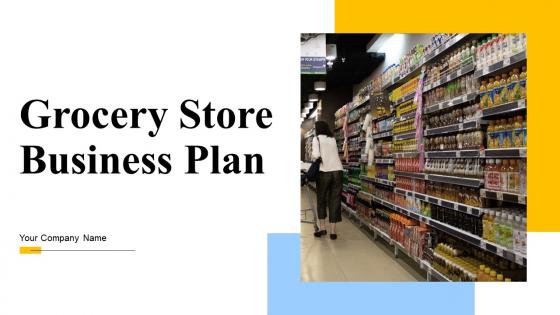
Slide 1: This slide introduces Grocery Store Business Plan. State your company name and begin.
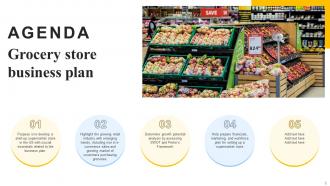
Slide 2: This is an Agenda slide. State your agendas here.
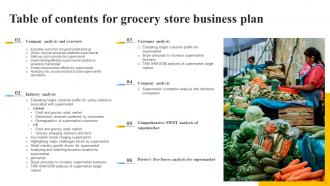
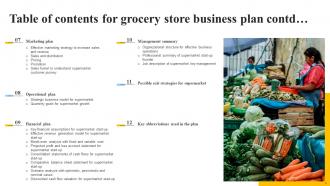
Slide 3: This slide shows Table of Content for the presentation.
Slide 4: This slide also shows Table of Content for the presentation.
Slide 5: This slide shows title for topics that are to be covered next in the template.
Slide 6: This slide provides the key highlights of the supermarket store including a quick pitch.
Slide 7: This slide covers the supermarket industry's vision, mission, and goals to ensure that it will deliver an excellent customer experience.
Slide 8: This slide provides the details related to the start-up expenditures that incur during the process of establishing a supermarket store.
Slide 9: This slide presents the problem associated with the supermarket in the retail industry and how the company will implement an effective solution to overcome the existing gap.
Slide 10: This slide describes information related to the wide range of products and services offered by the supermarket.
Slide 11: This slide covers the important points to be considered while dealing with different supermarket products in the market.
Slide 12: This slide shows title for topics that are to be covered next in the template.
Slide 13: This slide highlights the facts representing contribution of supermarkets globally.
Slide 14: This slide presents the detailed assessment of a supermarket within the retail industry.
Slide 15: This slide also presents the detailed assessment of a supermarket within the retail industry.
Slide 16: This slide continues displaying the detailed assessment of a supermarket within the retail industry.
Slide 17: This slide highlights the detailed assessment of a supermarket within the retail industry.
Slide 18: This slide describes the detailed assessment of a supermarket within the retail industry.
Slide 19: This slide also describes the detailed assessment of a supermarket within the retail industry.
Slide 20: This slide highlights the key market trends that have the potential to change the current market scenario, as well as ways that the company can stay ahead of competitors.
Slide 21: This slide depicts details about various challenges catered by the supermarket in the retail industry.
Slide 22: This slide provides the details about various growth drivers resulting in supermarket progress.
Slide 23: This slide depicts an ideal business location for a supermarket that minimizes the risk of failure.
Slide 24: This slide shows title for topics that are to be covered next in the template.
Slide 25: This slide covers an assessment of how the company's products will fit into a particular market and where they will acquire the most traction with customers.
Slide 26: This slide provides an overview of how to better understand the target audience, to fine-tune marketing campaigns, and increase supermarket business.
Slide 27: This slide depicts the market potential of supermarkets in terms of TAM, SAM, and SOM to assist startups and enterprise firms alike.
Slide 28: This slide shows title for topics that are to be covered next in the template.
Slide 29: This slide provides a details related to the major participants and key competitors of the industry to gain insight into their products, sales, and marketing tactic.
Slide 30: This slide shows title for topics that are to be covered next in the template.
Slide 31: This slide identify the industry' strengths, weaknesses, opportunities, and threats related to the business.
Slide 32: This slide shows title for topics that are to be covered next in the template.
Slide 33: This slide highlights porter’s five forces model and its implications in the US supermarket.
Slide 34: This slide shows title for topics that are to be covered next in the template.
Slide 35: This slide implements an effective go-to-market strategy for bringing the company's products or services to an end customer.
Slide 36: This slide also implements an effective go-to-market strategy for bringing the company's products or services to an end customer.
Slide 37: This slide continues implementing an effective go-to-market strategy for bringing the company's products or services to an end customer.
Slide 38: This slide also describes an effective go-to-market strategy for bringing the company's products or services to an end customer.
Slide 39: This slide provides information regarding the customer journey mapping to track users' actions and key touch points across various levels.
Slide 40: This slide shows title for topics that are to be covered next in the template.
Slide 41: This slide highlights the supermarket business model used to understand the operational details of the company.
Slide 42: This slide covers particular objectives or goals that the organization intends to attain as part of its business plan.
Slide 43: This slide shows title for topics that are to be covered next in the template.
Slide 44: This slide depicts the important financial assumptions that are to be made while setting supermarket store in terms of income, expense, and balance sheet.
Slide 45: This slide shows the effective revenue model of the supermarket in the retail industry, which displays the cost incurred and the various sources of income.
Slide 46: This slides highlights the break-even analysis of the firm providing an estimate of the minimum volume of revenue required to cover the fixed cost of business.
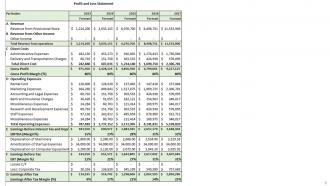
Slide 47: This slides provides an overview of the projected profit and loss statement to visualize the supermarket store’s financial performance for the next five years.
Slide 48: This slides also provides an overview of the projected profit and loss statement to visualize the supermarket store’s financial performance for the next five years.
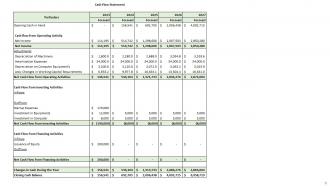
Slide 49: This slides highlights the company's cash flow statement to provide a detailed picture of what happened to a business's cash during a specified period.
Slide 50: This slides also highlights the company's cash flow statement to provide a detailed picture of what happened to a business's cash during a specified period.
Slide 51: This slides covers the information related to the company's financial position at a specific time by showing the details of the assets of the company.
Slide 52: This slides also covers the information related to the company's financial position at a specific time by showing the details of the assets of the company.
Slide 53: This slide examines the effects of potential future events on the company’s performance by considering different outcomes.
Slide 54: This slide also examines the effects of potential future events on the company’s performance by considering different outcomes.
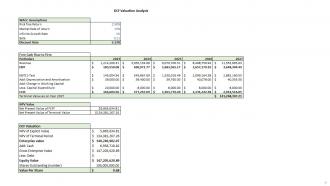
Slide 55: This slide calculates the amount of money an investor would get from an investment after adjusting for the time value of money.
Slide 56: This slide shows title for topics that are to be covered next in the template.
Slide 57: This slide highlights the organizational hierarchy in the company used to define the staff structure.
Slide 58: This slide presents the founder’s biggest professional achievements and most valuable skills and the proven ways in which he will use those skills to achieve valuable results.
Slide 59: This slide describes the job roles and responsibilities of supermarket key management people.
Slide 60: This slide also highlights the job roles and responsibilities of supermarket store key management people.
Slide 61: This slide continues highlighting the job roles and responsibilities of Supermarket store key management people.
Slide 62: This slide shows title for topics that are to be covered next in the template.
Slide 63: This slide represents exit strategies such as sell-offs, IPOs, mergers, and acquisitions that enable the entrepreneur to liquidate their position.
Slide 64: This slide shows title for topics that are to be covered next in the template.
Slide 65: This slide highlights the shorter version of existing words to save time and take up less space.
Slide 66: This slide shows all the icons included in the presentation.
Slide 67: This slide is titled as Additional Slides for moving forward.
Slide 68: This is About Us slide to show company specifications, services etc.
Slide 69: This slide shows Post It Notes for reminders and deadlines. Post your important notes here.
Slide 70: This is an Idea Generation slide to state a new idea or highlight information, specifications etc.
Slide 71: This slide depicts Venn diagram with text boxes.
Slide 72: This slide provides 30 60 90 Days Plan with text boxes.
Slide 73: This slide presents Roadmap with additional textboxes.
Slide 74: This is a Thank You slide with address, contact numbers and email address.
Grocery Store Business Plan Powerpoint Presentation Slides with all 81 slides:
Use our Grocery Store Business Plan Powerpoint Presentation Slides to effectively help you save your valuable time. They are readymade to fit into any presentation structure.








FAQs for Grocery Store Business Plan
Your business plan needs to nail the basics first - market analysis, competition, target customers. Figure out your store concept and location strategy. Financial projections are huge here, especially startup costs and cash flow. Seriously, grocery stores can burn through cash fast if you're not careful. Layout and operational stuff matters more than people think - bad flow kills sales. Don't skip the marketing plan either, especially how you'll compete with the big chains. Oh, and your product mix strategy. Start with a strong executive summary covering all this, then break each section down properly.
Dude, market trends literally control everything in grocery right now. Online ordering and curbside pickup aren't going anywhere - customers expect that stuff. Health trends are insane too. Everyone wants organic, local, plant-based everything compared to like 2019. Quick shopping trips are huge. Nobody wants to spend an hour wandering around anymore. If you don't adapt to what people actually want, you'll get left behind fast. I'd survey customers regularly and switch up your layout and inventory based on their feedback. What worked ten years ago? Forget it.
Honestly, local sourcing is huge right now - people want to support their community farms. Build those relationships first. Then maybe add something the big stores don't have, like a solid organic section or international foods. I've seen too many stores try to do everything at once though. Pick one or two things you can actually do better than the chains. Customer service still matters way more than people think. Make your layout super easy to navigate and train staff who actually help. Oh, and loyalty programs work if they're not complicated - simple points, real rewards. Start small, then expand once you've nailed the basics.
First thing - drive around and see what you're up against. Whole Foods vs dollar stores tells you everything about the neighborhood. Check census data for age groups, income, household sizes, but honestly? Just talk to people. Ask what they wish they had nearby. Look at foot traffic too - are people just passing through or do they actually live here. Parking's huge (learned that the hard way helping my cousin with his shop). Then match your inventory and prices to whoever's gonna be your regulars.
So you'll want revenue projections, startup costs, operating expenses, and cash flow for like 3-5 years. Break down revenue by category - produce, dairy, packaged stuff, etc. Grocery margins are stupidly thin, so get detailed with this part. Don't forget seasonal swings since everyone goes crazy around holidays. Include break-even analysis and P&L statements too. Oh, and factor in inventory turnover rates - fresh stuff moves way differently than canned goods. I'd start conservative with your numbers and maybe run a few different scenarios just in case.
Dude, location is everything with grocery stores. High foot traffic and easy parking are non-negotiables. Make sure you can actually see the place from main roads too. Check the demographics - your customers need to live nearby and have money for what you're selling. I watched this fancy market bomb because they opened in a super budget area, which was painful to see. Don't plant yourself right next to Walmart unless you want to get steamrolled. But being near a pharmacy? That's actually smart for foot traffic. Oh, and research zoning laws first. Future development plans matter too.
Honestly, inventory management can make or break your grocery store. You're juggling thousands of products while trying not to waste money on stuff that'll expire. Good POS software is your best friend here - it tracks everything automatically and tells you when to reorder. The tricky part is predicting what people actually want (seasonal stuff gets weird). You want enough stock so customers don't leave empty-handed, but not so much that you're throwing out spoiled food every week. Get the balance right and you'll save money while keeping people happy.
Mix it up with suppliers - hit the big guys like Sysco for your basics, but don't sleep on local farms and specialty spots for the good stuff. Those major distributors are honestly kind of annoying to deal with at first, but they won't leave you hanging. Relationships are everything here, way more than I expected when I started. Hit up trade shows and farmers markets to scope out options. Quality and delivery consistency matter most, especially with anything that can spoil. Oh, and always have backups ready because stuff goes wrong constantly in this business.
Honestly, mobile apps are where it's at - throw in personalized deals and loyalty points to keep people coming back. Self-checkout is hit or miss (some folks still refuse to touch those things), but it does move lines faster. Your inventory apps should track what's actually selling so you're not stuck with random stuff nobody wants. Click-and-collect through the app is huge right now too. The trick is using their purchase history to send deals that don't feel like spam. Oh, and don't go crazy trying to do everything at once - pick one or two things first and see how they work.
Definitely do a big grand opening with samples and competitive prices on stuff people buy weekly. Instagram's perfect for showing off your fresh produce - way better than Facebook for that. Partner with local farms and community groups since grocery stores are basically neighborhood businesses anyway. Loyalty programs work too, though honestly everyone has one now so make yours actually worth it. Don't forget old-school flyers either; my mom still plans her whole shopping around those weekly ads. Oh, and hit up local schools for partnerships. Build from your grand opening and focus on being the convenient option.
Okay so three big areas to hit: sourcing, operations, and waste stuff. Partner with local suppliers first - cuts transport costs and the whole carbon footprint thing. For operations, budget for energy-efficient equipment and LED lighting upfront. The waste management part is honestly where you'll win over customers the most. Composting programs, ditching plastic bags, partnering with food banks for donations. Oh and definitely track your waste reduction percentages because investors want actual numbers, not just feel-good stories. Sustainability isn't just trendy anymore - it legitimately saves money and builds customer loyalty long-term.
Dude, the paperwork is honestly the worst part. Business license is obvious, but you'll also need a food retailer's permit from the health department - they're super picky about everything. Resale permit lets you buy wholesale without paying tax twice. Planning to sell beer? That licensing process is brutal and takes like 6 months, no joke. Building permits if you're renovating, fire clearance, workers' comp if you hire people. My cousin went through this mess last year - just start everything NOW because it all takes forever.
Honestly, just nail the basics first - milk, bread, eggs. People literally memorize these prices at every store. Sell them at cost or even lose a little to get folks in the door. Then you make your money on everything else they grab. Oh, and definitely do the $2.99 thing instead of $3.00 - I know it's dumb but it actually works. Bundle deals are solid too. Check what your competitors are charging weekly because prices shift constantly. The key is being clear about what you're offering - cheap everything or quality stuff that's worth the extra buck.
Honestly, solid onboarding is everything - product knowledge, food safety, customer service basics. Cross-training makes a huge difference too. If your cashier can stock shelves, scheduling becomes so much easier. Pay people decently and do regular check-ins because grocery work is pretty rough sometimes. Oh, and promote from within whenever you can - people notice that stuff. I'd start with a buddy system for new hires, maybe break training into chunks so it's not overwhelming. Performance reviews sound boring but they actually help with keeping people around.
Basically, you're giving people a reason to stick with you instead of shopping around. Points work great - they buy stuff, earn points, feel good about it. My grocery store does this thing where you get exclusive coupons and honestly? I totally fall for it every time. Keep it super simple though, like a basic punch card or points system. Don't overcomplicate it right away. The real magic happens when you track what they're buying and send them deals on stuff they actually want. Even something basic like "buy 10 sandwiches, get one free" is way better than nothing.
-
The visual appeal of the templates is just unparalleled! I was so worried about the design of my presentation but SlideTeam made it all so easy.
-
Requested a complete pitch deck. Delivered immediately and with high quality well researched content.